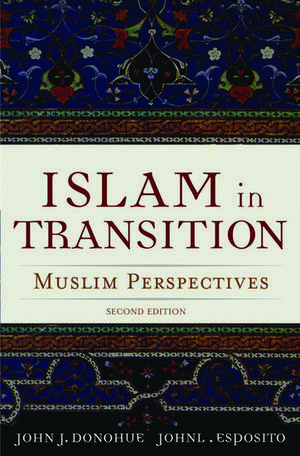
Islam in Transition: Muslim Perspectives
Editat de John J. Donohue, John L. Espositoen Limba Engleză Paperback – 9 mar 2006
Preț: 574.41 lei
Preț vechi: 757.55 lei
-24%
Puncte Express: 862
Carte tipărită la comandă
Livrare economică 10-15 decembrie
Livrare prin curier în România Termenul estimat este afișat lângă disponibilitate.
Transport gratuit pentru acest produs Plată online sau ramburs, în funcție de opțiunile comenzii.
Retur gratuit în 14 zile Comandă securizată și suport în română.
Specificații
ISBN-13: 9780195174311
ISBN-10: 0195174313
Pagini: 528
Dimensiuni: 235 x 161 x 24 mm
Greutate: 0.72 kg
Ediția:2 Rev ed.
Editura: Oxford University Press
Colecția OUP USA
Locul publicării:New York, United States
ISBN-10: 0195174313
Pagini: 528
Dimensiuni: 235 x 161 x 24 mm
Greutate: 0.72 kg
Ediția:2 Rev ed.
Editura: Oxford University Press
Colecția OUP USA
Locul publicării:New York, United States
V-ar putea interesa
-
 The Shias of PakistanAndreas Rieck-19%Preț: 489.41 lei604.21 lei
 -
 -18%Preț: 382.10 lei464.10 lei
 -
 -27%Preț: 547.70 lei755.26 lei
 -
 Preț: 226.44 lei
 -
 Islam and the Problem of Black SufferingSherman A. Jackson-12%Preț: 296.37 lei335.13 lei
 -
 Ibn Taymiyya's Theological EthicsSophia Vasalou-31%Preț: 806.02 lei1170.23 lei
 -
 Ibn `Arabī's Mystical PoeticsDenis E. McAuley-31%Preț: 694.53 lei1007.62 lei
 -
 Prayer in Islamic Thought and PracticeMarion Holmes KatzPreț: 214.56 lei
 -
 Living Out Islam – Voices of Gay, Lesbian, and Transgender MuslimsScott Siraj Al– Kugle-23%Preț: 605.43 lei786.27 lei
 -
 The Principles of SufismAl-B&Preț: 306.14 lei
 -
 The People vs Muhammad - Psychological AnalysisJ. K SheindlinPreț: 144.68 lei
 -
 Preț: 352.17 lei
 -
 Living Out IslamScott Siraj Al-Haqq KuglePreț: 271.46 lei
 -
 Sensei: A Connor Burke Martial Arts ThrillerJohn J. DonohuePreț: 77.82 lei
 -
 Early IslamKarl-Heinz OhligPreț: 377.04 lei
 -
 Preț: 456.50 lei
 -
 Preț: 182.66 lei
 -
 Islam: An IntroductionCatharina Raudvere-19%Preț: 190.69 lei235.33 lei
Cuprins
- *=New to this edition
- Introduction
- I. Early Responses: Crisis and the Search for Identity
- Rifaa Badawi Rafi al-Tahtawi: Fatherland and Patriotism
- Sayyid Jamal al-Din al-Afghani: An Islamic Response to Imperialism; Islamic Solidarity
- Shaykh Muhammad Abduh: Islam, Reason, and Civilization
- Sir Sayyid Ahmad Khan: India and English Government; Islam: The Religion of Reason and Nature
- II. Islam and the Modern State
- Islam and Nationalism
- Rashid Rida: Patriotism, Nationalism, and Group Spirit in Islam
- Amir Shakib-Arslan: Our Decline and Its Causes
- Taha Husayn: The Future of Culture in Egypt
- Hasan al-Banna: The New Renaissance
- Abd al-Rahman al-Bazzaz: Islam and Arab Nationalism
- Muhammad Iqbal: A Separate Muslim State in the Subcontinent
- Abu-l-Ala Mawdudi: Nationalism and Islam
- Islam and Socialism
- Shaykh Mahmud Shaltut: Socialism and Islam
- Muammar al-Qadhdhafi: The Third Way
- Michel Aflaq: The Arab Personality: Between Past and Present
- Mustafa Sibai: Islamic Socialism
- Sayid Qutb: Social Justice in Islam
- The Algerian National Charter: Islam and the Socialist Revolution
- A.K. Brohi: The Concept of Islamic Socialism
- Islam in the Contemporary Secular State
- Ali Abd al-Raziq: The Caliphate and the Bases of Power
- Hichem Djait: Islam, Reform, and the New Arab Man
- Mustafa Mahmud: Islam vs. Marxism and Capitalism
- Mushie ul-Haq: Islam in Secular India
- * Asghar Ali Engineer: Islam and Secularism
- III. Islam and Social Change
- The Modernization of Islamic Law
- Subhi Mahmasani: Adaptation of Islamic Jurisprudence to Modern Social Needs
- Asaf A.A. Fyzee: The Reinterpretation of Islam
- The Debate over Family Law Reform in Pakistan
- * Amina Wadud: Rights and Roles of Women
- * Ahmed Zaki Yamani: The Political Competence of Women
- * M. Ashmawi: Reforming Islam and Islamic Law
- * Heba Rouf-Ezzat: On the Future of Women and Politics in the Arab World
- * Sisters in Islam: Chronology of a Struggle for Equal Rights
- * Fatwas: The Veil/Hijab
- * Bio-ethics/Family Planning
- Islam and Economics
- Ayatullah Mahmud Taliqani: The Characteristics of Islamic Economics
- Khurshid Ahmad: Islam and the Challenge of Economic Development
- M. Umar Chapra: The Islamic Welfare State
- * M. Baqr al-Sadr: The Psychological Role of Islam in Economic Development
- IV. Islam and Contemporary Issues
- Islam and Democracy
- Abu-l-Ala Mawdudi: Political Theory of Islam
- * Raschid Ghannoushi: Islamists' Participation in a non-Islamic Government
- Mohammed Selim al-Awa: Political Pluralism: An Islamic Perspective
- * Murad Hofmann: Democracy or Shuracracy
- * Abdul Aziz Sachedina: Why Democracy, and Why Now?
- * Abdel Karim Soroush: Tolerance and Governance
- * Abid Ullah Jan: Neither Required nor an Issue
- Islam and the West: Clash and Dialogue
- * Anwar Ibrahim: The Need for Civlizational Dialogue
- * Anwar Ibrahim: The Need for Civilizational Dialogue
- * M. Shahrour: Islamic Culture in Danger
- * Ali Shariati: Religion and Protest
- * Mohammed Khatami: Dialogue between East and West
- * Seyyed Hossein Nasr: Reflections Upon Islam and the West
- * T.J. Winter: The Poverty of Fanaticism
- Jihad Defined and Redefined
- * Sherman Jackson: Jihad in the Modern World
- * Sayyid Qutb: Jihad in the Cause of God
- * Farag: The Forgotten Duty
- * Abudllah Al-Azzam: Caravan: Global Jihad
- * Osama Bin Laden: Neo-Jihad or Global Jihad
- * HAMAS: The Covenant of the Islamic Resistance Movement
- * Shams al-Din: On the Political Unity of Using Armed Violence
- * Shaykh Muhammed Fadlallah: We must think before we act; September 11 was a gift to the U.S. administration
- Khaled Abou El Fadl: Islam and Violence: Our Forgotten Legacy
- * Fatwas: Jihad, Suicide Bombing, and Martyrdom
- Global Voices: Issues of Identity
- * Mustafa Ceric: The Many Voices of Islam: Cultivating Intellectual Pluralism
- * Tariq Ramadan: The Arab World and the Muslims Faced with their Contradictions
- * Osman Bakar: Islam and the Malay Civilizational Identity: Tension and Harmony between Ethnicity and Religiosity
- * Nurcholish Madjid: Islamic Faith and the Problem of Pluralism: Relations among the Believers
- * Muqtedar Khan: Reason and Individual Reasoning (Ijtihad)
- * Ali Mazrui: Human History as Divine Revelation: A Dialogue