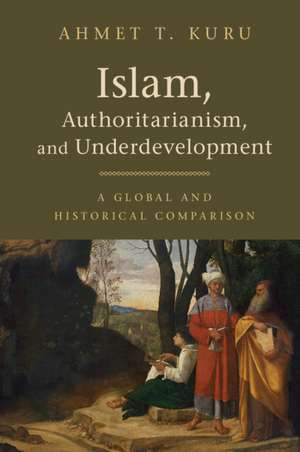
Islam, Authoritarianism, and Underdevelopment
Autor Ahmet T. Kuruen Limba Engleză Paperback – aug 2019
Această monografie de cercetare publicată de Cambridge University Press propune o reevaluare provocatoare a rădăcinilor autoritarismului și stagnării economice în statele cu majoritate musulmană. Ahmet T. Kuru depășește dihotomiile simpliste care pun subdezvoltarea pe seama religiei sau exclusiv pe seama colonialismului, oferind în schimb o explicație instituțională și istorică riguroasă. Remarcăm modul în care autorul demonstrează că declinul nu a fost un dat istoric, ci rezultatul marginalizării intelectualilor și burgheziei odată cu ascensiunea alianței dintre ulema și puterea militară în secolul al XI-lea. Structura volumului facilitează o înțelegere progresivă, pornind de la realitățile politice contemporane și coborând spre fundamentele istorice. Partea a doua a cărții este deosebit de valoroasă, documentând „epoca de aur” (secolele VII-XI) în care savanții și negustorii dominau viața publică, și contrastând-o cu perioada imperiilor militare ulterioare. Cititorii familiarizați cu Islam Instrumentalized de Jean-Philippe Platteau vor aprecia modul în care Kuru completează perspectiva economică cu o analiză politică profundă a structurilor de putere. În timp ce Platteau se concentrează pe utilizarea religiei ca instrument de legitimare, Kuru pune accentul pe distrugerea competiției intelectuale și economice prin monopolul de stat. În contextul operei sale, acest volum extinde preocupările din Secularism and State Policies toward Religion, unde Ahmet T. Kuru analiza politicile statelor laice. Aici, el aplică o lentilă similară asupra dinamicii dintre ideologie și politici publice, dar la o scară istorică mult mai vastă. Rezultatul este un text dens, dar clar, esențial pentru înțelegerea mecanismelor care blochează creativitatea și competiția în lumea musulmană contemporană.
Preț: 251.25 lei
Carte tipărită la comandă
Livrare economică 02-16 decembrie
Specificații
ISBN-10: 1108409474
Pagini: 322
Ilustrații: 5 tables
Dimensiuni: 152 x 229 x 20 mm
Greutate: 0.53 kg
Editura: Cambridge University Press
Locul publicării:New York, United States
V-ar putea interesa

De ce să citești această carte
Recomandăm această carte cercetătorilor și studenților la științe politice sau studii islamice care caută o explicație dincolo de clișee. Cititorul va câștiga o perspectivă clară asupra modului în care alianțele istorice dintre religie și armată pot frâna dezvoltarea unei întregi regiuni. Este un instrument critic pentru a înțelege de ce reformele politice eșuează adesea în absența unei restructurări a relațiilor dintre elitele intelectuale și cele aflate la putere.
Despre autor
Ahmet T. Kuru este profesor de științe politice la San Diego State University și a ocupat funcția de director adjunct al Centrului pentru Studiul Democrației, Toleranței și Religiei la Columbia University (SIPA). Expertiza sa în intersecția dintre religie și politică este recunoscută la nivel internațional, lucrarea de față având la bază dizertația sa premiată cu premiul Aaron Wildavsky de către American Political Science Association. Contribuțiile sale academice au fost publicate în jurnale de prestigiu precum World Politics și Comparative Politics, consolidându-i reputația de specialist în politici comparate și lumea islamică.
Descriere scurtă
Cuprins
Recenzii
'Generations of thinkers have puzzled over why the Muslim world, once intellectually creative and commercially vibrant, fell behind economically and came to symbolize repressive governance. In this meticulously researched, insightful, and provocative book, Ahmet T. Kuru attributes these interlinked transformations to complex alliances between religious officials and states. Islam, Authoritarianism, and Underdevelopment will captivate scholars in many disciplines, and also the broader public interested in Islam's intellectual, political, and economic roles through the ages.' Timur Kuran, Duke University, North Carolina
'Ahmet T. Kuru offers a nuanced interpretation of the links between Islam and authoritarianism, in which the religion is not the culprit, but complex socio-political developments are to be blamed for the near-failure of Islamic societies to develop democracy and an innovative economy. His historical analysis sheds new light on a highly important and sensitive debate, and helps us to understand better the deep roots of the Islamic Sonderweg.' Jan Luiten van Zanden, Universiteit Utrecht, The Netherlands
'In this far-ranging and original book, Ahmet T. Kuru explores just how it came to pass that the Muslim Middle East in the modern period experienced a dramatic decline in cultural and political dynamism relative to the societies of Western Europe. The question is one that has preoccupied comparative politics and historiography for more than a century. But no scholar has explored the issue with the sociological richness, comparative erudition, or depth of insight Kuru achieves in this book. This is one of the most important works in years on the politics and culture of Muslim modernity, and one that literally transforms the state of our knowledge.' Robert W. Hefner, Boston University
'This volume is well suited for anyone interested in the Middle East, the Islamic world, or political and development theory.' J. Alkorani, Choice
'Kuru … undertakes an ambitious and, on balance, successful analysis of the ills of the authoritarianism, economic backwardness, and religious violence that plague 49 Muslim-majority states.' John Waterbury, Foreign Affairs
'[Kuru's] central point concerning the damage caused by the entanglement of religious and political actors is a fresh and convincing perspective in a debate that has become circular and stale.' Claire Sadar, Ahval
'[Kuru's] book is a must-read study for anyone interested in political science, history and various other social science branches … I must stress the exhaustiveness of this book's bibliography.' Ahmet Erdi Öztürk, Democratization
'This book conveys a refreshing and nuanced historical analysis which emphasizes that understanding the historical roots of these problems leaves us better equipped not only in comprehending their full extent, but also in solving them.' Therese Sefton, Journal of Peace Research
'Kuru's new book is a ground-breaking history and analysis of the evolution of the state in Muslim countries. Thoroughly researched and accessibly written.' James M. Dorsey, New Books Network
'Without doubt, Kuru's book is a must-read study and a pivotal source.' Abdelaziz El Amrani, Hespéris-Tamuda
'… an excellent work. Rich in details with academic vigor, the book will find its place on the shelves of various disciplines. Kuru's engaging style makes the reading a rewarding, joyful experience.' Mustafa Gurbuz, Arab Studies Quarterly
'Ahmet Kuru has done an amazing job of navigating through the academic minefield with aplomb in answering some of the questions that many even would not dare to pose. This book is undoubtedly one of the best I have read for some time. Kuru's work should be lauded and be part of essential reading for many areas of pedagogy.' Dipak K. Gupta, Terrorism and Political Violence
'Islam, Authoritarianism, and Underdevelopment is a tour de force that lays out the broader context for the failures of the contemporary Muslim world and the ways in which religion can shape political outcomes.' A.Kadir Yildirim, Perspectives on Politics
'A magnum opus; it appears to be a product of painstaking inquiries, enormous bibliographical research, nuanced historical comparisons, and interdisciplinary analyses.' Serhan Tanrıverdi, Turkish Studies