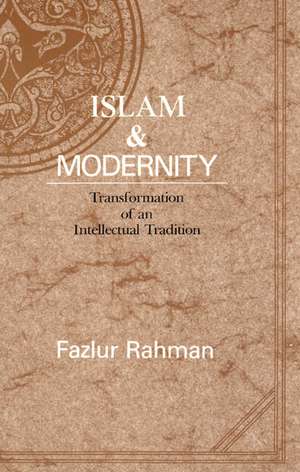
Islam and Modernity: Transformation of an Intellectual Tradition: Publications of the Center for Middle Eastern Studies, cartea 15
Autor Fazlur Rahmanen Limba Engleză Paperback – 15 mai 1984
Deși nu este un curs de limbă cu resurse digitale precum audio sau video, Islam and Modernity funcționează ca o platformă teoretică esențială pentru înțelegerea evoluției intelectuale a lumii musulmane. Remarcăm o abordare curajoasă a autorului Fazlur Rahman, care analizează tensiunea dintre textul sacru și necesitățile lumii contemporane. Credem că valoarea acestui volum rezidă în critica metodologică adusă modului în care este studiat și predat Coranul. Rahman identifică două erori majore: incapacitatea dogmaticilor de a distinge între principiile universale și răspunsurile specifice unor situații istorice din secolul al VII-lea, și reacția secularistă care, în fața rigidității religioase, a ales să ignore tradiția. Reținem propunerea sa pentru o nouă hermeneutică, menită să ofere o bază solidă pentru educație și dezvoltare socială. Ca și Islam, o altă lucrare fundamentală a aceluiași autor, acest volum acoperă transformările tradiției musulmane, dar cu o metodologie mult mai aplicată pe reforma sistemului intelectual și educațional. Dacă titluri precum Islam in the Modern World de Jeffrey T. Kenney oferă o panoramă a mișcărilor și regiunilor, Rahman preferă o sondare profundă a filozofiei și jurisprudenței, oferind un plan de acțiune pentru savanții și pedagogii musulmani. Este o lectură densă, publicată în cadrul Publications of the Center for Middle Eastern Studies, care refuză dihotomiile simpliste între tradiționalism și modernism.
Preț: 234.04 lei
Carte disponibilă
Livrare economică 16-30 noiembrie
Livrare express 31 octombrie-06 noiembrie pentru 19.91 lei
Specificații
ISBN-10: 0226702847
Pagini: 182
Ilustrații: black & white illustrations
Dimensiuni: 137 x 213 x 15 mm
Greutate: 0.23 kg
Ediția:Revised
Editura: University of Chicago Press
Colecția University of Chicago Press
Seria Publications of the Center for Middle Eastern Studies
Locul publicării:United States
V-ar putea interesa
-
 The Koran: A Very Short IntroductionMichael Cook-19%Preț: 58.08 lei71.35 lei
 -
 Buddha: A Very Short IntroductionMichael Carrithers-19%Preț: 57.08 lei70.76 lei
 -
 Being ConfirmedNick AikenPreț: 74.84 lei
 -
 No Future Without ForgivenessDesmond Tutu-20%Preț: 85.30 lei106.68 lei
 -
 -60%Preț: 60.02 lei148.90 lei
 -
 Preț: 107.04 lei
 -
 Simplify Your Spiritual LifeDonald S WhitneyPreț: 100.12 lei
 -
 Girls of Grace Make it RealPoint Of GracePreț: 98.68 lei
 -
 The Indwelling Life of ChristIan ThomasPreț: 88.58 lei
 -
 The KoranE. H PalmerPreț: 111.80 lei
De ce să citești această carte
Recomandăm această carte cercetătorilor și studenților interesați de studiile islamice și de istoria ideilor. Cititorul câștigă o perspectivă clară asupra modului în care hermeneutica poate debloca impasul dintre tradiția religioasă și cerințele modernității. Este un instrument teoretic indispensabil pentru cei care doresc să înțeleagă rădăcinile intelectuale ale reformei în Islam și provocările educaționale cu care se confruntă societățile musulmane actuale.
Despre autor
Fazlur Rahman a fost un proeminent savant și filozof pakistanez, considerat unul dintre cei mai importanți gânditori reformiști ai Islamului din secolul XX. Profesor la Universitatea din Chicago, Rahman și-a dedicat cariera analizării tradiției intelectuale islamice, pledând pentru o reinterpretare critică a surselor primare. Opera sa, ancorată în rigoarea academică occidentală și în cunoașterea profundă a teologiei clasice, a influențat generații de cercetători în domeniul eticii, jurisprudenței și filozofiei religioase.