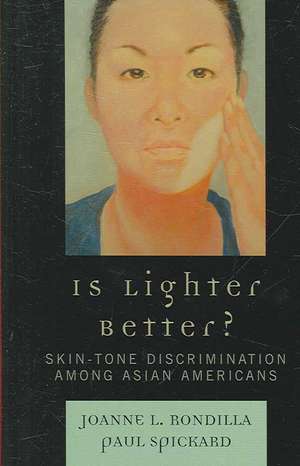
Is Lighter Better?: Skin-Tone Discrimination among Asian Americans: Rowman & Littlefield Publishers
Autor Joanne L. Rondilla, Paul Spickarden Limba Engleză Hardback – 23 feb 2007
Din seria Rowman & Littlefield Publishers
-
 Preț: 113.89 lei
 - 13%
 Preț: 155.38 lei
 -
 Preț: 109.93 lei
 - 20%
 Preț: 370.93 lei
 - 19%
 Preț: 323.76 lei
 - 25%
 Preț: 228.52 lei
 - 19%
 Preț: 328.78 lei
 - 28%
 Preț: 148.13 lei
 - 20%
 Preț: 191.09 lei
 - 24%
 Preț: 255.02 lei
 - 16%
 Preț: 109.26 lei
 - 31%
 Preț: 351.69 lei
 - 15%
 Preț: 127.13 lei
 - 22%
 Preț: 328.37 lei
 - 19%
 Preț: 324.21 lei
 - 30%
 Preț: 355.24 lei
 - 23%
 Preț: 258.39 lei
 -
 Preț: 402.96 lei
 - 23%
 Preț: 282.77 lei
 - 24%
 Preț: 275.28 lei
 - 31%
 Preț: 351.50 lei
 - 22%
 Preț: 331.09 lei
 - 32%
 Preț: 373.39 lei
 - 34%
 Preț: 842.33 lei
 - 19%
 Preț: 314.30 lei
 - 23%
 Preț: 363.28 lei
 - 21%
 Preț: 128.84 lei
 - 30%
 Preț: 774.75 lei
 - 23%
 Preț: 278.65 lei
 - 22%
 Preț: 266.38 lei
 - 19%
 Preț: 344.02 lei
 - 32%
 Preț: 594.45 lei
 - 31%
 Preț: 566.85 lei
 - 22%
 Preț: 367.22 lei
 - 19%
 Preț: 322.03 lei
 - 16%
 Preț: 148.06 lei
 - 21%
 Preț: 369.53 lei
 - 19%
 Preț: 323.37 lei
 - 20%
 Preț: 314.77 lei
 - 30%
 Preț: 424.70 lei
 - 25%
 Preț: 344.18 lei
 - 30%
 Preț: 703.64 lei
 - 14%
 Preț: 152.49 lei
 - 30%
 Preț: 847.72 lei
 - 19%
 Preț: 316.66 lei
 - 23%
 Preț: 283.57 lei
 - 29%
 Preț: 727.24 lei
 - 23%
 Preț: 262.16 lei
 - 19%
 Preț: 343.92 lei
Preț: 687.16 lei
Preț vechi: 1002.26 lei
-31%
Puncte Express: 1031
Carte tipărită la comandă
Livrare economică 03-17 decembrie
Livrare prin curier în România Termenul estimat este afișat lângă disponibilitate.
Transport gratuit pentru acest produs Plată online sau ramburs, în funcție de opțiunile comenzii.
Retur gratuit în 14 zile Comandă securizată și suport în română.
Specificații
ISBN-13: 9780742554931
ISBN-10: 0742554937
Pagini: 158
Dimensiuni: 152 x 230 x 16 mm
Greutate: 0.35 kg
Editura: Bloomsbury Publishing
Colecția Rowman & Littlefield
Seria Rowman & Littlefield Publishers
Locul publicării:New York, United States
ISBN-10: 0742554937
Pagini: 158
Dimensiuni: 152 x 230 x 16 mm
Greutate: 0.35 kg
Editura: Bloomsbury Publishing
Colecția Rowman & Littlefield
Seria Rowman & Littlefield Publishers
Locul publicării:New York, United States
V-ar putea interesa
-
 The Political Integration of Ethnic Minorities in BritainAnthony F. Heath-31%Preț: 804.56 lei1169.36 lei
 -
 Punishing Race: A Continuing American DilemmaMichael Tonry-21%Preț: 255.21 lei323.25 lei
 -
 Preț: 401.13 lei
 -
 InterculturalismT. CantlePreț: 399.07 lei
 -
 Language RightsV. Pupavac-15%Preț: 670.07 lei788.32 lei
 -
 -27%Preț: 76.01 lei104.42 lei
 -
 Another Darkness, Another DawnBecky Taylor-7%Preț: 209.86 lei226.20 lei
 -
 Anders Breivik and the Rise of IslamophobiaSindre BangstadPreț: 159.63 lei
 -
 News for All the PeopleJuan GonzalezPreț: 176.26 lei
 -
 Revitalising Indigenous LanguagesMarja-Liisa OlthuisPreț: 332.71 lei
 -
 Gypsy EmpireEAMON DILLONPreț: 78.99 lei
 -
 No Place to Call HomeKatharine QuarmbyPreț: 108.66 lei
 -
 Growing Up Asian in AustraliaAlice PungPreț: 137.75 lei
Cuprins
Chapter 1: Colorism in Asian America
Chapter 2: The Darker and Lighter Sister: Telling Our Stories
Chapter 3: The Survey
Chapter 4: Making a Better Me? Pure. White. Flawless.
Chapter 5: The Unkindest Cut: Cosmetic Surgery
Epilogue
Appendices
Chapter 2: The Darker and Lighter Sister: Telling Our Stories
Chapter 3: The Survey
Chapter 4: Making a Better Me? Pure. White. Flawless.
Chapter 5: The Unkindest Cut: Cosmetic Surgery
Epilogue
Appendices
Recenzii
This eye-opener exposes a prevalent but concealed issue of colorism among Asian Americans. . . . Considering that the scholarly literature on colorism among Asian Americans is very limited in contrast with the rich literature on other racial groups, Rondilla and Spickard's book is a pioneering work that raises numerous questions inviting further research. Highly recommended.
Rondilla and Spickard deftly expose the unacknowledged but pervasive phenomenon of colorism in Asian American communities. Their brilliant and complex analysis goes beyond the Black/White racial paradigm and covers a broad range of topics including family pressures to be light, class status, the use of skin lighteners, and cosmetic surgery. The analysis is daring and pathbreaking. This is, unequivocally, the most comprehensive and sophisticated book on this issue to date.
Is Lighter Better? breaks new ground to explore the many ways that colorism profoundly influences Asian Americans, especially women. Relying upon in-depth interviews and survey data with individuals from many Asian communities, the authors skillfully link the desire for lighter skin and 'sharp' [European-like] facial features to systems of racial domination and status inequalities that equate dark complexion with a peasant past. Complicit in fostering colorism is the beauty industry, which promises that skin lighteners and cosmetic surgery to alter Asian features-to look more White-solve all problems. Replete with rich examples and keen insights, this book is essential reading for anyone interested in the complexities of color hierarchies.
This is a riveting book, which reveals the complex issue of colorism in the Asian Pacific Islander American community. People are caught between assumed hegemonic Whiteness and challenges to authenticity because they may not be 'Asian looking enough.' Colorism strikes at the very core of what it means to be Asian American today. Is it just 'self hate' that motivates some to whiten their skin, straighten their hair, or have eyelid surgery? Is Lighter Better? exposes the unspoken assumptions of colorism in some Asian Pacific Islander communities and brings to light complex bodily negotiations and hierarchies of acceptance based on race, class, and gender appearances. The answers may not always be as they appear.
Rondilla and Spickard deftly expose the unacknowledged but pervasive phenomenon of colorism in Asian American communities. Their brilliant and complex analysis goes beyond the Black/White racial paradigm and covers a broad range of topics including family pressures to be light, class status, the use of skin lighteners, and cosmetic surgery. The analysis is daring and pathbreaking. This is, unequivocally, the most comprehensive and sophisticated book on this issue to date.
Is Lighter Better? breaks new ground to explore the many ways that colorism profoundly influences Asian Americans, especially women. Relying upon in-depth interviews and survey data with individuals from many Asian communities, the authors skillfully link the desire for lighter skin and 'sharp' [European-like] facial features to systems of racial domination and status inequalities that equate dark complexion with a peasant past. Complicit in fostering colorism is the beauty industry, which promises that skin lighteners and cosmetic surgery to alter Asian features-to look more White-solve all problems. Replete with rich examples and keen insights, this book is essential reading for anyone interested in the complexities of color hierarchies.
This is a riveting book, which reveals the complex issue of colorism in the Asian Pacific Islander American community. People are caught between assumed hegemonic Whiteness and challenges to authenticity because they may not be 'Asian looking enough.' Colorism strikes at the very core of what it means to be Asian American today. Is it just 'self hate' that motivates some to whiten their skin, straighten their hair, or have eyelid surgery? Is Lighter Better? exposes the unspoken assumptions of colorism in some Asian Pacific Islander communities and brings to light complex bodily negotiations and hierarchies of acceptance based on race, class, and gender appearances. The answers may not always be as they appear.