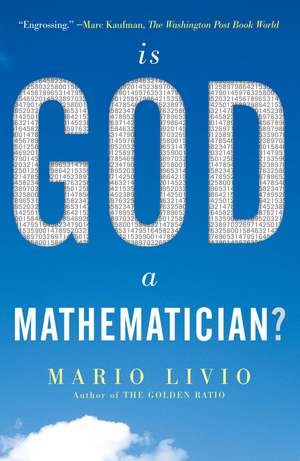
Is God a Mathematician?
Autor Mario Livioen Limba Engleză Paperback – 27 iul 2017
Evoluția astrofizicii și a fizicii particulelor din ultimele decenii a demonstrat că matematica nu este doar un limbaj descriptiv, ci o forță predictivă care anticipează realități fizice înainte ca acestea să fie observate. În Is God a Mathematician?, astrofizicianul Mario Livio abordează una dintre cele mai profunde întrebări ale cunoașterii umane: cum se explică faptul că o disciplină aparent abstractă, dezvoltată în mintea umană, se mulează perfect pe structura universului? Observăm o trecere de la simpla istorie a numerelor la o analiză metafizică a realității, ancorată în dilema celebră a lui Eugene Wigner privind eficacitatea „nerezonabilă” a matematicii.
Suntem de părere că forța acestei lucrări rezidă în capacitatea autorului de a sintetiza milenii de gândire, de la școala lui Pitagora la teoriile lui Einstein, într-o narațiune fluidă despre relația dintre gândire și materie. Volumul este comparabil cu The Mathematical Representation of Physical Reality de Shahen Hacyan în rigurozitate, dar actualizat pentru publicul larg prin accentul pus pe latura umană a marilor matematicieni și pe implicațiile cosmologice recente. Spre deosebire de Meaning in Mathematics de John Polkinghorne, care se concentrează pe fundamentele metafizice, Livio utilizează experiența sa de astrofizician pentru a ancora conceptele abstracte în date observaționale concrete.
Această lucrare reprezintă o evoluție firească în opera lui Mario Livio, completând temele explorate în The Golden Ratio. Dacă în acea lucrare se concentra pe un singur număr fascinant, aici extinde perspectiva asupra întregului aparat matematic. De asemenea, stilul analitic, dar accesibil, amintește de modul în care autorul a tratat eșecurile geniale în Brilliant Blunders, oferind cititorului nu doar succesul teoriilor, ci și procesul sinuos al descoperirii. Cele 320 de pagini, susținute de 65 de ilustrații, construiesc un argument solid pentru ideea că matematica este coloana vertebrală a realității noastre.
Preț: 111.65 lei
Carte disponibilă
Livrare economică 07-21 noiembrie
Specificații
ISBN-10: 0743294068
Pagini: 320
Ilustrații: 65 b-w images t-o
Dimensiuni: 140 x 214 x 23 mm
Greutate: 0.28 kg
Editura: Simon&Schuster
Colecția Simon & Schuster
V-ar putea interesa
-
 Alan Turing: His Work and ImpactS. Barry Cooper-20%Preț: 405.62 lei508.35 lei
 -
 From Here to InfinityIan Stewart-19%Preț: 86.74 lei107.33 lei
 -
 Graph Theory 1736-1936Norman L. Biggs-31%Preț: 568.26 lei825.09 lei
 -
 The Mathematics of Great AmateursJulian Lowell Coolidge-33%Preț: 659.91 lei981.06 lei
 -
 The Infinite in the FiniteAlistair Macintosh Wilson-32%Preț: 670.04 lei987.21 lei
 -
 The History of Mathematics: A Very Short IntroductionJacqueline Stedall-20%Preț: 56.62 lei70.82 lei
 -
 Meaning in MathematicsJohn Polkinghorne-11%Preț: 337.62 lei380.60 lei
 -
 Pi: A Source BookJ. L. Berggren-18%Preț: 1922.15 lei2344.09 lei
 -
 Mathematical DiscoveryGeorge Polya-27%Preț: 1547.42 lei2119.76 lei
 -
 The Accelerating UniverseMario LivioPreț: 108.62 lei
 -
 The USSR Olympiad Problem BookD. O. ShklarskyPreț: 191.64 lei
 -
 The Golden RatioMario LivioPreț: 109.29 lei
 -
 Preț: 167.30 lei
 -
 Preț: 103.96 lei
 -
 Preț: 387.37 lei
 -
 From Zero to Infinity: What Makes Numbers InterestingConstance Reid-20%Preț: 204.26 lei255.33 lei
De ce să citești această carte
Recomandăm această carte oricărui cititor pasionat de istoria ideilor și de filosofia științei. Mario Livio reușește să transforme o întrebare abstractă într-o investigație captivantă despre limitele minții umane. Veți câștiga o perspectivă nouă asupra modului în care legile naturii sunt scrise într-un limbaj matematic, înțelegând de ce această disciplină este instrumentul suprem de predicție a viitorului științific.
Despre autor
Mario Livio este un astrofizician de renume internațional, activând ca Senior Astrophysicist la Space Telescope Science Institute, instituția care gestionează operațiunile științifice ale telescopului Hubble. Expertiza sa în cosmologie și pasiunea pentru comunicarea științei l-au transformat într-un autor de succes, fiind recunoscut pentru abilitatea de a explica concepte complexe pe înțelesul tuturor. Lucrările sale, precum Galileo sau The Golden Ratio, reflectă un interes profund pentru intersecția dintre știință, istorie și artă, poziționându-l ca o voce autoritară în literatura de popularizare a științei.
Descriere scurtă
Nobel Laureate Eugene Wigner once wondered about “the unreasonable effectiveness of mathematics” in the formulation of the laws of nature. Is God a Mathematician? investigates why mathematics is as powerful as it is. From ancient times to the present, scientists and philosophers have marveled at how such a seemingly abstract discipline could so perfectly explain the natural world. More than that—mathematics has often made predictions, for example, about subatomic particles or cosmic phenomena that were unknown at the time, but later were proven to be true. Is mathematics ultimately invented or discovered? If, as Einstein insisted, mathematics is “a product of human thought that is independent of experience,” how can it so accurately describe and even predict the world around us?
Physicist and author Mario Livio brilliantly explores mathematical ideas from Pythagoras to the present day as he shows us how intriguing questions and ingenious answers have led to ever deeper insights into our world. This fascinating book will interest anyone curious about the human mind, the scientific world, and the relationship between them.
Notă biografică
Recenzii
"This highly readable book explores one of the most fascinating questions that lies at the heart of fundamental physics -- why is mathematics so effective in describing nature and is mathematics an invention of the human mind or part of the fabric of physical reality? Livio provides a wonderful review of the various issues, presents a wide variety of opinions, and in addition some fascinating insights of his own. I strongly recommend this volume to anyone interested in these questions." -- David Gross, 2004 Nobel Prize Winner in Physics, Frederick W. Gluck Professor of Theoretical Physics and Director, Kavli Institute For Theoretical Physics, University of California, Santa Barbara
"All science proceeds from the assumption that the cosmos is ordered in an intelligible way. Beneath the bewildering richness of natural phenomena there lies an elegant mathematical unity. How astonishing that the human mind is attuned to this hidden subtext of nature! With elegance and clarity, Mario Livio charts how, through science and mathematics, we have come to glimpse the fundamental rules on which the universe runs." -- Paul Davies, author of The Goldilocks Enigma and Director of the Beyond Center for Fundamental Concepts in Science, Arizona State University
"An exhilarating foray into the founding premises of mathematical science." -- Booklist
"Theologians have God, philosophers existence, and scientists mathematics. Mario Livio makes the case for how these three ideas might be related...Livio's rich history gives the discussions human force and verve." -- Sam Kean, New Scientist