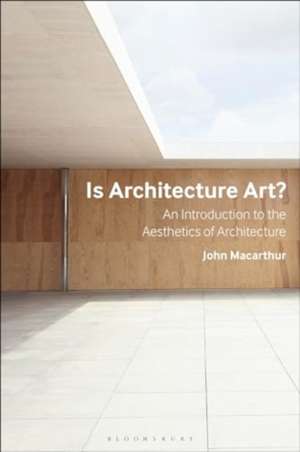
Is Architecture Art?: An Introduction to the Aesthetics of Architecture
Autor John Macarthuren Limba Engleză Paperback – 28 noi 2024
Is architecture an art, like literature or music? Or is it more akin to science or engineering? Can buildings be artworks, just like paintings and sculptures, or does their fundamentally functional nature mean they cannot be considered pure works of art?
Questions of architecture, art, and aesthetics do not allow for simple answers. But by asking such questions, we can usefully reveal the ways in which the concepts and meanings of architecture have changed over the centuries, and how they continue to change in the contemporary era.
Is Architecture Art? explores the key conceptual questions about the aesthetic appreciation of architecture and its persistently contested status as an artform. It engages the work of thinkers ranging from Hume and Kant to Adorno, Tafuri, and Rancière, and draws on accessible and thought-provoking accounts of historical and contemporary architectural and art theory. Taking novel approaches to issues that will be familiar to the practising architect, it shows how aesthetics and art theory can open up and illuminate architectural theory, issue by issue. Is Architecture Art? will provoke discussion and debate among architects and architectural theorists, and force a new understanding of the purpose of architectural practice in the contemporary era as the concepts of 'art', 'the arts', and of the creative economy have shifted and blurred as never before.
Preț: 187.48 lei
Preț vechi: 221.28 lei
-15%
Puncte Express: 281
Carte disponibilă
Livrare economică 06-20 noiembrie
Livrare express 22-28 octombrie pentru 69.85 lei
Livrare prin curier în România Termenul estimat este afișat lângă disponibilitate.
Transport gratuit de la 400.00 lei Plată online sau ramburs, în funcție de opțiunile comenzii.
Retur gratuit în 14 zile Comandă securizată și suport în română.
Specificații
ISBN-13: 9781350147706
ISBN-10: 1350147702
Pagini: 256
Ilustrații: 26 bw illus
Dimensiuni: 156 x 232 x 18 mm
Greutate: 0.52 kg
Editura: Bloomsbury Publishing
Colecția Bloomsbury Visual Arts
Locul publicării:London, United Kingdom
ISBN-10: 1350147702
Pagini: 256
Ilustrații: 26 bw illus
Dimensiuni: 156 x 232 x 18 mm
Greutate: 0.52 kg
Editura: Bloomsbury Publishing
Colecția Bloomsbury Visual Arts
Locul publicării:London, United Kingdom
V-ar putea interesa
-
 Architecture: A Very Short IntroductionAndrew Ballantyne-20%Preț: 57.26 lei71.18 lei
 -
 But Is It Art?: An Introduction to Art TheoryCynthia Freeland-18%Preț: 89.70 lei109.04 lei
 -
 Architecture DependsJeremy TillPreț: 141.98 lei
 -
 -19%Preț: 265.22 lei325.62 lei
 -
 The Ten Books on ArchitectureVitruviusPreț: 140.25 lei
 -
 AssembleAaron Betsky-16%Preț: 305.66 lei362.37 lei
 -
 The Architecture Concept BookJames Tait-15%Preț: 202.32 lei239.22 lei
 -
 Architreasures: A Journey Through 20th-Century ArchitectureGeoffrey Goddard-8%Preț: 406.60 lei441.96 lei
 -
 Architecture For CultureBeatrice GrenierPreț: 330.95 lei
 -
 Introduction to ArchitectureFrancis D. K. ChingPreț: 443.74 lei
 -
 -32%Preț: 567.14 lei832.51 lei
 -
 Up in the AirHolly SmithPreț: 151.38 lei
 -
 Drawing ArchitectureHelen ThomasPreț: 347.63 lei
 -
 Towards Another ArchitectureOwen HopkinsPreț: 309.95 lei
 -
 Art Nouveau: The Architecture of Modern LifePaul GreenhalghPreț: 348.31 lei
 -
 Preț: 140.91 lei
 -
 Persuasion of PlaceCheryl Weber-8%Preț: 398.62 lei433.29 lei
 -
 Spaces for LearningLisa Baker-18%Preț: 286.88 lei349.43 lei
 -
 On Architecture and WorkCharlotte Malterre-BarthesPreț: 111.53 lei
 -
 Spacetimes MatterJamie-Scott BaxterPreț: 298.72 lei
Cuprins
List of Figures
Preface and Acknowledgements
Introduction
1. Is Architecture (an) Art?
2. Sensing Space
3. Discipline, Medium
4. The work of architecture
5. Values
6. Freedom and Utility
Afterword
Bibliography
Index
Preface and Acknowledgements
Introduction
1. Is Architecture (an) Art?
2. Sensing Space
3. Discipline, Medium
4. The work of architecture
5. Values
6. Freedom and Utility
Afterword
Bibliography
Index
Recenzii
John MacArthur combines a thorough knowledge of classical aesthetics and art theory, with all its philosophical implications, with a near exhaustive knowledge of modern architectural theory. This book offers much more than an introduction: it brilliantly and inspiringly surveys and synthesises the question of the status of architecture, and is undeniably an obligatory reference from now on.
No word is more abused and degraded in contemporary discussions of architecture than "aesthetics," and John Macarthur's Is Architecture Art? is a welcome corrective. His nuanced, knowledgeable, incisive writing, and the organization of his book into brief discussions of distinct yet permeable problems - from "standards of taste" to "autonomy" to "the sublime" to "aesthetic education" - will have a long life as a standard resource for architecture students, practitioners, and scholars. Macarthur is more interested in entanglements than answers, so for those seeking the fast-food pseudo-knowledge of serviceable catchphrases, this is not a book for you. It is a book that will reward those who are enticed by the pleasures of a problem well-posed, fascinated by a historical example fully scrutinized, and satisfied by an argument elegantly phrased.
The question of whether architecture is an art or not has been knocking about since the eighteenth century. Macarthur wisely does not try to answer it - sometimes it is, sometimes it isn't. Instead he lays bare the whole apparatus which has not let the question go away, and that has led to there being such different answers to it. In so doing - and here lies the book's real originality - it becomes a full-blown enquiry, of a kind not previously seen, into the relevance of philosophical aesthetics to the practice of making buildings. Macarthur persuasively shows us why this relationship matters to the discipline of architecture, possibly more now than ever before.
No word is more abused and degraded in contemporary discussions of architecture than "aesthetics," and John Macarthur's Is Architecture Art? is a welcome corrective. His nuanced, knowledgeable, incisive writing, and the organization of his book into brief discussions of distinct yet permeable problems - from "standards of taste" to "autonomy" to "the sublime" to "aesthetic education" - will have a long life as a standard resource for architecture students, practitioners, and scholars. Macarthur is more interested in entanglements than answers, so for those seeking the fast-food pseudo-knowledge of serviceable catchphrases, this is not a book for you. It is a book that will reward those who are enticed by the pleasures of a problem well-posed, fascinated by a historical example fully scrutinized, and satisfied by an argument elegantly phrased.
The question of whether architecture is an art or not has been knocking about since the eighteenth century. Macarthur wisely does not try to answer it - sometimes it is, sometimes it isn't. Instead he lays bare the whole apparatus which has not let the question go away, and that has led to there being such different answers to it. In so doing - and here lies the book's real originality - it becomes a full-blown enquiry, of a kind not previously seen, into the relevance of philosophical aesthetics to the practice of making buildings. Macarthur persuasively shows us why this relationship matters to the discipline of architecture, possibly more now than ever before.