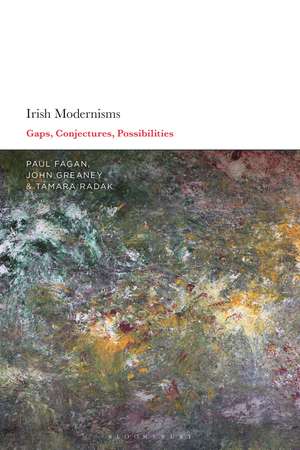
Irish Modernisms: Gaps, Conjectures, Possibilities
Editat de Paul Fagan, Dr John Greaney, Tamara Radaken Limba Engleză Paperback – 20 apr 2023
Probing Irish modernism's responsiveness to contemporary theory beyond postcolonial and Irish studies, Irish Modernisms: Gaps, Conjectures, Possibilities uses diverse paradigms, including weak theory, biopolitics, posthumanism and the nonhuman turn, to rethink Irish modernism's organising themes: the material body, language, mediality, canonicity, war, state violence, prostitution, temporality, death, mourning. Across the volume, cutting-edge work from queer theory and gender studies draws urgent attention to the too-often marginalized importance of women's writing and queer expression to the Irish avant-garde, while critical reappraisals of the coordinates of race and national history compel us to ask not only where and when Irish modernism occurred, but also whose modernism it was?
Preț: 212.30 lei
Preț vechi: 293.91 lei
-28%
Puncte Express: 318
Carte tipărită la comandă
Livrare economică 03-17 decembrie
Livrare prin curier în România Termenul estimat este afișat lângă disponibilitate.
Transport gratuit de la 400.00 lei Plată online sau ramburs, în funcție de opțiunile comenzii.
Retur gratuit în 14 zile Comandă securizată și suport în română.
Specificații
ISBN-13: 9781350267282
ISBN-10: 1350267287
Pagini: 280
Dimensiuni: 152 x 232 x 16 mm
Greutate: 0.44 kg
Editura: Bloomsbury Publishing
Colecția Bloomsbury Academic
Locul publicării:London, United Kingdom
ISBN-10: 1350267287
Pagini: 280
Dimensiuni: 152 x 232 x 16 mm
Greutate: 0.44 kg
Editura: Bloomsbury Publishing
Colecția Bloomsbury Academic
Locul publicării:London, United Kingdom
Cuprins
Contributors
Acknowledgements
Introduction: Irish Modernisms in the Plural
Paul Fagan (Salzburg University, Austria), John Greaney (University of Pennsylvania, USA), Tamara Radak (University of Vienna, Austria)
Part 1
Contested Canons: Testing the Limits of Irish Modernism
1. Explaining Ourselves: Hannah Berman, Jewish Nationalism and Irish Modernism
John Brannigan (University College Dublin, Ireland)
2. A Forgotten Irish Modernist: Ethel Colburn Mayne
Elke D'hoker (KU Leuven, Belgium)
3. Melancholy Modernism: The Loss of the Irish Woman Poet 1930-1950
Lucy Collins (University College Dublin, Ireland)
4. Death and the Nonhuman in Elizabeth Bowen's Fiction
Maureen O'Connor (University College Cork, Ireland)
5. The Languages of Irish Modernism: Máirtín Ó Cadhain and Samuel Beckett
Eoin Byrne (NUI Galway, Ireland)
Part 2
Corporeal Texts, Discursive Bodies: Biopolitical Irish Modernisms
6. Irish Skin: The Epidermiology of Modernism
Barry Sheils (Durham University, UK)
7. Irish Modernism and Revivalism: A Queer History?
Seán Hewitt (Trinity College Dublin, Ireland)
8. 'Survival of the Unfittest': Synge, Yeats and the Rhetoric of Health
Lloyd (Meadhbh) Houston (University of Oxford, UK)
9. Rhetorics of Sacrifice: Sex, Gender and the Death Penalty in James Joyce, W.B. Yeats, and the 1916 Generation
Katherine Ebury (Sheffield University, UK)
10. 'The ranks of respectability': Prostitution, Citizenship & the Free State in the Novels of Liam O'Flaherty
Laura Lovejoy (University College Cork, Ireland)
11. James Joyce and Samuel Beckett: Blind Bards in the Age of Silent Cinema
Cleo Hanaway-Oakley (Bristol University, UK)
Part 3
Minor/Major Forms: Intermedial Irish Modernisms
12. Letters and Weak Theory in Irish Modernism
Maebh Long (University of Waikato, New Zealand)
13. The Machine in the (Holy) Ghost: Anti-Science Literature, Genre Fiction and Irish Modernism, 1890-1940
Jack Fennell (University of Limerick, Ireland)
14. Mechanical Animals, Flying Men and Educated Monkeys: Technology & Modernity in the Comic Strips of Jack B. Yeats
Michael Connerty (Dún Laoghaire Institute of Art, Design and Technology, Ireland)
15. 'the funeral of one's past': Thomas MacGreevy as Ireland's Modernist War Poet
Daniel Curran (Maynooth University, Ireland)
16. The Full Little Jug: Flann O'Brien and the Irish Public Sphere
Catherine Flynn (UC, Berkeley, USA)
Bibliography
Index
Acknowledgements
Introduction: Irish Modernisms in the Plural
Paul Fagan (Salzburg University, Austria), John Greaney (University of Pennsylvania, USA), Tamara Radak (University of Vienna, Austria)
Part 1
Contested Canons: Testing the Limits of Irish Modernism
1. Explaining Ourselves: Hannah Berman, Jewish Nationalism and Irish Modernism
John Brannigan (University College Dublin, Ireland)
2. A Forgotten Irish Modernist: Ethel Colburn Mayne
Elke D'hoker (KU Leuven, Belgium)
3. Melancholy Modernism: The Loss of the Irish Woman Poet 1930-1950
Lucy Collins (University College Dublin, Ireland)
4. Death and the Nonhuman in Elizabeth Bowen's Fiction
Maureen O'Connor (University College Cork, Ireland)
5. The Languages of Irish Modernism: Máirtín Ó Cadhain and Samuel Beckett
Eoin Byrne (NUI Galway, Ireland)
Part 2
Corporeal Texts, Discursive Bodies: Biopolitical Irish Modernisms
6. Irish Skin: The Epidermiology of Modernism
Barry Sheils (Durham University, UK)
7. Irish Modernism and Revivalism: A Queer History?
Seán Hewitt (Trinity College Dublin, Ireland)
8. 'Survival of the Unfittest': Synge, Yeats and the Rhetoric of Health
Lloyd (Meadhbh) Houston (University of Oxford, UK)
9. Rhetorics of Sacrifice: Sex, Gender and the Death Penalty in James Joyce, W.B. Yeats, and the 1916 Generation
Katherine Ebury (Sheffield University, UK)
10. 'The ranks of respectability': Prostitution, Citizenship & the Free State in the Novels of Liam O'Flaherty
Laura Lovejoy (University College Cork, Ireland)
11. James Joyce and Samuel Beckett: Blind Bards in the Age of Silent Cinema
Cleo Hanaway-Oakley (Bristol University, UK)
Part 3
Minor/Major Forms: Intermedial Irish Modernisms
12. Letters and Weak Theory in Irish Modernism
Maebh Long (University of Waikato, New Zealand)
13. The Machine in the (Holy) Ghost: Anti-Science Literature, Genre Fiction and Irish Modernism, 1890-1940
Jack Fennell (University of Limerick, Ireland)
14. Mechanical Animals, Flying Men and Educated Monkeys: Technology & Modernity in the Comic Strips of Jack B. Yeats
Michael Connerty (Dún Laoghaire Institute of Art, Design and Technology, Ireland)
15. 'the funeral of one's past': Thomas MacGreevy as Ireland's Modernist War Poet
Daniel Curran (Maynooth University, Ireland)
16. The Full Little Jug: Flann O'Brien and the Irish Public Sphere
Catherine Flynn (UC, Berkeley, USA)
Bibliography
Index
Recenzii
This varied and vibrant collection accomplishes two huge tasks: consolidating the field of New Irish modernisms and exploring hitherto unperceived objects (journalism, letters, films, comic strips, lost poems, scientific writing, etc.) along with less visible actors. It is bracing to read Joyce with Hannah Berman, Beckett's bilingualism with O'Nolan's and Ó Cadhain's, or place W. B. Yeats next to Thomas MacGreevy and Ethel Colburn Mayne. Those alert chronicles redeem the fullness of past Irish cultural history: whatever was old or unmodern is here made "fresh and strange."
Irish Modernisms: Gaps, Conjectures, Possibilities is a welcome contribution to the field of Irish modernism, impressive in its conception and remarkably fresh and timely despite engaging a field and a set of concepts that have been up for scholarly debate for quite some time. the joy of the chapters is their ability to approach (and invite a study of) Irish modernism from a bottom-up historical perspective, while interrogating the cultural capital that has accrued to the critical label. This is a powerful and original way of thinking through the paradox of a scholarly field that occupies the very centre of any Global Modernist canon yet remains profoundly (even proudly) local in its historical, political and linguistic self-identifications.
Irish Modernisms: Gaps, Conjectures, Possibilities is a welcome contribution to the field of Irish modernism, impressive in its conception and remarkably fresh and timely despite engaging a field and a set of concepts that have been up for scholarly debate for quite some time. the joy of the chapters is their ability to approach (and invite a study of) Irish modernism from a bottom-up historical perspective, while interrogating the cultural capital that has accrued to the critical label. This is a powerful and original way of thinking through the paradox of a scholarly field that occupies the very centre of any Global Modernist canon yet remains profoundly (even proudly) local in its historical, political and linguistic self-identifications.