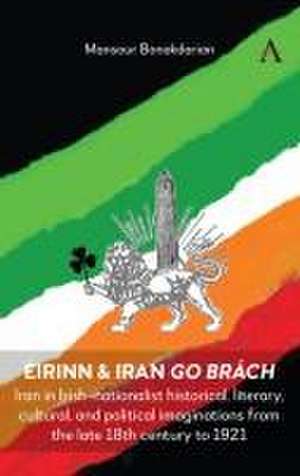
Éirinn & Iran go Brách
Autor Mansour Bonakdarianen Limba Engleză Hardback – 5 dec 2023
Preț: 679.22 lei
Preț vechi: 838.55 lei
-19%
Puncte Express: 1019
Carte tipărită la comandă
Livrare economică 26 octombrie-09 noiembrie
Livrare prin curier în România Termenul estimat este afișat lângă disponibilitate.
Transport gratuit pentru acest produs Plată online sau ramburs, în funcție de opțiunile comenzii.
Retur gratuit în 14 zile Comandă securizată și suport în română.
Specificații
ISBN-13: 9781839989452
ISBN-10: 1839989459
Pagini: 786
Dimensiuni: 157 x 235 x 50 mm
Greutate: 1.41 kg
Editura: Anthem Press
ISBN-10: 1839989459
Pagini: 786
Dimensiuni: 157 x 235 x 50 mm
Greutate: 1.41 kg
Editura: Anthem Press
Notă biografică
Mansour Bonakdarian specializes in modern British, Irish, Iranian, and imperial history.
Cuprins
Introduction, Chapter One "Iran" in Irish Nationalist Antiquarian Imaginations: The Late-Eighteenth and Early-Nineteenth Century; Chapter Two Thomas Moore's Poetic and Historical Irans: Intercepted Letters (1813), Lalla Rookh (1817), and The History of Ireland (1835); Chapter Three Irans of Young Ireland Imaginations, 1842-1848: From Thomas Osborne Davis' "Thermopylae" to James Clarence Mangan's "Aye-travailing Gnomes"; Chapter Four Contemporary Affinities: The Nation & the Anglo-Iranian War of 1856-1857; Chapter Five An Gorta Mór of Others and Nationalist Neglect: The Nation & the Iranian Famine of 1870-1872; Chapter Six The Ghosts of Iran's Past in Irish Nationalist Imaginations in the Second Half of the Nineteenth Century; Chapter Seven Irish Nationalists and the Iranian Question, 1906-1921; Chapter Eight Perspectival Detour: Iranian Familiarity with Ireland and the Irish Question Prior to the Easter Rising; Chapter Nine Nation, History, and Memory: The Irish Free State, Europe-Centered Worlding of Ireland, and James Joyce's Finnegans Wake (1939); Conclusion; Historical Apophenia, Affinities, Departures, and Nescience; Bibliography
Descriere
Descriere de la o altă ediție sau format:
Approaching Irish nationalism through the historical lens of “Iran,” this book investigates patterns of Irish nationalist self-configuration and uses of memory, counter-memory, and historical amnesia by means of worlding Ireland from the late eighteenth century until Ireland’s partition and the founding of Irish Free State in 1922.
Approaching Irish nationalism through the historical lens of “Iran,” this book investigates patterns of Irish nationalist self-configuration and uses of memory, counter-memory, and historical amnesia by means of worlding Ireland from the late eighteenth century until Ireland’s partition and the founding of Irish Free State in 1922.