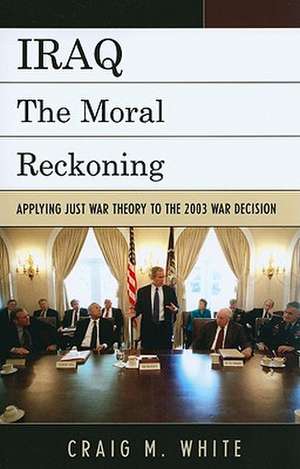
Iraq: The Moral Reckoning
Autor Craig M. Whiteen Limba Engleză Paperback – 19 mar 2010
For each criterion, Iraq: The Moral Reckoning painstakingly weighs Bush administration statements, or those of its supporters, against evidence available at the time. A wide range of viewpoints and evidence is considered, and contrary arguments are refuted. One full chapter is given to neoconservative arguments on just war theory and its application from prominent war supporters. Each criterion, except sovereign authority, is shown not to have been met. The book concludes with a discussion of the implications of an unjust war for the United States and the world.
The intensive weighing of each criterion against the facts and the balanced approach make the book unique. By demonstrating a comprehensive application of the theory to one war, it not only sets a new standard for evaluating the 2003 Iraq war, but also shows how present and future wars can be better evaluated in moral and practical terms, based on knowledge available at the time.
Preț: 345.19 lei
Preț vechi: 483.79 lei
-29%
Puncte Express: 518
Carte tipărită la comandă
Livrare economică 03-17 decembrie
Livrare prin curier în România Termenul estimat este afișat lângă disponibilitate.
Transport gratuit de la 400.00 lei Plată online sau ramburs, în funcție de opțiunile comenzii.
Retur gratuit în 14 zile Comandă securizată și suport în română.
Specificații
ISBN-13: 9780739138946
ISBN-10: 0739138944
Pagini: 295
Ilustrații: black & white illustrations
Dimensiuni: 156 x 234 x 22 mm
Greutate: 0.41 kg
Editura: Bloomsbury Publishing
Colecția Lexington Books
Locul publicării:New York, United States
ISBN-10: 0739138944
Pagini: 295
Ilustrații: black & white illustrations
Dimensiuni: 156 x 234 x 22 mm
Greutate: 0.41 kg
Editura: Bloomsbury Publishing
Colecția Lexington Books
Locul publicării:New York, United States
Cuprins
Chapter 1 Preface
Part 2 Part I. Introducing Just War Theory
Chapter 3 Chapter 1. Introduction: An Old Theory, Today's and Tomorrow's Wars
Chapter 4 Chapter 2. How to Apply the Criteria, and Who Should Do It
Part 5 Part II. Applying the Criteria
Chapter 6 Chapter 3. Sovereign Authority
Chapter 7 Chapter 4. Just Cause I: An Armed, Reckless Regime that Harbored Terrorists
Chapter 8 Chapter 5. Just Cause II: Preemption, UN Resolutions, and a New Iraq
Chapter 9 Chapter 6. Just Cause III: The Legal Case
Chapter 10 Chapter 7. Right Intention/The Aim of Peace
Chapter 11 Chapter 8. Proportionality of Ends
Chapter 12 Chapter 9. Last Resort
Chapter 13 Chapter 10. Reasonable Chance of Success
Chapter 14 Chapter 11. Replies to Neoconservative Objections
Part 15 Part III. Conclusion
Chapter 16 Chapter 12. Was It Just? Evaluation and Consequences
Part 17 Appendices
Chapter 18 Appendix A. Thomas Aquinas on War
Chapter 19 Appendix B. Quotations from the Duelfer Report
Part 2 Part I. Introducing Just War Theory
Chapter 3 Chapter 1. Introduction: An Old Theory, Today's and Tomorrow's Wars
Chapter 4 Chapter 2. How to Apply the Criteria, and Who Should Do It
Part 5 Part II. Applying the Criteria
Chapter 6 Chapter 3. Sovereign Authority
Chapter 7 Chapter 4. Just Cause I: An Armed, Reckless Regime that Harbored Terrorists
Chapter 8 Chapter 5. Just Cause II: Preemption, UN Resolutions, and a New Iraq
Chapter 9 Chapter 6. Just Cause III: The Legal Case
Chapter 10 Chapter 7. Right Intention/The Aim of Peace
Chapter 11 Chapter 8. Proportionality of Ends
Chapter 12 Chapter 9. Last Resort
Chapter 13 Chapter 10. Reasonable Chance of Success
Chapter 14 Chapter 11. Replies to Neoconservative Objections
Part 15 Part III. Conclusion
Chapter 16 Chapter 12. Was It Just? Evaluation and Consequences
Part 17 Appendices
Chapter 18 Appendix A. Thomas Aquinas on War
Chapter 19 Appendix B. Quotations from the Duelfer Report
Recenzii
Craig White analyzes the U.S. decision to go to war in Iraq in terms of the moral justification for war, a topic too often treated superficially at best in our foreign policy establishment. With wars ongoing, and many advocating more wars, we would do well to look to Mr. White's work to see what light the Just War Theory sheds on some of the most momentous decisions we face.
Craig White has written an exhaustively well-documented, scrupulously balanced, deeply scholarly consideration of the justice of the Iraq war, informed by the professional insights of a career diplomat. The work exemplifies intellectual courage and a profound love of country while finding the best attempts to justify the Iraq war egregiously defective. White dispassionately unmasks folly masquerading as perennial wisdom, willfulness as virtue, and pettiness as gravitas. What a pity that the sober judgment found in this book was lacking in those leaders given the crisis and opportunity presented by 9/11. History does not doom us to its repetition if we but avail ourselves of the perceptive insights White here offers us.
The tragic strategic, economic, and humanitarian consequences of the U.S. invasion and occupation of Iraq have long been apparent. Craig White does an important service in taking a comprehensive evaluation of the critical underlying issue of the morality of the invasion itself, specifically its failure to meet widely-accepted criteria for a just war. As a career diplomat, White recognizes that such questions are of great importance not only to theologians and philosophers, but also to policy makers and ordinary citizens. He makes his case in a thorough and convincing manner.
A rigorous analysis and application of the six criteria of Just War Theory to the 2003 decision by the Bush White House to go to war against Iraq..White does an excellent job reviewing the history and importance of Just War Theory and gives us an excellent run down of the meaning and development of the six criteria..I highly encourage all Catholics and people who take war seriously (everyone should) to read this book. This book ought to serve as a guide to all consideration of future U.S. wars and the Catholic's response to them.
White handles this extremely controversial topic in a fir, thorough, and nonpartisan manner, reaching logical conclusions..Military and civilian leaders, clergy, political theorists, and concerned citizens will all gain a deeper moral understanding of conflict by engaging the questions that White raises and refining their own ethical framework for determining justified force.
Craig White has written an exhaustively well-documented, scrupulously balanced, deeply scholarly consideration of the justice of the Iraq war, informed by the professional insights of a career diplomat. The work exemplifies intellectual courage and a profound love of country while finding the best attempts to justify the Iraq war egregiously defective. White dispassionately unmasks folly masquerading as perennial wisdom, willfulness as virtue, and pettiness as gravitas. What a pity that the sober judgment found in this book was lacking in those leaders given the crisis and opportunity presented by 9/11. History does not doom us to its repetition if we but avail ourselves of the perceptive insights White here offers us.
The tragic strategic, economic, and humanitarian consequences of the U.S. invasion and occupation of Iraq have long been apparent. Craig White does an important service in taking a comprehensive evaluation of the critical underlying issue of the morality of the invasion itself, specifically its failure to meet widely-accepted criteria for a just war. As a career diplomat, White recognizes that such questions are of great importance not only to theologians and philosophers, but also to policy makers and ordinary citizens. He makes his case in a thorough and convincing manner.
A rigorous analysis and application of the six criteria of Just War Theory to the 2003 decision by the Bush White House to go to war against Iraq..White does an excellent job reviewing the history and importance of Just War Theory and gives us an excellent run down of the meaning and development of the six criteria..I highly encourage all Catholics and people who take war seriously (everyone should) to read this book. This book ought to serve as a guide to all consideration of future U.S. wars and the Catholic's response to them.
White handles this extremely controversial topic in a fir, thorough, and nonpartisan manner, reaching logical conclusions..Military and civilian leaders, clergy, political theorists, and concerned citizens will all gain a deeper moral understanding of conflict by engaging the questions that White raises and refining their own ethical framework for determining justified force.