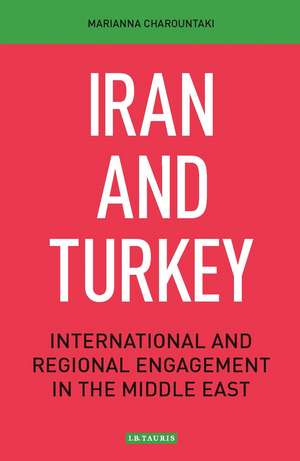
Iran and Turkey: International and Regional Engagement in the Middle East
Autor Marianna Charountakien Limba Engleză Hardback – 27 mar 2018
This book traces the major determinants of Turkish and Iranian foreign policies and their influence on events in the Middle East. Based on an examination of these states' politics and policies since 1979, and using material gathered from interviews with leading political figures from Turkey, Iran and the Kurdistan Region of Iraq, Marianna Charountaki offers fresh insights into how we understand the contemporary global order. Of particular importance, this book shows, is the effect of both external and internal factors on foreign policy and how the interaction between state and non-state actors informs political decisions. In placing these issues in a theoretical framework, Marianna Charountaki pioneers a new conceptual map within International Relations. An interdisciplinary study that provides a fresh new perspective, this book will be of particular interest to scholars of International Relations, Politics, Foreign Policy, Kurdish and Middle East Studies.
Preț: 647.26 lei
Preț vechi: 959.20 lei
-33%
Puncte Express: 971
Carte tipărită la comandă
Livrare economică 23 noiembrie-07 decembrie
Livrare prin curier în România Termenul estimat este afișat lângă disponibilitate.
Transport gratuit pentru acest produs Plată online sau ramburs, în funcție de opțiunile comenzii.
Retur gratuit în 14 zile Comandă securizată și suport în română.
Specificații
ISBN-13: 9781788311809
ISBN-10: 1788311809
Pagini: 368
Ilustrații: 3 maps, 2 figures
Dimensiuni: 138 x 216 mm
Greutate: 0.57 kg
Editura: Bloomsbury Publishing
Colecția I.B.Tauris
Locul publicării:London, United Kingdom
ISBN-10: 1788311809
Pagini: 368
Ilustrații: 3 maps, 2 figures
Dimensiuni: 138 x 216 mm
Greutate: 0.57 kg
Editura: Bloomsbury Publishing
Colecția I.B.Tauris
Locul publicării:London, United Kingdom
Cuprins
Chapter 1
Introduction
Literature Review: A critique
Determinants of Turkish-Iranian relations: A justification
Methodology: An Interdisciplinary and Comparative Examination from a Multi-actor Perspective
Conclusion
Chapter 2
Determinants of the Iranian- Turkish relations: A Historical Review
The Role of the Elites: Army and Ulama versus Army and Ayatollahs
Turkish versus Iranian Republicanism: International Interference as an External Force
The Influence of the Cold War on Turkish-Iranian Politics
Islamist Turkey versus Islamic Iran: The Impact of Foreign Policy Principles
Conclusion
Chapter 3
Turkey-Iran Relations during the Cold War
The Iranian Revolution and its Impact on the Cold War
Non-state Actors as Facilitator of State Foreign Policy
Iraq as factor under the prism of Gulf War I
External Interference: The US Role versus Soviet Influence
Economics of War: Iranian-Turkish Economic and Political Alliances
Conclusion
Chapter 4
Turkish-Iranian Relations in the 1990s: The Impact of Gulf War II and the Consolidation of the Kurdish Status
The Impact of Gulf War II on Turkish-Iranian relations
Gulf War II and its Aftermath: The Role of the Kurds
Conclusion
Chapter 5
The Iraq War and the Rise of Non-state actors (2001-2010)
The Role of Iraq in the formulation of Turkish- Iranian relations: Political and Economic Considerations
Non-state Actors in Iranian and Turkish foreign policies: The Kurds as A Force for Change
Iranian-Turkish Rapprochement: International and Regional Structures
Epilogue: Towards A Conceptual Analysis
Conclusion
Chapter 6
Turkish- Iranian Relations under the Lens of the Syrian Crisis: A New Era for Middle Eastern Politics The Syrian Factor
Conclusion
Chapter 7
Conclusions and Conceptualisations
Empirical and Conceptual Implications
A New Pattern of Alliances: The International Dimension
Theoretical Framework: A model of multi-dimensional interrelations
Conclusion
List of Figures
Appendix
Bibliography
Introduction
Literature Review: A critique
Determinants of Turkish-Iranian relations: A justification
Methodology: An Interdisciplinary and Comparative Examination from a Multi-actor Perspective
Conclusion
Chapter 2
Determinants of the Iranian- Turkish relations: A Historical Review
The Role of the Elites: Army and Ulama versus Army and Ayatollahs
Turkish versus Iranian Republicanism: International Interference as an External Force
The Influence of the Cold War on Turkish-Iranian Politics
Islamist Turkey versus Islamic Iran: The Impact of Foreign Policy Principles
Conclusion
Chapter 3
Turkey-Iran Relations during the Cold War
The Iranian Revolution and its Impact on the Cold War
Non-state Actors as Facilitator of State Foreign Policy
Iraq as factor under the prism of Gulf War I
External Interference: The US Role versus Soviet Influence
Economics of War: Iranian-Turkish Economic and Political Alliances
Conclusion
Chapter 4
Turkish-Iranian Relations in the 1990s: The Impact of Gulf War II and the Consolidation of the Kurdish Status
The Impact of Gulf War II on Turkish-Iranian relations
Gulf War II and its Aftermath: The Role of the Kurds
Conclusion
Chapter 5
The Iraq War and the Rise of Non-state actors (2001-2010)
The Role of Iraq in the formulation of Turkish- Iranian relations: Political and Economic Considerations
Non-state Actors in Iranian and Turkish foreign policies: The Kurds as A Force for Change
Iranian-Turkish Rapprochement: International and Regional Structures
Epilogue: Towards A Conceptual Analysis
Conclusion
Chapter 6
Turkish- Iranian Relations under the Lens of the Syrian Crisis: A New Era for Middle Eastern Politics The Syrian Factor
Conclusion
Chapter 7
Conclusions and Conceptualisations
Empirical and Conceptual Implications
A New Pattern of Alliances: The International Dimension
Theoretical Framework: A model of multi-dimensional interrelations
Conclusion
List of Figures
Appendix
Bibliography
Recenzii
There is a vital need for this book. Summing Up: Recommended. Upper-division undergraduates through faculty.
Notă biografică
Marianna Charountaki is a Lecturer in Kurdish Politics and International Relations in the School of History, Politics and International Relations at the University of Leicester, UK, where she is also the Head of the Kurdistan International Studies Unit.