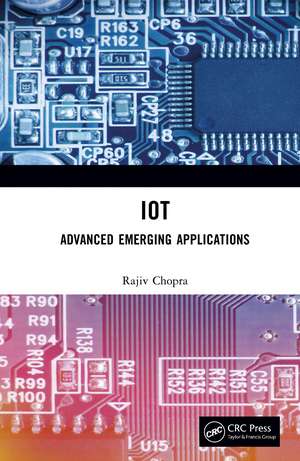
IoT: Advanced Emerging Applications
Autor Rajiv Chopraen Limba Engleză Hardback – 22 ian 2026
- Comprehensive coverage of IoT fundamentals and advanced applications
- Detailed exploration of IoT components including RFID, WSNs, and embedded platforms
- In-depth analysis of IoT application development and design challenges
- Specialized focus on Industrial IoT (IIoT) implementation and requirements
- Thorough examination of Fog Computing in relation to IoT systems
This title has been co-published with Manakin Press. Taylor & Francis does not sell or distribute the print edition in India, Pakistan, Nepal, Bhutan, Sri Lanka and Bangladesh.
Preț: 859.97 lei
Preț vechi: 1074.97 lei
-20%
Puncte Express: 1290
Carte tipărită la comandă
Livrare economică 08-22 decembrie
Livrare prin curier în România Termenul estimat este afișat lângă disponibilitate.
Transport gratuit pentru acest produs Plată online sau ramburs, în funcție de opțiunile comenzii.
Retur gratuit în 14 zile Comandă securizată și suport în română.
Specificații
ISBN-13: 9781041206910
ISBN-10: 1041206917
Pagini: 326
Ilustrații: 178
Dimensiuni: 152 x 229 mm
Greutate: 0.62 kg
Ediția:1
Editura: CRC Press
Colecția CRC Press
ISBN-10: 1041206917
Pagini: 326
Ilustrații: 178
Dimensiuni: 152 x 229 mm
Greutate: 0.62 kg
Ediția:1
Editura: CRC Press
Colecția CRC Press
V-ar putea interesa
-
 Computer Networks: A Systems ApproachLarry L. Peterson-40%Preț: 577.87 lei956.74 lei
 -
 The Internet of Things, Revised and Updated EditionSamuel Greengard-20%Preț: 93.42 lei116.48 lei
 -
 -40%Preț: 458.81 lei768.90 lei
 -
 -30%Preț: 445.71 lei639.30 lei
 -
 -20%Preț: 397.16 lei496.45 lei
 -
 -15%Preț: 436.67 lei513.73 lei
 -
 -20%Preț: 214.84 lei268.55 lei
 -
 -20%Preț: 218.14 lei272.67 lei
 -
 -35%Preț: 287.78 lei443.61 lei
 -
 -36%Preț: 295.82 lei462.12 lei
 -
 -36%Preț: 284.35 lei440.95 lei
 -
 Advances in AI for Cloud, Edge, and Mobile Computing ApplicationsShrikaant Kulkarni-20%Preț: 1296.62 lei1620.78 lei
 -
 Internet of Things (IoT)Mansaf Alam-20%Preț: 1342.28 lei1677.85 lei
 -
 Wireless Networks and Industrial IoTNurul Huda Mahmood-24%Preț: 1010.14 lei1329.14 lei
 -
 Challenges in the IoT and Smart EnvironmentsReza Montasari-20%Preț: 1009.35 lei1261.68 lei
 -
 IoT Based Smart ApplicationsNidhi Sindhwani-18%Preț: 995.30 lei1213.79 lei
 -
 IT Applications for Sustainable LivingMuhamad Husaini Abu Bakar-20%Preț: 314.65 lei393.32 lei
 -
 Concise Guide to the Internet of ThingsMichael Mccarthy-20%Preț: 421.74 lei527.18 lei
 -
 -18%Preț: 1177.49 lei1435.96 lei
Public țintă
Academic and PostgraduateNotă biografică
Rajiv Chopra is faculty member in the Computer Science and Engineering Department at DCE, Gurugram, Haryana. He specializes in Internet of Things, wireless sensor networks, and advanced networking protocols. Dr. Chopra has published extensively in international journals and conferences, and has guided numerous research scholars in computer science and engineering.
Cuprins
1. Introduction to IoT
1.0 Introduction
1.1 Vision, Definition and Characteristics of IoT
1.2 Some Basic Terminologies Related to IoT
1.3 Conceptual Framework
1.4 Architectural Overview
1.5 Technology Behind IoT
1.6 Sources of IoT
1.7 Design Principles of IoT
1.8 Needed Capabilities of IoT
1.9 IoT Stack
1.10 IoT Levels
1.11 IoT Applications
1.12 Sensing
1.13 Actuation
1.14 Basics of Networking
1.15 M2M Communication
1.16 IoT Examples
1.17 Sensor as A Service (Se-AAS)/XAAS
1.18 Role of Cloud in IoT
1.19 Security Aspects in IoT
Summary
Multiple Choice Questions [MCQs] with Answers
Exercise Questions
2. IoT and Its Components
2.0 Introduction
2.1 RFID
2.2 Wireless Sensor Networks (WSNs)
2.3 Participatory Sensing Technology
2.4 Embedded Platforms for IoT–Embedded Computing Basics
2.5 Communications
2.6 LoWPAN
2.7 HART and Wireless HART
2.8 Near Field Communication (NFC)
2.9 Software Components
2.10 Programming APIs (Using Python) for Communication Protocols – MQTT, UDP, TCP
Summary
Multiple Choice Questions [MCQs] with Answers
Conceptual Short Questions with Answers
Exercise Questions
3. IoT Application Development and Design Challenges
3.0 Introduction
3.1 IoT Design Methodology
3.2 Requirement and Process Model of IoT
3.3 Process Specification
3.4 Information Model for IoT Applications
3.5 Service Specification
3.6 Functional and Operational View
3.7 Principles and Security Challenges of IoT
3.8 Vulnerabilities of IoT
3.9 Unstructured Data Storage on Cloud/Local Server
3.10 IoT Applications
Summary Multiple Choice Questions [MCQs] with Answers
Conceptual Short Questions with Answers
Exercise Questions
4. IIoT Industrial IoT
4.0 Introduction
4.1 IIoT Requirements
4.2 Design Considerations of IIoT
4.3 Applications of IIoT
4.4 Merits of IIoT
4.5 Challenges of IIoT and Its Solutions
Summary
Multiple Choice Questions [MCQs] with Answers
Conceptual Short Questions with Answers
Exercise Questions
5. Fog Computing
5.0 Introduction
5.1 Need of Fog Computing
5.2 Requirements of IoT
5.3 Architecture of Fog
5.4 Working of Fog
5.5 Advantages of Fog
5.6 Applications of Fog
5.7 Challenges of Fog Summary
Multiple Choice Questions [MCQs] with Answers
Conceptual Short Questions with Answers
Exercise Questions
6. Flying Ad Hoc Network
6.0 Introduction
6.1 Mobile Ad Hoc Network (MANET)
6.2 Characteristics of MANET
6.3 Vehicular Ad Hoc Network (VANET)
6.4 Comparison between MANETs, VANETs, and FANETs
6.5 Characteristics of VANET
6.6 Various Communicating Standard Protocols
6.7 Network Architecture of FANET
6.8 Classification of Unmanned Aerial Vehicle Networks
6.9 Challenges in Unmanned Aerial Vehicle Ad Hoc
6.10 Literature Review
6.11 Various Routing Protocols for Ad Hoc Network
6.12 Proactive Protocol
6.13 Reactive Protocol
6.14 Hybrid Protocol
6.15 Geographical Based Protocol
6.16 Hierarchical Based Protocol
Summary Multiple Choice Questions (MCQs) with Answers
Abbreviations References
Experiments in IoT–Lab
Index
1.0 Introduction
1.1 Vision, Definition and Characteristics of IoT
1.2 Some Basic Terminologies Related to IoT
1.3 Conceptual Framework
1.4 Architectural Overview
1.5 Technology Behind IoT
1.6 Sources of IoT
1.7 Design Principles of IoT
1.8 Needed Capabilities of IoT
1.9 IoT Stack
1.10 IoT Levels
1.11 IoT Applications
1.12 Sensing
1.13 Actuation
1.14 Basics of Networking
1.15 M2M Communication
1.16 IoT Examples
1.17 Sensor as A Service (Se-AAS)/XAAS
1.18 Role of Cloud in IoT
1.19 Security Aspects in IoT
Summary
Multiple Choice Questions [MCQs] with Answers
Exercise Questions
2. IoT and Its Components
2.0 Introduction
2.1 RFID
2.2 Wireless Sensor Networks (WSNs)
2.3 Participatory Sensing Technology
2.4 Embedded Platforms for IoT–Embedded Computing Basics
2.5 Communications
2.6 LoWPAN
2.7 HART and Wireless HART
2.8 Near Field Communication (NFC)
2.9 Software Components
2.10 Programming APIs (Using Python) for Communication Protocols – MQTT, UDP, TCP
Summary
Multiple Choice Questions [MCQs] with Answers
Conceptual Short Questions with Answers
Exercise Questions
3. IoT Application Development and Design Challenges
3.0 Introduction
3.1 IoT Design Methodology
3.2 Requirement and Process Model of IoT
3.3 Process Specification
3.4 Information Model for IoT Applications
3.5 Service Specification
3.6 Functional and Operational View
3.7 Principles and Security Challenges of IoT
3.8 Vulnerabilities of IoT
3.9 Unstructured Data Storage on Cloud/Local Server
3.10 IoT Applications
Summary Multiple Choice Questions [MCQs] with Answers
Conceptual Short Questions with Answers
Exercise Questions
4. IIoT Industrial IoT
4.0 Introduction
4.1 IIoT Requirements
4.2 Design Considerations of IIoT
4.3 Applications of IIoT
4.4 Merits of IIoT
4.5 Challenges of IIoT and Its Solutions
Summary
Multiple Choice Questions [MCQs] with Answers
Conceptual Short Questions with Answers
Exercise Questions
5. Fog Computing
5.0 Introduction
5.1 Need of Fog Computing
5.2 Requirements of IoT
5.3 Architecture of Fog
5.4 Working of Fog
5.5 Advantages of Fog
5.6 Applications of Fog
5.7 Challenges of Fog Summary
Multiple Choice Questions [MCQs] with Answers
Conceptual Short Questions with Answers
Exercise Questions
6. Flying Ad Hoc Network
6.0 Introduction
6.1 Mobile Ad Hoc Network (MANET)
6.2 Characteristics of MANET
6.3 Vehicular Ad Hoc Network (VANET)
6.4 Comparison between MANETs, VANETs, and FANETs
6.5 Characteristics of VANET
6.6 Various Communicating Standard Protocols
6.7 Network Architecture of FANET
6.8 Classification of Unmanned Aerial Vehicle Networks
6.9 Challenges in Unmanned Aerial Vehicle Ad Hoc
6.10 Literature Review
6.11 Various Routing Protocols for Ad Hoc Network
6.12 Proactive Protocol
6.13 Reactive Protocol
6.14 Hybrid Protocol
6.15 Geographical Based Protocol
6.16 Hierarchical Based Protocol
Summary Multiple Choice Questions (MCQs) with Answers
Abbreviations References
Experiments in IoT–Lab
Index
Descriere
This book covers Internet of Things fundamentals, components, application development, and advanced topics including Industrial IoT, Fog Computing, and Flying Ad Hoc Networks. With practical experiments and assessment questions, it serves as a comprehensive resource for students and professionals in computing and engineering fields.