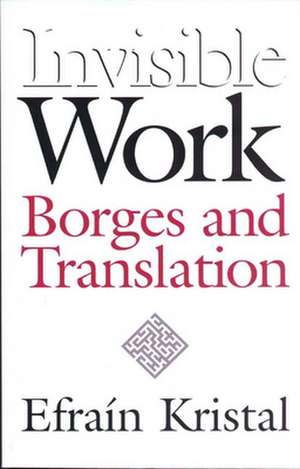
Invisible Work: Borges and Translation
Autor Efrain Kristalen Limba Engleză Paperback – mai 2002
Borges's bold habits as translator and his views on translation had a decisive impact on his creative process. Translation is also a recurrent motif in Borges's stories. In "The Immortal," for example, a character who has lived for many centuries regains knowledge of poems he had authored, and almost forgotten, by way of modern translations. Many of Borges's fictions include actual or imagined translations, and some of his most important characters are translators. In "Pierre Menard, author of the Quixote," Borges's character is a respected Symbolist poet, but also a translator, and the narrator insists that Menard's masterpiece-his "invisible work"-adds unsuspected layers of meaning to Cervantes's Don Quixote. George Steiner cites this short story as "the most acute, most concentrated commentary anyone has offered on the business of translation."
In an age where many discussions of translation revolve around the dichotomy faithful/unfaithful, this book will surprise and delight even Borges's closest readers and critics.
| Toate formatele și edițiile | Preț | Express |
|---|---|---|
| Paperback (1) | 297.08 lei 6-8 săpt. | |
| Vanderbilt University Press – mai 2002 | 297.08 lei 6-8 săpt. | |
| Hardback (1) | 454.50 lei 6-8 săpt. | |
| Vanderbilt University Press – mai 2002 | 454.50 lei 6-8 săpt. |
Preț: 297.08 lei
Puncte Express: 446
Preț estimativ în valută:
52.54€ • 61.42$ • 45.68£
52.54€ • 61.42$ • 45.68£
Carte tipărită la comandă
Livrare economică 07-21 martie
Specificații
ISBN-13: 9780826514080
ISBN-10: 0826514081
Pagini: 280
Dimensiuni: 127 x 203 x 16 mm
Greutate: 0.34 kg
Ediția:New.
Editura: Vanderbilt University Press
Colecția Vanderbilt University Press
ISBN-10: 0826514081
Pagini: 280
Dimensiuni: 127 x 203 x 16 mm
Greutate: 0.34 kg
Ediția:New.
Editura: Vanderbilt University Press
Colecția Vanderbilt University Press
V-ar putea interesa
-
 The Giggle-A-Day Joke BookChild of Achievement(tm) Awards thePreț: 43.60 lei
 -
 Milton's Grand StyleChristopher Ricks-24%Preț: 351.29 lei463.71 lei
 -
 -34%Preț: 600.34 lei903.78 lei
 -
 English Drama: (Excluding Shakespeare)Stanley Wells-16%Preț: 282.79 lei337.63 lei
 -
 Shakespeare's Imagery and What it Tells UsCaroline F. E. SpurgeonPreț: 368.43 lei
 -
 Myth, Literature and the African WorldWole SoyinkaPreț: 101.19 lei
 -
 Preț: 207.36 lei
 -
 Virginia WoolfLaura MarcusPreț: 244.30 lei
 -
 In TheoryAijaz AhmadPreț: 114.80 lei
 -
 Archaeologies of the FutureFredric JamesonPreț: 236.45 lei
Notă biografică
Efrain Kristal is professor of Spanish and comparative literature at UCLA and author of Temptation of the Word: The Novels of Mario Vargas Llosa, also published by Vanderbilt University Press.
Recenzii
A must-read for all students, scholars, and hedonic readers of the Argentine fabulist, as well as a groundbreaking expansion of the fields of translation studies and comparative literature.
--Suzanne Jill Levine
It is no surprise ... that translation figures large in Borges' poetics, and Kristal does an extraordinary job of tracing this trope throughout the blind writerís long career.
--Virginia Quarterly Review
Invisible Work: Borges and Translation reveals that behind every tale by Borges there pulses a generative translation. Efrain Kristal has brought to light the extent to which Borges's methods as translator--who habitually changes the titles, excises passages, transforms characters, and develops potentialities--intervene in the conception and execution of his fictions. Borges's strategies as translator and creative writer are one and the same.
--Saul Yurkievich
While Borges's writings have already generated mountains of commentary, his work as a translator has received little more than a passing nod. Efrain Kristal's close and detailed study of Borges's translations makes dramatically clear how they embody his whole view of writing--that all writing is a form of rewriting, that writers are essentially recreators. His translations are much more than linguistic renderings of an original--they are transformations--and Kristal's scrupulous reading of them shows them to be a fundamental part of the Borges canon. As translator, Borges more than fulfills Octavio Paz's claim: 'Everything we do is translation, and all translations are in a way creations.'
--Alastair Reid
--Suzanne Jill Levine
It is no surprise ... that translation figures large in Borges' poetics, and Kristal does an extraordinary job of tracing this trope throughout the blind writerís long career.
--Virginia Quarterly Review
Invisible Work: Borges and Translation reveals that behind every tale by Borges there pulses a generative translation. Efrain Kristal has brought to light the extent to which Borges's methods as translator--who habitually changes the titles, excises passages, transforms characters, and develops potentialities--intervene in the conception and execution of his fictions. Borges's strategies as translator and creative writer are one and the same.
--Saul Yurkievich
While Borges's writings have already generated mountains of commentary, his work as a translator has received little more than a passing nod. Efrain Kristal's close and detailed study of Borges's translations makes dramatically clear how they embody his whole view of writing--that all writing is a form of rewriting, that writers are essentially recreators. His translations are much more than linguistic renderings of an original--they are transformations--and Kristal's scrupulous reading of them shows them to be a fundamental part of the Borges canon. As translator, Borges more than fulfills Octavio Paz's claim: 'Everything we do is translation, and all translations are in a way creations.'
--Alastair Reid