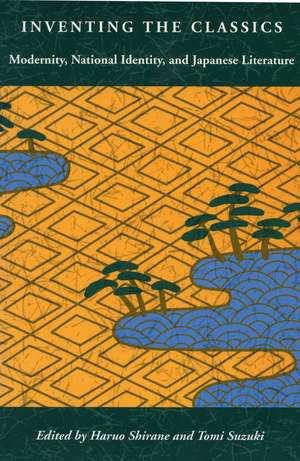
Inventing the Classics: Modernity, National Identity, and Japanese Literature
Editat de Haruo Shirane, Tomi Suzukien Limba Engleză Paperback – 2002
Descoperim în Inventing the Classics o perspectivă demistificatoare asupra modului în care s-a format identitatea culturală a Japoniei. Această lucrare aduce un element de noutate crucial: argumentează că noțiunea de „clasici” (precum Povestea lui Genji sau Man'yoshu) nu este una ancestrală, ci un produs al modernității de la finele secolului al XIX-lea. Observăm cum transformarea Japoniei într-un stat-națiune a necesitat inventarea unei tradiții literare liniare, proces puternic influențat de categoriile disciplinare europene.
Remarcăm structura riguroasă a volumului, care analizează fiecare text major în contextul puterii socio-economice și religioase. Această abordare completează perspectiva oferită de Origins of Modern Japanese Literature de Kojin Karatani, care se concentrează pe fundamentele teoretice ale modernității, adăugând o analiză factuală detaliată a rolului școlilor și comentatorilor în procesul de canonizare. De asemenea, lucrarea se intersectează tematic cu Gender and National Literature de Tomiko Yoda, aprofundând modul în care identitatea de gen a influențat receptarea textelor din perioada Heian.
În contextul operei lui Haruo Shirane, acest volum reprezintă puntea critică între lucrările sale tehnice, precum Classical Japanese: A Grammar, și studiile sale despre memoria culturală. Dacă în alte scrieri Shirane oferă instrumentele de descifrare a limbajului, aici analizează mecanismele politice care au ridicat aceste texte la rangul de simboluri naționale. Tonul este academic și precis, oferind o examinare critică a modului în care valorile literare sunt produse și reproduse de instituții, făcând din acest volum un instrument indispensabil pentru înțelegerea istoriei critice a literaturii japoneze.
Preț: 232.56 lei
Carte disponibilă
Livrare economică 02-16 noiembrie
Specificații
ISBN-10: 0804741050
Pagini: 352
Dimensiuni: 152 x 229 x 20 mm
Greutate: 0.47 kg
Ediția:1
Editura: Stanford University Press
Colecția Stanford University Press
V-ar putea interesa
-
 Preț: 253.99 lei
 -
 -27%Preț: 891.94 lei1221.83 lei
 -
 Preț: 372.07 lei
 -
 -23%Preț: 471.41 lei612.22 lei
 -
 Preț: 441.79 lei
 -
 Japanese Cinema: Texts and ContextsAlastair PhillipsPreț: 475.20 lei
 -
 The Novel, Volume 1Franco MorettiPreț: 444.33 lei
 -
 The Novel, Volume 2Franco MorettiPreț: 446.71 lei
 -
 Performed Literature: Words and Music by Bob DylanBetsy Bowden-34%Preț: 412.24 lei626.13 lei
 -
 -35%Preț: 343.32 lei531.28 lei
 -
 Japanese Aesthetics and AnimeDani CavallaroPreț: 236.32 lei
 -
 An Introduction to Japanese Court PoetryEarl MinerPreț: 200.19 lei
 -
 Preț: 269.59 lei
 -
 Preț: 200.65 lei
 -
 Preț: 159.92 lei
 -
 Gender and National LiteratureTomiko YodaPreț: 252.62 lei
 -
 The Cambridge History of Japanese LiteratureHaruo Shirane-23%Preț: 1275.57 lei1656.59 lei
 -
 Japanese Writers and the WestS. OkadaPreț: 369.77 lei
 -
 Distant ReadingFranco MorettiPreț: 142.34 lei
 -
 Preț: 417.79 lei
 -
 -23%Preț: 2300.09 lei2987.13 lei
 -
 Man'yōshū (Book 1)Alexander Vovin-23%Preț: 728.15 lei945.64 lei
 -
 Worlding a Peripheral LiteratureMarko Juvan-15%Preț: 508.27 lei597.96 lei
De ce să citești această carte
Această carte este esențială pentru studenții și cercetătorii interesați de istoria Japoniei și de teoria literară. Cititorul câștigă o înțelegere profundă a modului în care literatura este utilizată pentru a construi identități naționale. Este o recomandare excelentă pentru cei care doresc să treacă dincolo de lectura estetică a textelor clasice și să înțeleagă forțele politice și sociale care le-au consacrat valoarea în modernitate.
Despre autor
Haruo Shirane, profesor de literatură japoneză la Universitatea Columbia, este un specialist recunoscut internațional în cultura și literatura Japoniei. Expertiza sa acoperă o gamă largă, de la ficțiunea în proză și poezia clasică până la interacțiunea dintre cultura de elită și cea populară. Autor și editor a peste douăzeci de volume, Shirane a contribuit fundamental la domeniu prin lucrări precum Japan and the Culture of the Four Seasons și manuale de referință ca Classical Japanese. Opera sa se concentrează pe memoria culturală și pe modul în care tradiția este reinterpretată în diverse contexte istorice.
Descriere scurtă
This book addresses the issue of national identity and the ways in which modern European disciplinary notions of "literature" and genres played a major role in the modern canonization process. These "classics" did not have inherent, unchanging value; instead, their value was produced and reproduced by various institutions and individuals in relation to socio-economic power. How then were these texts elevated and used? What kinds of values were given to them? How was this process related to larger social, political, and religious configurations?
This book, which looks in depth at each of the major "classics," explores these questions in a broad historical context, from the medieval period, when multiple canons competed with each other, through the early modern and modern periods. Throughout, the essays focus on the roles of schools, commentators, and socio-religious institutions, and on issues of gender. The result is a new view of the transformation of the Japanese canon and its intimate connection with the issue of national and cultural identity.
Recenzii
Notă biografică
Textul de pe ultima copertă
“The collection presents a truly significant contribution to the study of Japanese literature. . . . All the essays are solidly researched and lucidly written, and the volume is certain to be widely used and cited.”—Journal of Asian Studies