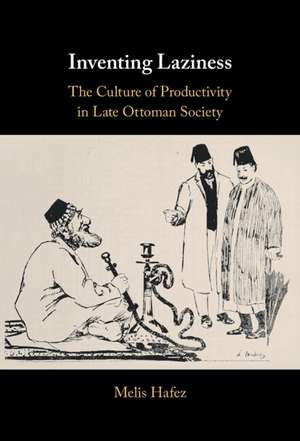
Inventing Laziness
Autor Melis Hafezen Limba Engleză Hardback – 9 noi 2021
Preț: 608.98 lei
Preț vechi: 684.25 lei
-11%
Puncte Express: 913
Carte tipărită la comandă
Livrare economică 02-16 decembrie
Livrare prin curier în România Termenul estimat este afișat lângă disponibilitate.
Transport gratuit pentru acest produs Plată online sau ramburs, în funcție de opțiunile comenzii.
Retur gratuit în 14 zile Comandă securizată și suport în română.
Specificații
ISBN-13: 9781108427845
ISBN-10: 1108427847
Pagini: 320
Dimensiuni: 157 x 235 x 22 mm
Greutate: 0.62 kg
Editura: Cambridge University Press
Locul publicării:Cambridge, United Kingdom
ISBN-10: 1108427847
Pagini: 320
Dimensiuni: 157 x 235 x 22 mm
Greutate: 0.62 kg
Editura: Cambridge University Press
Locul publicării:Cambridge, United Kingdom
Cuprins
Introduction; 1. Moralizing productivity in the age of reform; 2. Criminalizing laziness: Punishment, reward, and negotiation in the Ottoman bureaus; 3. Imagining Ottoman dandies and industrious effendis; 4. Militarizing the productive body; 5. Exclusionism at work: Politics, power, and productivity; Epilogue; Bibliography; Index.
Recenzii
'Melis Hafez's brilliant exposé of the calls for improvement in Ottoman citizens' productivity ties into a larger global transition implicating the modern state, capitalism, and a bourgeois intellectual elite. Inventing Laziness is thus a revelation that sets the standard for both Ottoman and larger European studies for the next generation.' Isa Blumi, Stockholm University
'Melis Hafez brilliantly explores late Ottoman discourses and anxieties regarding laziness as a major social disease and the need to turn Ottomans into proactive and productive citizens. By using a broad set of Ottoman texts and sources, many of them examined for the first time, Hafez analyzes this new culture of productivity, offering a sophisticated, multi-layered and persuasive discussion about its intellectual and Islamic sources, development, and ramifications.' Eyal Ginio, The Hebrew University of Jerusalem
'Hafez' original and substantive work considers the ways in which an Ottoman culture of productivity, crucial to the national project, was developed and promoted. She shows Islamist authors deploying the language of productivity to defend the role of Islam and emphasize its relevance for a new Ottoman nation. An intriguing read.' Palmira Brummett, The University of Tennessee, Knoxville
'Melis Hafez brilliantly explores late Ottoman discourses and anxieties regarding laziness as a major social disease and the need to turn Ottomans into proactive and productive citizens. By using a broad set of Ottoman texts and sources, many of them examined for the first time, Hafez analyzes this new culture of productivity, offering a sophisticated, multi-layered and persuasive discussion about its intellectual and Islamic sources, development, and ramifications.' Eyal Ginio, The Hebrew University of Jerusalem
'Hafez' original and substantive work considers the ways in which an Ottoman culture of productivity, crucial to the national project, was developed and promoted. She shows Islamist authors deploying the language of productivity to defend the role of Islam and emphasize its relevance for a new Ottoman nation. An intriguing read.' Palmira Brummett, The University of Tennessee, Knoxville
Descriere
A lively and original study tracing the development of 'laziness' as a way to understanding emerging civic culture in the Ottoman Empire.