Cantitate/Preț
Produs

Introduction to Survey Sampling

Autor Graham Kalton
en Limba Engleză Hardback – sep 1983
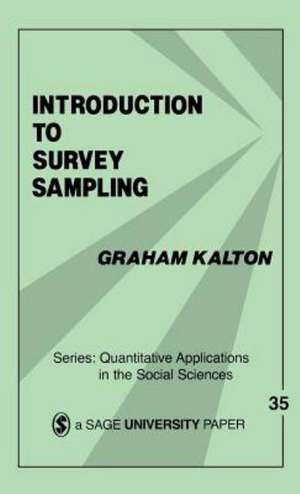
Reviews sampling methods used in surveys: simple random sampling, systematic sampling, stratification, cluster and multi-stage sampling, sampling with probability proportional to size, two-phase sampling, replicated sampling, panel designs, and non-probability sampling. Kalton discusses issues of practical implementation, including frame problems and non-response, and gives examples of sample designs for a national face-to-face interview survey and for a telephone survey. He also treats the use of weights in survey analysis, the computation of sampling errors with complex sampling designs, and the determination of sample size.
Citește tot Restrânge

Preț: 67094 lei

Preț vechi: 78934 lei
-15%

Puncte Express: 1006

Carte tipărită la comandă

Livrare economică 03-17 septembrie

Livrare prin curier în România Termenul estimat este afișat lângă disponibilitate.
Transport gratuit pentru acest produs Plată online sau ramburs, în funcție de opțiunile comenzii.
Retur gratuit în 14 zile Comandă securizată și suport în română.

Specificații

ISBN-13: 9781483347264
ISBN-10: 1483347265
Pagini: 96
Dimensiuni: 145 x 222 x 9 mm
Greutate: 0.27 kg
Editura: SAGE Publications

Recenzii

This book is a second revision of what will continue to be the classic short treatment of the subject.
“A wonderful resource for professionals who utilize survey sampling methodology. It provides indepth
information for readers on ways to improve survey schemes.” 
“This updated edition is a welcome addition to the field of survey sampling. Kalton provides a
concise and accessible approach to the design of complex sample surveys. New or expanded
topics address sampling challenges in an online world, issues of missing data, variance estimation
and adaptations of sampling methods for hard-to-reach populations. I’m looking forward to using
this 2nd edition in my sampling course!” 

Cuprins

Series Editor Introduction
Preface
Acknowledgments
About the Author
Chapter 1: Introduction to Survey Sampling
Chapter 2: Simple Random Sampling
Chapter 3: Systematic Sampling
Chapter 4: Stratification
Proportionate Stratification
Disproportionate Stratification
Choice of Strata
Poststratification
Chapter 5: Cluster and Multi-Stage Sampling
Chapter 6: Probability Proportional to Size Sampling
Chapter 7: Other Probability Designs
Two-Phase Sampling
Dual-Frame Sampling
Replicated Sampling
Designs for Surveys Over Time
Responsive and Adaptive Designs
Chapter 8: Sampling Frames
Missing Elements
Clusters
Blanks and Foreign Elements
Duplicate Listings
Unlocatable Listings
Address-Based Sampling
Sampling for Telephone Surveys
Chapter 9: Nonresponse
Unit Nonresponse
Item Nonresponse
Chapter 10: Base Weights
Chapter 11: Compensating for Missing Data
Nonresponse Weighting Adjustments
Calibration Adjustments
Imputation
Chapter 12: Variance Estimation
The Taylor Series Linearization Method
Balanced Repeated Replications
Jackknife Repeated Replications
The Bootstrap
Some General Issues
Chapter 13: Sample Size
Chapter 14: Examples of National Probability Sample Designs
National Household Surveys in Sub-Saharan Africa
The 2016 American National Election Study
The 2017 California Health Interview Survey
The American Community Survey
Chapter 15: Nonprobability Sampling
Quota Sampling
Sampling Methods for “Hard-to-Survey” Populations
Sampling Methods for Internet Surveys
Small-Area Estimation
Chapter 16: Concluding Remarks
References
Index

Descriere

Descriere de la o altă ediție sau format:
Sample design is key to all surveys, fundamental to data collection, and to the analysis and interpretation of the data. Introduction to Survey Sampling, Second Edition provides an authoritative and accessible source on sample design strategies and procedures that is a required reading for anyone collecting or analyzing survey data. Graham Kalton discusses different types of probability samples, stratification (pre and post), clustering, dual frames, replicates, response, base weights, design effects, and effective sample size. It is a thorough revision and update of the first edition, published more than 35 years ago. Although the concepts of probability sampling are largely the same, there have been important developments in the application of these concepts as research questions have increasingly spanned multiple disciplines, computers have become central to data collection as well as data analysis, and cell phones have become ubiquitous, but response rates have fallen, and public willingness to engage in survey research has waned. While most of the volume focuses on probability samples, there is also a chapter on nonprobability samples, which are becoming increasingly important with the rise of social media and the world wide web.