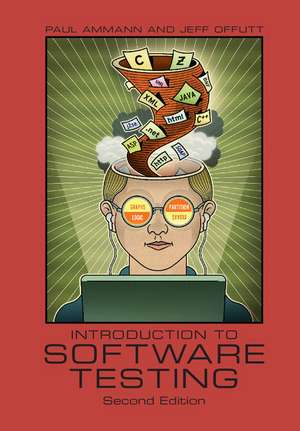
Introduction to Software Testing
Autor Paul Ammann, Jeff Offutten Limba Engleză Hardback – 13 dec 2016
Suntem de părere că expertiza practică a autorului Paul Ammann, cu un istoric solid în configurarea infrastructurilor complexe și diagnoza sistemelor, conferă volumului Introduction to Software Testing o ancorare rară în realitatea tehnică. Această lucrare, publicată de Cambridge University Press, nu se mulțumește cu o prezentare superficială a conceptelor, ci redefinește testarea ca pe un proces riguros de aplicare a unor criterii generale pe structuri matematice. Remarcăm progresia logică a conținutului: de la fundamentele automatizării în prima parte, la analiza detaliată a grafurilor și logicii în secțiunea dedicată criteriilor de acoperire, culminând cu implementarea practică și planificarea testelor. Evoluția față de ediția anterioară este vizibilă prin accentul pus pe tehnologiile actuale, precum aplicațiile web și sistemele embedded, integrând totodată framework-ul JUnit pentru o experiență de învățare aplicată. Dacă Essentials of Software Testing de Ralf Bierig v-a oferit cadrul teoretic și o punte între artă și știință, această carte oferă instrumentele practice și rigoarea necesară pentru a valida software-ul la standarde industriale. În contextul operei autorului, care a explorat anterior dinamica piețelor industriale, acest volum marchează o specializare profundă în calitatea proceselor tehnice. Recomandăm acest manual pentru structura sa modulară, care permite atât studiul academic, cât și consultarea punctuală în proiecte de dezvoltare software unde testarea de regresie și oracolele de testare eficiente sunt critice.
Preț: 490.04 lei
Preț vechi: 612.55 lei
-20%
Carte tipărită la comandă
Livrare economică 05-19 septembrie
Specificații
ISBN-10: 1107172012
Pagini: 364
Ilustrații: 79 b/w illus.
Dimensiuni: 182 x 261 x 25 mm
Greutate: 0.95 kg
Ediția:Revizuită
Editura: Cambridge University Press
Locul publicării:New York, United States
V-ar putea interesa
-
 Specifying SoftwareR. D. Tennent-20%Preț: 399.76 lei499.70 lei
 -
 The B-BookJ. R. Abrial-20%Preț: 745.49 lei931.86 lei
 -
 The Elements of C# StyleKenneth Baldwin-39%Preț: 133.81 lei218.81 lei
 -
 Software Modeling and DesignHassan Gomaa-20%Preț: 665.25 lei831.56 lei
 -
 Reactive SystemsLuca Aceto-20%Preț: 684.37 lei855.47 lei
 -
 Practical Formal Methods in Software EngineeringBruce Ian Mills-20%Preț: 377.02 lei471.27 lei
 -
 -20%Preț: 1415.67 lei1769.60 lei
 -
 -23%Preț: 2113.27 lei2744.51 lei
 -
 Systems and Software Development, Modeling, and AnalysisD. B. A. Mehdi Khosrow-Pour-23%Preț: 1161.81 lei1508.85 lei
 -
 The Mikado MethodOla Ellnestam-20%Preț: 247.80 lei309.75 lei
 -
 An Introduction to ScrumTed Owens-20%Preț: 31.19 lei38.99 lei
 -
 Optimizing MapreduceKaled Tannir-20%Preț: 198.73 lei248.42 lei
 -
 Mockito CookbookMarcin Grzejszczak-20%Preț: 257.43 lei321.79 lei
 -
 Disappearance at Devil's RockPaul Tremblay-17%Preț: 54.23 lei65.41 lei
 -
 Software Project Effort EstimationAdam Trendowicz-20%Preț: 337.85 lei422.31 lei
 -
 Cloud Computing and Services ScienceIvan Ivanov-20%Preț: 323.41 lei404.26 lei
 -
 Service-Oriented Computing--ICSOC 2013 WorkshopsAlessio Lomuscio-20%Preț: 664.92 lei831.16 lei
 -
 Foundations of Health Information Engineering and SystemsJeremy Gibbons-20%Preț: 322.37 lei402.96 lei
 -
 Evaluation of Novel Approaches to Software EngineeringJoaquim Filipe-20%Preț: 326.23 lei407.78 lei
 -
 Verified Software: Theorie, Tools, ExperimentsErnie Cohen-20%Preț: 325.44 lei406.80 lei
 -
 Practitioner's Knowledge RepresentationEmilia Mendes-20%Preț: 324.09 lei405.11 lei
 -
 Model-Driven Software Migration: A MethodologyChristian Wagner-20%Preț: 733.21 lei916.52 lei
 -
 Requirements EngineeringDidar Zowghi-20%Preț: 324.59 lei405.74 lei
De ce să citești această carte
Recomandăm această carte studenților și inginerilor software care doresc să treacă de la testarea intuitivă la o metodologie sistematică. Cititorul câștigă o înțelegere profundă a criteriilor de acoperire (logică, grafuri, sintaxă) și abilități practice de automatizare cu JUnit. Este un instrument esențial pentru cei care vor să stăpânească validarea sistemelor complexe, de la aplicații OO la software embedded, asigurând o calitate superioară a codului prin design de test bazat pe modele.
Despre autor
Paul T. Ammann este un specialist cu o vastă experiență practică în domeniul infrastructurii IT, activând ca expert în configurarea și depanarea serverelor Novell, Windows NT și UNIX. Certificările sale, precum CCNA, și activitatea de consultant în diagnosticarea hardware-ului și analiza performanței rețelelor îi oferă o perspectivă pragmatică asupra fiabilității sistemelor informatice. Această experiență de teren completează profilul său academic, permițându-i să abordeze testarea software nu doar ca pe o disciplină teoretică, ci ca pe o componentă vitală a ciclului de viață al produselor tehnologice. Lucrările sale anterioare reflectă un interes larg pentru eficiența proceselor industriale și de business.
Descriere scurtă
Cuprins
Recenzii
Review of the first edition: '… well written, logically organized, and provides excellent examples as well as useful course materials (such as homework assignments and quizzes) … greatly facilitates the teaching and learning process. I plan to … use the Ammann and Offutt text [again] … students … complimented the book in their student evaluations (a very rare occurrence) … [it] provides an excellent high level as well as detailed presentation of topics that are often difficult for students to master, such as control flow graph coverage, data flow graph coverage (including all-defs, all-uses, all-du-paths criteria), graph coverage for use cases, logic coverage (predicate coverage, clause coverage) [and] syntax-based testing … In particular, the logic coverage chapter took very complex concepts and made them understandable for the students. Also, the examples that appear in the book are very useful and are highly representative of what our students run into after they graduate and land jobs as developers and/or testers.' Jane Hayes, University of Kentucky
Review of the first edition: 'This software testing textbook creatively uses only four models to capture current software testing techniques helping students, researchers, and practitioners to deeply grasp these techniques from an abstract, systematic perspective. The textbook provides excellent balance between theory and practice!' Tao Xie, North Carolina State University
Review of the first edition: 'This is a great book for learning software testing. The clear terminology definitions and comprehensive examples provide an easy way to master the software testing techniques … for people who work in or [are] prepar[ing] to enter the software testing field, this book is definitely what you need in your hand.' Ling Liu, ETH Zurich
Review of the first edition: 'Where has this book been all these years? [It] reminds me why I wanted to study software testing in graduate school: testing touches on all the interesting theoretical/engineering models/representations for software.' Arthur Reyes, University of Texas, Arlington
Review of the first edition: 'These two leading researchers provide an excellent exposition of the recent advancement of software testing in a manner that is suitable for classroom use. Theoretical concepts are covered rigorously and in practical contexts allowing students to build a solid foundation while being well-connected to the real applications. The abundant examples and exercises make both teaching and learning a more tangible task. In addition to classroom use, the balanced coverage of theory and application also makes the book a valuable addition to the practitioner's bookshelf.' Jeff Lei, University of Texas, Arlington
Review of the first edition: 'The authors logically break down the discussion into four key coverage criteria: graph-based, logic-based, syntax-based, and partition-based testing. They provide a solid theoretical presentation of software testing and test coverage criteria … A concise but brief introduction to software testing.' R. S. Stansbury, Choice
'My favorite text book on software testing just became even better! I particularly like the new chapters on model-driven testing, JUnit, test plans and test oracles. As before it covers testing concepts and techniques that are important for students and practitioners alike. The new edition is still compact, the writing insightful and easily understandable. A must for any software engineering library.' Anneliese Amschler Andrews, University of Denver
'Software testing is one of the most important activities currently undertaken by our species, underpinning international security, social interaction, healthcare, transport, and economic well-being. No economic sector nor human activity remains untouched by software testing, yet it remains poorly understood, inefficient and often insufficiently effective, thereby requiring textbooks just such as this. This is an excellent introduction to software testing, covering principles, foundations, techniques and test management. It will be an invaluable book for practitioners, students and researchers alike. The authors, Paul Amman and Jeff Offutt, are both highly accomplished authors, and outstanding internationally-leading scholars, who have significantly advanced the field of software testing themselves, and are, therefore, well-placed to provide an introduction to this is critical field of science and engineering.' Mark Harman, Head of Software Systems Engineering, University College London
'This book manages to capture - in a concise, clear, and precise form - the most important concepts pertaining to software testing. This is the best introduction to the topic that is available, as it includes many theoretical and practical insights that will provide the readers with a solid foundation in the subject matter.' Lionel Briand, University of Luxembourg
'This software testing textbook creatively uses only four models to capture current software testing techniques helping students, researchers, and practitioners to deeply grasp these techniques from an abstract, systematic perspective. The textbook provides excellent balance between theory and practice! The 2nd edition includes valuable new contents to allow readers to learn these software testing techniques in common settings in industrial practices.' Tao Xie, University of Illinois, Urbana-Champaign