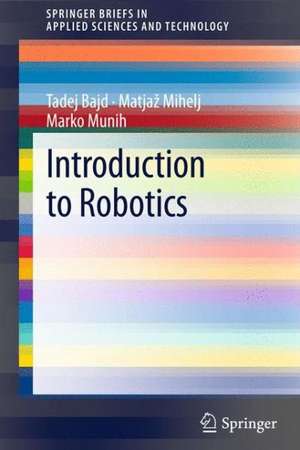
Introduction to Robotics: SpringerBriefs in Applied Sciences and Technology
Autor Tadej Bajd, Matja¿ Mihelj, Marko Munihen Limba Engleză Paperback – 19 mar 2013
Din seria SpringerBriefs in Applied Sciences and Technology
-
 Preț: 312.71 lei
 -
 Preț: 379.02 lei
 - 20%
 Preț: 326.97 lei
 -
 Preț: 378.77 lei
 -
 Preț: 470.50 lei
 -
 Preț: 382.08 lei
 -
 Preț: 429.04 lei
 -
 Preț: 382.68 lei
 -
 Preț: 380.26 lei
 - 20%
 Preț: 324.90 lei
 -
 Preț: 336.26 lei
 -
 Preț: 393.96 lei
 -
 Preț: 334.91 lei
 -
 Preț: 262.20 lei
 -
 Preț: 334.09 lei
 -
 Preț: 265.02 lei
 -
 Preț: 383.67 lei
 -
 Preț: 382.68 lei
 -
 Preț: 379.58 lei
 -
 Preț: 461.36 lei
 - 20%
 Preț: 226.91 lei
 -
 Preț: 363.26 lei
 -
 Preț: 385.41 lei
 -
 Preț: 391.30 lei
 -
 Preț: 396.35 lei
 -
 Preț: 332.21 lei
 -
 Preț: 379.88 lei
 -
 Preț: 251.49 lei
 -
 Preț: 330.32 lei
 - 5%
 Preț: 354.23 lei
 -
 Preț: 398.15 lei
 -
 Preț: 334.09 lei
 -
 Preț: 366.64 lei
 - 20%
 Preț: 286.05 lei
 -
 Preț: 333.81 lei
 -
 Preț: 378.48 lei
 -
 Preț: 382.08 lei
 -
 Preț: 369.31 lei
 -
 Preț: 333.28 lei
 -
 Preț: 381.54 lei
 -
 Preț: 400.85 lei
 -
 Preț: 379.88 lei
 -
 Preț: 378.48 lei
 -
 Preț: 379.31 lei
 - 20%
 Preț: 314.65 lei
 - 20%
 Preț: 326.02 lei
 -
 Preț: 413.73 lei
 -
 Preț: 368.70 lei
 - 15%
 Preț: 476.02 lei
 -
 Preț: 376.86 lei
Preț: 378.30 lei
Puncte Express: 567
Carte tipărită la comandă
Livrare economică 27 noiembrie-11 decembrie
Livrare prin curier în România Termenul estimat este afișat lângă disponibilitate.
Transport gratuit de la 400.00 lei Plată online sau ramburs, în funcție de opțiunile comenzii.
Retur gratuit în 14 zile Comandă securizată și suport în română.
Specificații
ISBN-13: 9789400761001
ISBN-10: 9400761007
Pagini: 92
Ilustrații: VII, 83 p. 42 illus.
Dimensiuni: 155 x 235 x 6 mm
Greutate: 0.15 kg
Ediția:2013
Editura: Springer
Colecția SpringerBriefs in Applied Sciences and Technology
Seria SpringerBriefs in Applied Sciences and Technology
Locul publicării:Dordrecht, Netherlands
ISBN-10: 9400761007
Pagini: 92
Ilustrații: VII, 83 p. 42 illus.
Dimensiuni: 155 x 235 x 6 mm
Greutate: 0.15 kg
Ediția:2013
Editura: Springer
Colecția SpringerBriefs in Applied Sciences and Technology
Seria SpringerBriefs in Applied Sciences and Technology
Locul publicării:Dordrecht, Netherlands
V-ar putea interesa
-
 Arduino Robot BonanzaGordon McComb-38%Preț: 210.57 lei339.85 lei
 -
 Robotics: A Very Short IntroductionAlan Winfield-20%Preț: 57.12 lei71.12 lei
 -
 The Technological SingularityMurray Shanahan-21%Preț: 97.48 lei122.92 lei
 -
 Optimal ControlFrank L Lewis-9%Preț: 992.25 lei1090.39 lei
 -
 Practical Field RoboticsSturges-8%Preț: 636.53 lei691.87 lei
 -
 Human-Robot Interaction in Social RoboticsTakayuki Kanda-18%Preț: 1611.04 lei1964.69 lei
 -
 Parallel Robots: Mechanics and ControlHamid D. Taghirad-20%Preț: 1784.20 lei2230.26 lei
 -
 Process Control: Problems, Techniques and ApplicationsSamuel P. Werther-27%Preț: 1165.46 lei1585.77 lei
 -
 Robotics ResearchMakoto Kaneko-18%Preț: 1279.12 lei1559.91 lei
 -
 -18%Preț: 1773.44 lei2162.72 lei
 -
 -18%Preț: 1186.11 lei1446.49 lei
 -
 On-Line Trajectory Generation in Robotic SystemsTorsten Kröger-18%Preț: 946.33 lei1154.07 lei
 -
 Semantic Labeling of Places with Mobile RobotsÓscar Martinez Mozos-20%Preț: 615.72 lei769.65 lei
 -
 -20%Preț: 621.70 lei777.12 lei
 -
 Virtual Decomposition ControlWen-Hong Zhu-18%Preț: 957.96 lei1168.24 lei
 -
 RoboticsTadej BajdPreț: 389.73 lei
 -
 RoboticsTadej BajdPreț: 369.64 lei
 -
 Virtual Reality Technology and ApplicationsMatja¿ Mihelj-18%Preț: 750.58 lei915.34 lei
 -
 Robot MechanismsJadran LenarcicPreț: 394.22 lei
Public țintă
ResearchCuprins
1 Introduction.- 2 Rotation and Orientation.- 3 Pose and Displacement.-
4 Geometric Robot Model.- 5 Geometric Model of Anthropomorphic Robot with Spherical Wrist.- Index.
4 Geometric Robot Model.- 5 Geometric Model of Anthropomorphic Robot with Spherical Wrist.- Index.
Recenzii
From the reviews:
“Bajd, Mihelj, and Munih … provide illustrations of robot movement for a quick understanding of the topic. … The authors illustrate theory with detailed examples, understandable to beginners in the field and a useful refresher for those better versed in the technology. Overall, it is a succinct primer on robotic kinematics that could serve as a ‘CliffsNotes’-type companion to any introductory robotics movement course geared toward developing applied engineering sensibility in learners who are mathematically proficient. Summing Up: Recommended. Lower- and upper-division undergraduates; professionals/practitioners.” (G. Trajkovski, Choice, Vol. 51 (2), October, 2013)
“Bajd, Mihelj, and Munih … provide illustrations of robot movement for a quick understanding of the topic. … The authors illustrate theory with detailed examples, understandable to beginners in the field and a useful refresher for those better versed in the technology. Overall, it is a succinct primer on robotic kinematics that could serve as a ‘CliffsNotes’-type companion to any introductory robotics movement course geared toward developing applied engineering sensibility in learners who are mathematically proficient. Summing Up: Recommended. Lower- and upper-division undergraduates; professionals/practitioners.” (G. Trajkovski, Choice, Vol. 51 (2), October, 2013)
Textul de pe ultima copertă
This book is focused on geometrical models of robot mechanisms. Rotation and orientation of an object are described by Rodrigues's formula, rotation matrix and quaternions. Pose and displacement of an object are mathematically dealt with homogenous transformation matrices. The geometrical robot model is based on Denavit Hartenberg parameters. Direct and inverse model of six degrees of freedom anthropomorphic industrial robots are also presented.
Caracteristici
Compact presentation of spatial transformations Numerous original examples Direct and inverse models of real industrial robots Includes supplementary material: sn.pub/extras
Notă biografică
Matja Mihelj (Ph.D., University of Ljubljana, 2002) is a Full Professor at the University of Ljubljana. His research interests are in human-robot interaction, rehabilitation robotics, and wearable sensors. He has authored or coauthored over 40 journal publications and 9 monographs, and holds 3 patents. His contributions have been recognized with several national and international awards.
Tadej Bajd (Ph.D., University of Ljubljana, 1979) is President of the Slovenian Academy of Sciences and Arts, a Professor Emeritus at the University of Ljubljana, and a Fellow of the IEEE, AIMBE, and EAMBES. He is a member of the European Academy of Sciences and Arts and Slovenian Academy of Engineering. He is the author or coauthor of over 100 journal papers and several monographs.
Jadran Lenar¿i¿ (Ph.D., University of Ljubljana, 1986) is currently Director of the J. Stefan Institute, Ljubljana. His basic research interests include robotics, robot kinematics, biorobotics and humanoid robotics. He has edited a series of books on Advances in Robot Kinematics, and is a member of both the Slovenian Academy of Engineering and Accademia delle scienze di Bologna.
Ale Ude (Ph.D., University of Karlsruhe, 1995) is Head of the Department of Automatics, Biocybernetics, and Robotics at J. Stefan Institute, Ljubljana, and an Associate Professor at the University of Ljubljana. His research interests include robot sensorimotor learning, robot vision, humanoid robotics, and cognition.
Ale Stanovnik, (Ph.D., University of Ljubljana, 1980) is a Professor Emeritus of Physics with the University of Ljubljana. His research chiefly focused on experimental nuclear and particle physics. He is the author of a physics textbook and author or coauthor of more than 80 papers in scientific journals.
Sebastjan lajpah (Ph.D., University of Ljubljana, 2015) is a Teaching Assistant for courses in the fields of robotics, robot control, and human-robot interaction. Hisresearch is focused on wearable sensors, haptics, collaborative robotics, and robot control.
Jure Rejc (Ph.D., University of Ljubljana, 2008) is a researcher and Teaching Assistant for robotics and embedded systems. In addition, he works to develop robot-based applications and solutions for high-precision industrial measurements.
Marko Munih (Ph.D., University of Ljubljana, 1993) is a Full Professor and Head of the Robolab at the University of Ljubljana. His research is focused on robots in interaction and haptic interfaces, as well as robots in construction and measurement work. He has authored or coauthored 120 peer-reviewed journal articles and 4 textbooks, and holds 5 patents.