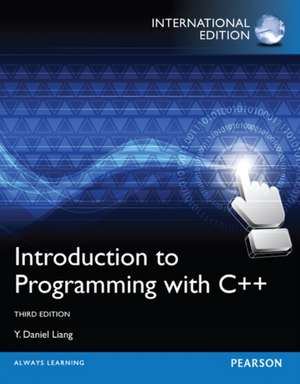
Introduction to Programming with C++
Autor Y. Liangen Limba Engleză Paperback – 2 mai 2013
Ne-a atras atenția în mod deosebit metodologia didactică aplicată în Introduction to Programming with C++, o lucrare ce prioritizează arhitectura logică în detrimentul memorării sintaxei. Considerăm că abordarea de tip 'fundamentals-first' este esențială pentru formarea unei gândiri structurate; autorul Y. Liang ghidează cititorul prin mecanismele de control, bucle și tablouri înainte de a introduce complexitatea programării orientate pe obiecte. Această succesiune garantează că fundamentele de logică sunt bine consolidate înainte de a trece la gestiunea dinamică a memoriei sau la polimorfism.
Organizarea volumului este riguroasă, fiind împărțită în trei secțiuni majore. Prima parte pune bazele C++, a doua explorează clasele, pointerii și tratarea excepțiilor, în timp ce a treia parte avansează spre structuri de date complexe și algoritmi. Ca și Tony Gaddis în Starting Out with C++ from Control Structures to Objects, autorul distilează experiența reală în principii acționabile, folosind exemple de cod scurte și diagrame sugestive care transformă conceptele abstracte în soluții tehnice vizibile.
Această a treia ediție păstrează rigoarea pedagogică regăsită și în celelalte lucrări ale autorului, precum Introduction to Python Programming and Data Struct sau Introduction to Java Programming and Data Structures, Global Edition. La fel ca în textele sale dedicate limbajelor Java și Python, Y. Liang menține un stil de scriere concis, axat pe rezolvarea problemelor, pregătind terenul pentru dezvoltarea de aplicații gata de producție. Capitolele bonus despre containerele și algoritmii STL (Standard Template Library) fac legătura directă cu nevoile actuale din industria software.
Preț: 636.39 lei
Preț vechi: 731.48 lei
-13%
Carte disponibilă
Livrare economică 12-26 noiembrie
Livrare express 29 octombrie-04 noiembrie pentru 62.48 lei
Specificații
ISBN-10: 0273793241
Pagini: 720
Dimensiuni: 252 x 203 x 38 mm
Greutate: 1.27 kg
Ediția:3 ed
Editura: Pearson Education
V-ar putea interesa
-
 C++ Ht Program 7/EPaul Deitel-23%Preț: 1391.62 lei1807.29 lei
 -
 -23%Preț: 1242.27 lei1613.34 lei
 -
 A Tour of C++Bjarne Stroustrup-20%Preț: 226.86 lei283.58 lei
 -
 C++ in One Hour a Day, Sams Teach YourselfSiddhartha Rao-20%Preț: 278.04 lei347.55 lei
 -
 -20%Preț: 588.01 lei735.01 lei
 -
 -20%Preț: 306.44 lei383.05 lei
 -
 C++ PrimerStanley B. Lippman-20%Preț: 393.23 lei491.53 lei
 -
 Programming with C++Kyla McMullen-23%Preț: 626.41 lei811.40 lei
 -
 C++ in 24 Hours, Sams Teach YourselfRogers Cadenhead-20%Preț: 184.48 lei230.60 lei
 -
 Rao, S: C++ in One Hour a Day, Sams Teach YourselfSiddhartha Rao-20%Preț: 239.24 lei299.05 lei
 -
 C++ All-in-One For DummiesJohn Paul Mueller-20%Preț: 227.58 lei284.48 lei
 -
 Mock, K: Absolute C++, Global EditionKenrick Mock-9%Preț: 617.74 lei678.83 lei
 -
 -20%Preț: 537.80 lei672.24 lei
 -
 C++ How to Program, Global EditionPaul Deitel-20%Preț: 496.44 lei620.55 lei
 -
 C++ ProgrammingD. Malik-20%Preț: 650.92 lei813.64 lei
 -
 C++ ProgrammingD. Malik-21%Preț: 660.74 lei839.02 lei
 -
 C++ Essentials for DummiesJohn Paul Mueller-20%Preț: 65.48 lei81.85 lei
 -
 BEGINNING C++ THROUGH GAME-3EMichael Dawson-22%Preț: 379.53 lei484.04 lei
 -
 C++ Programming in Easy StepsMike Mcgrath-20%Preț: 92.33 lei115.41 lei
De ce să citești această carte
Recomandăm această carte studenților și programatorilor aflați la început de drum care doresc să înțeleagă nu doar 'cum' să scrie cod, ci și 'de ce' funcționează acesta. Prin parcurgerea celor 720 de pagini, cititorul câștigă o bază solidă în C++, învățând să construiască algoritmi eficienți și componente reutilizabile, elemente critice pentru orice carieră în dezvoltare software.
Cuprins
Descriere scurtă
A solid foundation in the basics of C++ programming will allow students to create efficient, elegant code ready for any production environment.
Learning basic logic and fundamental programming techniques is essential for new programmers to succeed. A distinctive fundamentals-first approach and clear, concise writing style characterize Introduction to Programming with C++, 3/e. Basic programming concepts are introduced on control statements, loops, functions, and arrays before object-oriented programming is discussed. Abstract concepts are carefully and concretely explained using simple, short, and stimulating examples. Explanations are presented in brief segments, with many figures and tables.
NEW! This edition is available with MyProgrammingLab, an innovative online homework and assessment tool. Through the power of practice and immediate personalized feedback, MyProgrammingLab helps students fully grasp the logic, semantics, and syntax of programming.
Note: If you are purchasing the standalone text or electronic version, MyProgrammingLab does not come automatically packaged with the text. To purchase MyProgrammingLab, please visit: myprogramminglab.com or you can purchase a package of the physical text + MyProgrammingLab by searching the Pearson Higher Education web site. MyProgrammingLab is not a self-paced technology and should only be purchased when required by an instructor.
Teaching and Learning Experience
To provide a better teaching and learning experience, for both instructors and students, this program offers:
- Fundamentals-First: Basic programming concepts are introduced on control statements, loops, functions, and arrays before object-oriented programming is discussed.
- Problem-Driven Motivation: The examples and exercises throughout the book emphasize problem solving and foster the concept of developing reusable components and using them to create practical projects.
- Support for Instructors and Students: The author maintains a website at http://www.cs.armstrong.edu/liang/cpp3e that includes multiple interactive resources.