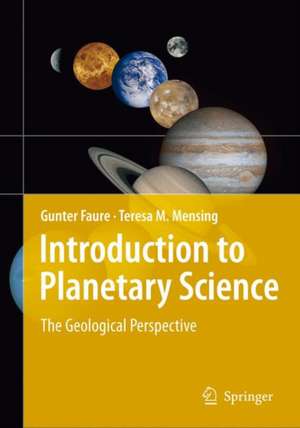
Introduction to Planetary Science
Autor Gunter Faure, Teresa M. Mensingen Limba Engleză Hardback – 12 apr 2007
Remarcăm în Introduction to Planetary Science o abordare riguros interdisciplinară care reușește să unifice ramuri ale științelor Pământului, adesea predate separat, sub cupola explorării sistemului solar. Lucrarea semnată de Gunter Faure și Teresa M. Mensing utilizează fundamentul geologiei terestre ca model de analiză pentru restul planetelor, facilitând o tranziție fluidă între astronomie, fizică și chimie. Ediția publicată de Springer este structurată în 24 de capitole ce urmăresc o progresie logică: de la bazele istorice și metoda științifică, trecând prin geneza stelelor, până la analiza detaliată a fiecărei planete și a sateliților lor naturali. Subliniem faptul că autorul Gunter Faure își aduce în această lucrare vasta experiență din volumele sale anterioare, precum Isotopes sau Origin of Igneous Rocks. Dacă în acele lucrări se concentra pe geochimia izotopilor și formarea rocilor pe Terra, în titlul de față extinde aceste concepte la scară cosmică, explicând compoziția meteoriților și evoluția planetei Venus sau a sateliților galileeni. Cartea completează perspectiva oferită de Planetary Geoscience de Jr Harry Y. McSween, adăugând o componentă istorică mai solidă și un accent sporit pe mecanica cerească, în timp ce McSween rămâne focalizat precumpănitor pe procesele geologice comparate. Structura este echilibrată, dedicând spații ample nu doar giganților gazoși, ci și corpurilor mici precum asteroizii, cometele și obiectele din centura Kuiper. Finalul tratatului este dedicat exoplanetelor și piticilor maro, ancorând cursul în realitatea cercetării contemporane. Stilul editorial este unul tehnic, specific nivelului universitar, dar îmbogățit cu „scientific briefs” care fac legătura între teorie și datele brute obținute din misiunile NASA.
Preț: 887.61 lei
Preț vechi: 1082.45 lei
-18%
Carte tipărită la comandă
Livrare economică 30 noiembrie-14 decembrie
Specificații
ISBN-10: 1402052332
Pagini: 548
Ilustrații: XX, 526 p.
Dimensiuni: 183 x 260 x 38 mm
Greutate: 1.28 kg
Ediția:2007
Editura: Springer
Locul publicării:Dordrecht, Netherlands
V-ar putea interesa
-
 15 Million DegreesLucie Green-20%Preț: 74.83 lei92.98 lei
 -
 What If the Earth Had Two Moons?Neil F. CominsPreț: 128.99 lei
 -
 Isotopes - Principles and Applications 3eGunter Faure-23%Preț: 1174.24 lei1524.98 lei
 -
 Lifting Titan's VeilRalph Lorenz-11%Preț: 442.65 lei497.36 lei
 -
 The Martian SurfaceJim Bell-14%Preț: 1087.13 lei1264.11 lei
 -
 The Surface of MarsMichael H. Carr-14%Preț: 1325.37 lei1541.14 lei
 -
 The Art Of TimingJohanna PaunggerPreț: 123.20 lei
 -
 Nearest StarLeon GolubPreț: 271.33 lei
 -
 Magnetotails in the Solar SystemAndreas Keiling-23%Preț: 1084.86 lei1408.90 lei
 -
 Guidebook to the ConstellationsPhil SimpsonPreț: 413.66 lei
 -
 The Hatfield Lunar AtlasAnthony Cook-15%Preț: 462.73 lei544.39 lei
Public țintă
GraduateDe ce să citești această carte
Recomandăm această lucrare studenților și profesioniștilor din geologie și astronomie care doresc să înțeleagă sistemul solar ca pe un sistem integrat. Cititorul câștigă o viziune unitară asupra modului în care procesele fizico-chimice modelează suprafețele planetare. Este resursa ideală pentru cei care vor să aplice cunoștințele de geologie terestră în contextul explorării spațiale actuale, oferind un aparat teoretic solid și date actualizate despre evoluția planetară.
Descriere scurtă
The subject matter is presented in 24 chapters that lead the reader through the solar system starting with historical perspectives on space exploration and the development of the scientific method. The presentations concerning the planets and their satellites emphasize that their origin and subsequent evolution can be explained by applications of certain basic principles of physics, chemistry, and celestial mechanics and that the surface features of the solid bodies in the solar system can be interpreted by means of the principles of geology.
Cuprins
Recenzii
"The authors … have produced a book that is remarkably up to date, nicely illustrated, and written in an engaging style. An especially effective touch us that each chapter ends with one or more scientific briefs … . presents an abundance of fascinating information about our cosmic neighborhood, in a form that is readily accessible to students majoring in Earth science. This text will significantly improve teaching and learning about planetary geoscience, and I will be using it for my own undergraduate course … ."
(Hap McSween, Elements, Vol. 4 (1), 2008)
"This book should be used as the basis for a capstone course for senior undergraduates and beginning graduate students majoring in the Earth sciences. … The book is fairly well up to date in terms of discoveries … . Positive points about the book include clear and abundant illustrations and a well-chosen reference list at the end of each chapter. … well-bound and well-illustrated book. … is comprehensive and balanced in its coverage of bodies in the solar system."
(David A. Rothery, Eos, Vol. 89 (15), 2008)
"When I was asked to review this textbook, I immediately said yes. I expected that I would enjoy reading the book and that I would undoubtedly learn from it either new facts or methods of presenting facts and their interpretation to students. I was not disappointed; in fact, I was delighted. The book captures the essence of modern planetary science in 24 chapters. The chapters do not overload the reader with an abundance of factual details and their interpreatations but instead present issues at a level that can be clearly understood by majors and nonmajors alike but without compromising the science. The book is clearly excellent - if not outstanding - for use in a course for nonmajors, and I highly recommend it. ... The book is not organized in what I consider to be a classic approach, which is actually a delightful change,and it works very well. In addition, the "science briefs" at the ends of chapters are a wonderful affirmation of each theme. Overall, the book is excellent."
(Harold C. Connolly Jr, The Journal of Geology, Vol. 116, p. 313, 2008)
"Introduction to Planetary Sciences – the Geological Perspective … is the brain-child of Gunter Faure and Theresa M. Mensing. … this text not only helps me to acquire new teaching material for my lecture classes, but also exposes me to the latest cosmologic discoveries, told from a geologic point of view. … . It is the authors’ unique ability to intertwine a strong dose of geology, with planetary science, in an easy to understand presentation, that generates the appeal of this book."
(Joseph F. Born Jr., American Association of Petroleum Geologists, Vol. 92 (5), May, 2008)
"A fascinating look at the worlds of our Solar System.
In this excellent textbook, Faure and Mensing succinctly and clearly describe what our Solar System is made of and how it works. Each planet is described in detail-its geology, history, satellites, chemistry, and orbital mechanics. The latest planetary knowledge is presented, and the book is very up-to-date on the latest developments in planetary science, with plenty of new information gleaned from the Hubble Space Telescope and the Cassini Probe. Principles of physics, chemistry, and geology as they pertain to the planets and their celestial mechanics are presented and every chapter is very well-written, clear, and fascinating.
The excellent text is complemented by many brilliant and fascinating pictures in every chapter, including new pictures of the surface of Titan from the Cassini Probe. The high quality of the pictures was a major factor which induced me to buy this book!
I would recommend this as a textbook for a geology class, and for anyone at all who has at least a basic background in science and wants to know more about theother worlds in our solar system and how they operate. It's not a cheap book but it's worth every penny."
(Gordon Trunk, Minneapolis, MN, USA, December 11, 2008)
“This book is a comprehensive review of the current knowledge of planetary sciences. … The book is best suited for upper division undergraduate students and for beginning graduate students. … a reference book on planetary sciences that will serve well the shelves of all Earth scientists. … Due to its holistic and complete approach of the Universe and the Earth’s place within the Universe, this book will benefit not only people involved in the planetary sciences but also all those involved in Earth Sciences.” (Susana Custódio, Pure and Applied Geophysics, Vol. 166, 2009)
Textul de pe ultima copertă
The subject matter is presented in 24 chapters that lead the reader through the solar system starting with historical perspectives on space exploration and the development of the scientific method. The presentations concerning the planets and their satellites emphasize that their origin and subsequent evolution can be explained by applications of certain basic principles of physics, chemistry, and celestial mechanics and that the surface features of the solid bodies in the solar system can be interpreted by means of the principles of geology.
- Organized in a hierarchical manner so that every chapter builds on preceding ones
- Abundantly illustrated with diagrams and color images
- Includes problem sets and a glossary