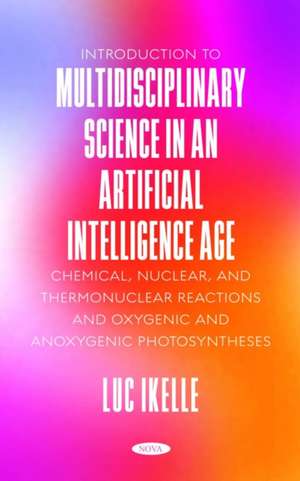
Introduction to Multidisciplinary Science in an Artificial-Intelligence Age: Chemical, Nuclear, and Thermonuclear Reactions, and Oxygenic and Anoxygenic Photosyntheses
Autor Luc Ikelleen Limba Engleză Hardback – 2 feb 2023
Preț: 1112.81 lei
Preț vechi: 1497.56 lei
-26%
Puncte Express: 1669
Carte disponibilă
Livrare economică 03-17 noiembrie
Livrare prin curier în România Termenul estimat este afișat lângă disponibilitate.
Transport gratuit pentru acest produs Plată online sau ramburs, în funcție de opțiunile comenzii.
Retur gratuit în 14 zile Comandă securizată și suport în română.
Specificații
ISBN-13: 9798886970487
Pagini: 410
Dimensiuni: 152 x 229 mm
Greutate: 0.72 kg
Editura: Nova
Colecția nova
Locul publicării:United States
Pagini: 410
Dimensiuni: 152 x 229 mm
Greutate: 0.72 kg
Editura: Nova
Colecția nova
Locul publicării:United States
Descriere
Descriere de la o altă ediție sau format:
The challenges of our time such as improving the length and quality of lives on Earth, improving short- and long- distance communication and transportation, predicting, adapting to, and mitigating natural hazards, and exploring space to improve our lives on Earth and for the survival of our civilization, transcend the current college curriculums or programs. The breadth of these challenges suggests that instead of splintering science education into endless disciplines, we should expose young minds to multidisciplinary science. Modern technology developments and scientific advances have already adopted cross-fertilization of science disciplines. In this book, we aim to provide young minds with the multidisciplinary education necessary to meet the scientific and technological challenges of our time. Chapter 1 gives an overview of the Earth, our solar system, and our universe. It also describes the early Earth’s atmosphere, the occurrence of oxygen in our atmosphere and carbon-based life on Earth, and some of the past mass-extensions on Earth. In the next two chapters we introduce, with significant details, some of the core fundamental notions that underpin modern science and engineering education and scientific training. These notions are (1) organic and inorganic matter, (2) radiative matter, (3) chemical bonds, (4) molecular vibrations, (5) living things, (6) DNA and RNA, (7) rock type and rock cycle, (8) rock weathering, (9) geologic hotspots, (10) geologic faults, (11) earthquakes and volcanoes, and (12) mantle convection. We then illustrate, with applications across disciplines, the importance of these notions in our lives and in understanding the world around us. Some of these applications have to do with the origin of chemical elements and of a significant number of molecules, the structures and compositions of biological cells, cell reproduction mechanisms, genetics and gene mutations, gene manipulation, the origin of the first biological cells, plate tectonics in our solar system, prediction of large earthquakes in Chile and Japan, and conventional and unconventional energy resources. No chapter is divided into biology, chemistry, and physics. We define and motivate the importance of a topic or problem. Then we address it, both qualitatively and quantitatively, starting with basic principles followed by a series of applications. The book contains analytical problems, as well as computational problems, that include MATLAB software developed especially for the classes associated with this book. In Chapter 3, an essay on a topic of considerable broad interest and debate is discussed at the end of this chapter. This essay is based on the background developed in this book. It may help students and readers see how the background that they have acquired plays a central role in understanding and addressing the major scientific and technological questions of our times.
The challenges of our time such as improving the length and quality of lives on Earth, improving short- and long- distance communication and transportation, predicting, adapting to, and mitigating natural hazards, and exploring space to improve our lives on Earth and for the survival of our civilization, transcend the current college curriculums or programs. The breadth of these challenges suggests that instead of splintering science education into endless disciplines, we should expose young minds to multidisciplinary science. Modern technology developments and scientific advances have already adopted cross-fertilization of science disciplines. In this book, we aim to provide young minds with the multidisciplinary education necessary to meet the scientific and technological challenges of our time. Chapter 1 gives an overview of the Earth, our solar system, and our universe. It also describes the early Earth’s atmosphere, the occurrence of oxygen in our atmosphere and carbon-based life on Earth, and some of the past mass-extensions on Earth. In the next two chapters we introduce, with significant details, some of the core fundamental notions that underpin modern science and engineering education and scientific training. These notions are (1) organic and inorganic matter, (2) radiative matter, (3) chemical bonds, (4) molecular vibrations, (5) living things, (6) DNA and RNA, (7) rock type and rock cycle, (8) rock weathering, (9) geologic hotspots, (10) geologic faults, (11) earthquakes and volcanoes, and (12) mantle convection. We then illustrate, with applications across disciplines, the importance of these notions in our lives and in understanding the world around us. Some of these applications have to do with the origin of chemical elements and of a significant number of molecules, the structures and compositions of biological cells, cell reproduction mechanisms, genetics and gene mutations, gene manipulation, the origin of the first biological cells, plate tectonics in our solar system, prediction of large earthquakes in Chile and Japan, and conventional and unconventional energy resources. No chapter is divided into biology, chemistry, and physics. We define and motivate the importance of a topic or problem. Then we address it, both qualitatively and quantitatively, starting with basic principles followed by a series of applications. The book contains analytical problems, as well as computational problems, that include MATLAB software developed especially for the classes associated with this book. In Chapter 3, an essay on a topic of considerable broad interest and debate is discussed at the end of this chapter. This essay is based on the background developed in this book. It may help students and readers see how the background that they have acquired plays a central role in understanding and addressing the major scientific and technological questions of our times.