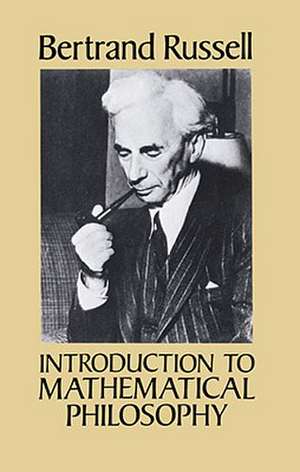
Introduction to Mathematical Philosophy
Autor Bertrand Russellen Limba Engleză Paperback – 14 sep 1993
In dealing with such topics as number, order, relations, limits and continuity, propositional functions, descriptions, and classes, Russell writes in a clear, accessible manner, requiring neither a knowledge of mathematics nor an aptitude for mathematical symbolism. The result is a thought-provoking excursion into the fascinating realm where mathematics and philosophy meet a philosophical classic that will be welcomed by any thinking person interested in this crucial area of modern thought."
Preț: 72.12 lei
Puncte Express: 108
Carte disponibilă
Livrare economică 10-24 noiembrie
Livrare prin curier în România Termenul estimat este afișat lângă disponibilitate.
Transport gratuit de la 400.00 lei Plată online sau ramburs, în funcție de opțiunile comenzii.
Retur gratuit în 14 zile Comandă securizată și suport în română.
Specificații
ISBN-13: 9780486277240
ISBN-10: 0486277240
Pagini: 224
Dimensiuni: 138 x 215 x 12 mm
Greutate: 0.23 kg
Editura: Dover Publications
ISBN-10: 0486277240
Pagini: 224
Dimensiuni: 138 x 215 x 12 mm
Greutate: 0.23 kg
Editura: Dover Publications
V-ar putea interesa
-
 Schaum's Outline of Complex Variables, 2edMurray Spiegel-13%Preț: 214.88 lei248.34 lei
 -
 Riemann SurfacesSimon Donaldson-33%Preț: 820.82 lei1219.67 lei
 -
 Quasiconformal Maps and Teichmüller TheoryAlastair Fletcher-30%Preț: 817.83 lei1170.42 lei
 -
 Riemann SurfacesSimon Donaldson-21%Preț: 373.46 lei473.87 lei
 -
 Problems and Solutions for Complex AnalysisRami Shakarchi-15%Preț: 471.95 lei555.23 lei
 -
 Freedom and Organisation, 1814-1914Bertrand RussellPreț: 380.14 lei
 -
 Fact and FictionBertrand RussellPreț: 251.74 lei
 -
 Complex AnalysisElias M. Stein-16%Preț: 656.05 lei781.02 lei
 -
 The Conquest of HappinessBertrand RussellPreț: 91.74 lei
 -
 The Impact of Science on SocietyBertrand RussellPreț: 171.40 lei
 -
 -18%Preț: 773.31 lei943.07 lei
 -
 Lectures on Several Complex VariablesPaul M. Gauthier-15%Preț: 542.88 lei638.68 lei
 -
 Preț: 392.46 lei
 -
 -18%Preț: 766.12 lei934.30 lei
 -
 Harmonic Analysis on Exponential Solvable Lie GroupsHidenori Fujiwara-15%Preț: 679.69 lei799.63 lei
 -
 Preț: 404.88 lei
Descriere
Work focuses on concepts of number, order, relations, limits and continuity, propositional functions, descriptions and classes, more.
Notă biografică
Bertrand Russell, (18 May 1872 - 2 February 1970) was a British philosopher, logician, mathematician, historian, writer, essayist, social critic, political activist, and Nobel laureate. At various points in his life, Russell considered himself a liberal, a socialist and a pacifist, although he also confessed that his sceptical nature had led him to feel that he had "never been any of these things, in any profound sense. Russell was born in Monmouthshire into one of the most prominent aristocratic families in the United Kingdom In the early 20th century, Russell led the British "revolt against idealism" He is considered one of the founders of analytic philosophy along with his predecessor Gottlob Frege, colleague G. E. Moore and protégé Ludwig Wittgenstein. He is widely held to be one of the 20th century's premier logicians.[67] With A. N. Whitehead he wrote Principia Mathematica, an attempt to create a logical basis for mathematics, the quintessential work of classical logic. His philosophical essay "On Denoting" has been considered a "paradigm of philosophy".[71] His work has had a considerable influence on mathematics, logic, set theory, linguistics, artificial intelligence, cognitive science, computer science (see type theory and type system) and philosophy, especially the philosophy of language, epistemology and metaphysics. Russell was a prominent anti-war activist and he championed anti-imperialism. Occasionally, he advocated preventive nuclear war, before the opportunity provided by the atomic monopoly had passed and he decided he would "welcome with enthusiasm" world government.[74] He went to prison for his pacifism during World War I. Later, Russell concluded that war against Adolf Hitler's Nazi Germany was a necessary "lesser of two evils" and criticised Stalinist totalitarianism, attacked the involvement of the United States in the Vietnam War and was an outspoken proponent of nuclear disarmament. In 1950, Russell was awarded the Nobel Prize in Literature "in recognition of his varied and significant writings in which he champions humanitarian ideals and freedom of thought"
Cuprins
Foreword to the Routledge Classics Edition Michael Potter Preface 1. The Series of Natural Numbers 2. Definition of Number 3. Finitude and Mathematical Induction 4. The Definition of Order 5. Kinds of Relations 6. Similarity of Relations 7. Rational, Real, and Complex Numbers 8. Infinite Cardinal Numbers 9. Infinite Series and Ordinals 10. Limits and Continuity 11. Limits and Continuity of Functions 12. Selections and the Multiplicative Axiom 13. The Axiom of Infinity and Logical Types 14. Incompatibility and the Theory of Deduction 15. Propositional Functions 16. Descriptions 17. Classes 18. Mathematics and Logic. Index