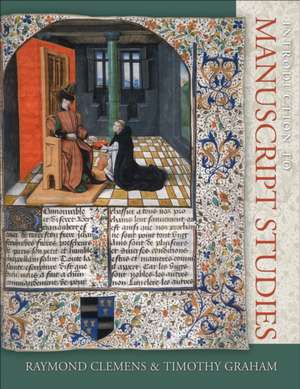
Introduction to Manuscript Studies
Autor Raymond Clemens, Timothy Grahamen Limba Engleză Paperback – 15 ian 2008
Organizată metodic pentru a facilita progresia de la obiectul fizic la înțelesul abstract, Introduction to Manuscript Studies ne propune o structură în trei piloni: procesul de producție (de la prepararea pergamentului la legătorie), tehnicile de descifrare și catalogare, și o analiză a genurilor consacrate. Descoperim aici un parcurs care nu omite dificultatea tehnică, abordând citirea textelor afectate de apă, foc sau insecte, dar și timpul necesar pentru a stăpâni paleografia prin studiul celor șaisprezece tipuri de scriere prezentate. Putem afirma că lucrarea transformă un domeniu arid într-o experiență vizuală vibrantă, grație planșelor color provenite din biblioteci de prestigiu precum Newberry Library. Fanii volumului The Medieval Manuscript Book vor recunoaște aceeași atenție la contextul cultural al obiectului, aplicată aici într-un format de manual care pune accent pe instrumentele practice de lucru. În timp ce Raymond Clemens a explorat misterul pur în The Voynich Manuscript, aici autorul revine la rigoarea academică, oferind o bază solidă pentru studenții de la istorie, litere sau teologie. Cartea acoperă tot spectrul necesar cercetării, de la rubricație și adnotări până la studiul cartularelor și al hărților medievale. Este, în esență, un ghid care ne învață cum să privim un codex nu doar ca pe un text, ci ca pe un artefact tehnologic complex, produs într-o eră pre-tipar.
Preț: 351.14 lei
Carte disponibilă
Livrare economică 02-16 septembrie
Livrare express 18-22 august pentru 89.45 lei
Specificații
ISBN-10: 0801487080
Pagini: 320
Ilustrații: 150
Dimensiuni: 230 x 308 x 29 mm
Greutate: 1.5 kg
Editura: Cornell University Press
V-ar putea interesa
-
 The Book of KellsBen Mackworth-Praed-20%Preț: 45.37 lei56.79 lei
 -
 -24%Preț: 127.28 lei167.69 lei
 -
 Ghosts of HomeMarianne HirschPreț: 245.13 lei
 -
 Evolution's BitePeter UngarPreț: 159.06 lei
 -
 Women in the War ZoneAnne Powel-14%Preț: 133.88 lei156.04 lei
 -
 Library Security: Better Communication, Safer FacilitiesSteve AlbrechtPreț: 412.14 lei
 -
 So You Want to Be an Academic Library DirectorColleen S. HarrisPreț: 431.19 lei
 -
 Advanced Penetration TestingWil Allsopp-20%Preț: 249.11 lei311.39 lei
 -
 Preț: 304.58 lei
 -
 Risk and Reliability in Geotechnical EngineeringKok-Kwang Phoon-18%Preț: 735.95 lei897.50 lei
 -
 -21%Preț: 369.65 lei466.16 lei
 -
 Last Judgment Iconography in the CarpathiansJohn-Paul HimkaPreț: 356.04 lei
 -
 Historical Dictionary of Unitarian UniversalismMark W. Harris-36%Preț: 861.86 lei1348.05 lei
 -
 Preț: 151.98 lei
 -
 Paper Politics: Socially Engaged Printmaking TodayJosh Macphee-31%Preț: 132.88 lei192.83 lei
 -
 Into the Carpathians: The Eastern Mountains)Alan E. SparksPreț: 172.53 lei
 -
 The Civic Foundations of Fascism in EuropeDylan RileyPreț: 205.77 lei
 -
 Danube a Cultural HistoryAndrew BeattiePreț: 103.14 lei
 -
 -9%Preț: 311.88 lei343.41 lei
 -
 Preț: 39.01 lei
De ce să citești această carte
Recomandăm această carte oricărui pasionat de istoria cărții sau student în științe umaniste care dorește să treacă de la admirația estetică la analiza critică. Cititorul câștigă competențe reale în identificarea scrierilor medievale și înțelegerea proceselor de conservare. Este un instrument de referință care transformă vizita într-o bibliotecă de manuscrise dintr-o simplă vizionare într-o experiență de descifrare activă a trecutului.
Despre autor
Raymond Clemens și Timothy Graham sunt autorități recunoscute în studiul manuscriselor, îmbinând expertiza curatorială cu cea academică. Raymond Clemens este cunoscut publicului larg pentru munca sa asupra The Voynich Manuscript, unde a facilitat accesul la unul dintre cele mai enigmatice texte ale istoriei. Timothy Graham aduce o vastă experiență în paleografie și istorie medievală. Împreună, cei doi autori reușesc să sintetizeze decenii de cercetare în ghiduri accesibile, publicate sub egida Cornell University Press, menite să pună bazele metodologice pentru noile generații de medievaliști.
Descriere scurtă
Descriere
Providing a comprehensive and accessible orientation to the field of medieval manuscript studies, this lavishly illustrated book by Raymond Clemens and Timothy Graham is unique among handbooks on paleography, codicology, and manuscript illumination in its scope and level of detail. It will be of immeasurable help to students in history, art history, literature, and religious studies who are encountering medieval manuscripts for the first time, while also appealing to advanced scholars and general readers interested in the history of the book before the age of print.
Introduction to Manuscript Studies features three sections:
- Part 1, "Making the Medieval Manuscript," offers an in-depth examination of the process of manuscript production, from the preparation of the writing surface through the stages of copying the text, rubrication, decoration, glossing, and annotation to the binding and storage of the completed codex.
- Part 2, "Reading the Medieval Manuscript," focuses on the skills necessary for the successful study of manuscripts, with chapters on transcribing and editing; reading texts damaged by fire, water, insects, and other factors; assessing evidence for origin and provenance; and describing and cataloguing manuscripts. This part ends with a survey of sixteen medieval scripts dating from the eighth to the fifteenth century.
- Part 3, "Some Manuscript Genres," provides an analysis of several of the most frequently encountered types of medieval manuscripts, including Bibles and biblical concordances, liturgical service books, Books of Hours, charters and cartularies, maps, and rolls and scrolls. The book concludes with an extensive glossary, a guide to dictionaries of medieval Latin, and a bibliography subdivided and keyed to the subsections of the volume's chapters.
Every chapter in this magisterial guidebook features numerous color plates that exemplify each aspect described in the text and are drawn primarily from the collections of the Newberry Library in Chicago and the Parker Library of Corpus Christi College, Cambridge.
Cuprins
Part I: Making the Medieval Manuscript
Chapter 1. Writing Supports
Chapter 2. Text and Decoration
Chapter 3. Correction, Glossing, and Annotation
Chapter 4. Assembling, Binding, and Storing the Completed ManuscriptPart II. Reading the Medieval Manuscript
Chapter 5. Working with Medieval Manuscripts
Chapter 6. Punctuation and Abbreviation
Chapter 7. Encounters with Damaged Manuscripts
Chapter 8, Assessing Manuscript Origin and Provenance
Chapter 9. Manuscript Description
Chapter 10. Selected ScriptsPart III: Some Manuscript Genres
Chapter 11, The Bible and Related Texts
Chapter 12. Liturgical Books and Their Calendars
Chapter 13. Books of Hours
Chapter 14. Charters and Cartularies
Chapter 15. Maps
Chapter 16. Rolls and ScrollsAppendix: Tools for the Study of Medieval Latin
by Anders WinrothGlossary
Bibliography
Index