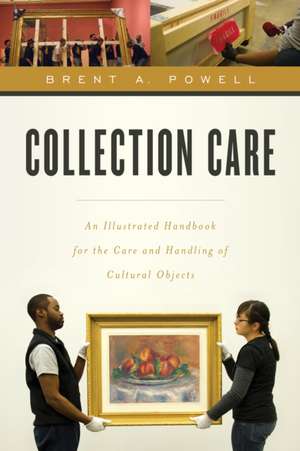
Collection Care: An Illustrated Handbook for the Care and Handling of Cultural Objects
Autor Brent Powell, Mervin Richarden Limba Engleză Paperback – 27 oct 2015
Recomandăm Collection Care ca pe un instrument de lucru esențial, structurat riguros în trei secțiuni care ghidează cititorul de la fundamentul teoretic la execuția tehnică. Prima parte stabilește contextul istoric și structurile organizaționale necesare unei culturi a conservării. Partea a doua detaliază protocoalele de lucru pentru obiecte bi și tridimensionale, în timp ce segmentul final analizează mediul intern al colecțiilor, cu accent pe factori critici precum iluminatul muzeal. Găsim în această lucrare un parcurs logic care transformă politicile de gestiune în acțiuni concrete de teren.
Ca și Samantha Forsko în Practical Approaches to Collections Care, autorul Brent Powell distilează experiență reală în principii acționabile, însă acest manual se distinge prin rigoarea tehnică și componenta vizuală bogată. Cele 100 de ilustrații și diagrame nu sunt simple anexe, ci elemente centrale care explică tehnici de ambalare, transport și depozitare. Merită menționat că volumul nu se limitează la obiecte, ci abordează și managementul resurselor umane — de la recrutare la instruirea continuă a personalului responsabil pentru siguranța artefactelor.
Experiența de lectură este definită de un ton pragmatic și autoritar. Analizele de caz, precum cele despre siguranța echipamentelor de ridicare sau evaluarea riscurilor în designul ambalajelor, oferă soluții testate în instituții de prestigiu din SUA și Australia. Spre deosebire de manualele pur teoretice, această resursă publicată de Bloomsbury Publishing sub amprenta Rowman & Littlefield acționează ca un ghid de bune practici adaptabil atât marilor muzee, cât și colecțiilor private care necesită standarde profesionale de conservare.
Preț: 369.65 lei
Preț vechi: 466.16 lei
-21%
Carte tipărită la comandă
Livrare economică 05-19 decembrie
Specificații
ISBN-10: 1442238828
Pagini: 446
Ilustrații: illustrations
Dimensiuni: 148 x 224 x 28 mm
Greutate: 0.66 kg
Editura: Bloomsbury Publishing
Colecția Rowman & Littlefield
Locul publicării:New York, United States
V-ar putea interesa
-
 -24%Preț: 127.28 lei167.38 lei
 -
 Ghosts of HomeMarianne HirschPreț: 245.13 lei
 -
 Evolution's BitePeter UngarPreț: 174.77 lei
 -
 Women in the War ZoneAnne Powel-14%Preț: 137.17 lei158.83 lei
 -
 Introduction to Manuscript StudiesRaymond ClemensPreț: 356.85 lei
 -
 Library Security: Better Communication, Safer FacilitiesSteve AlbrechtPreț: 412.14 lei
 -
 So You Want to Be an Academic Library DirectorColleen S. HarrisPreț: 431.19 lei
 -
 -20%Preț: 255.67 lei319.58 lei
 -
 Preț: 304.58 lei
 -
 Risk and Reliability in Geotechnical EngineeringKok-Kwang Phoon-18%Preț: 741.35 lei904.08 lei
 -
 Last Judgment Iconography in the CarpathiansJohn-Paul HimkaPreț: 368.85 lei
 -
 Historical Dictionary of Unitarian UniversalismMark W. Harris-35%Preț: 868.09 lei1345.60 lei
 -
 Preț: 157.20 lei
 -
 Paper Politics: Socially Engaged Printmaking TodayJosh Macphee-30%Preț: 137.31 lei196.20 lei
 -
 Into the Carpathians: The Eastern Mountains)Alan E. SparksPreț: 172.53 lei
 -
 The Civic Foundations of Fascism in EuropeDylan RileyPreț: 212.83 lei
 -
 Danube a Cultural HistoryAndrew BeattiePreț: 106.99 lei
 -
 -23%Preț: 505.78 lei656.86 lei
 -
 Shrinking Cities in RomaniaIlinca Paun ConstantinescuPreț: 554.18 lei
 -
 -9%Preț: 311.88 lei344.23 lei
 -
 Preț: 39.01 lei
De ce să citești această carte
Această carte este indispensabilă profesioniștilor din muzee, galerii sau arhive care doresc să implementeze protocoale de manipulare la standarde internaționale. Veți învăța cum să evaluați riscurile pentru obiecte fragile și cum să structurați instruirea echipei. Este o investiție în siguranța pe termen lung a patrimoniului cultural, oferind soluții tehnice vizuale pentru probleme complexe de depozitare și transport.
Descriere
Collection Care: An Illustrated Handbook for the Care and Handling of Cultural Objects provides a solid overview of basic collection care procedures and policies. The topics covered address the decision making criteria and risk assessment solutions involved in the best practices for handling art and artifacts. Technical subjects will cover proven techniques, materials, equipment and address problem solving assessment and current solutions. The comprehensive overview of staff responsibilities, relationships and training will bring the book to a conclusion of addressing the unison of all professionals responsible for proper handling and caring for collections. Highlights include: -This book provides both visual and narrative descriptions of current best practices for caring for collection objects. -Emphasis is placed on risk assessment in the decision-making process with proven, accepted technical methods and materials. -Detailed coverage of technical methods and methodologies for principles of proper handling, transport, and storage or two and three dimensional objects. -Chapters will cover the institutional structure for managing, hiring, training both full and part time staff responsible for safely handling and caring of collection objects. -100 photographs, figures, and charts provide overall directions for collection care, preventive maintenance, and proper handling of objects.
Cuprins
Acknowledgements
Preface
Part 1: Overview and History
Chapter 1: History
Focus On: Creating an Institutional Preservation Culture, Rebecca Fifield
Chapter 2: Organizational Structures
Case Study: Comparing Approaches: The Museum and the Transport Agent, Jim Grundy
Chapter 3: Training, Health, and Safety
Case Study: Mentoring and the Collection Care Profession, Kurt Christian
Case Study: Training at Crozier, Nicole Bouchard Tejeiro
Part 2: Guidelines and Principles
Chapter 4: Two-dimensional Objects: Procedures and Practices
Focus On: The US National Park Service Museum Handbooks: The Evolution of a Museum Manual, Dr. Abby Sue Fisher
Chapter 5: Three-dimensional Objects: Procedures and Practices
Focus On: Rigging Safety Is No Accident, Kevin Marshall
Focus On: Risk Assessment in Packing Design, John Molini
Part 3: Working within Collection Care Environments
Chapter 6: The Internal Environment
Focus On: Lighting in the Museum, Simm Steel
Chapter 7: The External Environment
Focus On: Art Packing and Transport: Cushioning Foam Selection and Application, Geoff Browne
Focus On: International Shipping by Air and Sea, Kim Powell
Chapter 8: Working with Materials and Equipment
Focus On: Specialized Art Handling Equipment: When It Is Necessary & How to Develop It, Mark Slattery
Bibliography
References and Resources
About the Contributors
About the Author
Recenzii
Many books address collection care, but they tend to be written by specialists for specialists. Thus, they are inclined to be narrowly focused and too often beyond the grasp of a generalist seeking a broad understanding of collection care. Brent Powell's book is an exception, aimed to educate a wide range of individuals. Anyone who manages a collection, or puts on a pair of gloves to move a small bronze, or packs a large sculpture for shipment overseas, should profit from reading Collection Care: An Illustrated Handbook for the Care and Handling of Cultural Objects.