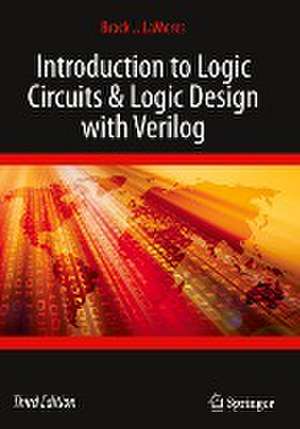
Introduction to Logic Circuits & Logic Design with Verilog
Autor Brock J. Lameresen Limba Engleză Hardback – 20 oct 2023
În ecosistemul proiectării sistemelor digitale moderne, Introduction to Logic Circuits & Logic Design with Verilog se impune ca un instrument tehnic riguros, concentrat pe utilizarea limbajului Verilog pentru implementarea hardware-ului de calcul. Observăm că autorul nu se limitează la sintaxa limbajului, ci ancorează procesul de design în fundamentele fizice ale circuitelor, acoperind de la sisteme de numerație și porți logice, până la circuite MSI și logica secvențială. Găsim în această carte o progresie logică, structurată special pentru a oglindi predarea în sala de curs: se începe cu bazele analogice versus digitale și se avansează către modelarea comportamentală complexă și designul sistemelor de calcul complete. Abordarea diferă de Digital Design de William James Dally prin faptul că este mai puțin abstractă și mult mai aplicabilă, punând accent pe fluxul de lucru real în care teoria este imediat validată prin exerciții de proiectare HDL. În timp ce alte manuale se concentrează pe arhitecturi de sistem la nivel înalt, Brock J. Lameres menține un echilibru între precizia „creion și hârtie” și eficiența simulării pe calculator. Putem afirma că lucrarea reprezintă o evoluție firească în bibliografia autorului, care a explorat anterior aceleași concepte prin prisma VHDL. Față de Introduction to Logic Circuits & Logic Design with VHDL, acest titlu adaptează întreaga metodologie pentru sintaxa Verilog, păstrând însă structura pedagogică bazată pe obiective de învățare clare și verificări de concept la finalul fiecărei secțiuni. Cuprinsul relevă o atenție deosebită acordată zonelor critice precum circuitele aritmetice și memoria, oferind o bază solidă pentru inginerii care vor lucra cu dispozitive de logică programabilă.
Preț: 571.32 lei
Preț vechi: 705.33 lei
-19%
Carte tipărită la comandă
Livrare economică 03-09 decembrie
Specificații
ISBN-10: 3031439457
Pagini: 548
Ilustrații: XVII, 527 p. 534 illus., 479 illus. in color.
Dimensiuni: 183 x 260 x 33 mm
Greutate: 1.28 kg
Ediția:Third Edition 2024
Editura: Springer
Locul publicării:Cham, Switzerland
V-ar putea interesa
-
 Fundamentals of Digital Logic with Verilog DesignStephen Brown-18%Preț: 1491.35 lei1818.72 lei
 -
 -40%Preț: 493.65 lei820.18 lei
 -
 Principles of Computer HardwareAlan Clements-28%Preț: 623.58 lei861.14 lei
 -
 Computer Architecture: A Quantitative ApproachJohn L. Hennessy-39%Preț: 539.69 lei882.55 lei
 -
 Foundations of Computer EngineeringMarilyn Wolf-40%Preț: 476.75 lei796.01 lei
 -
 -13%Preț: 483.52 lei558.92 lei
 -
 Learning the Art of ElectronicsThomas C. Hayes-8%Preț: 582.56 lei633.22 lei
 -
 Fundamentals of Digital Logic with VHDL Design ISEStephen Brown-21%Preț: 346.64 lei438.67 lei
 -
 Digital Electronics: A Practical Approach with VHDLWilliam Kleitz-13%Preț: 581.68 lei668.61 lei
 -
 -11%Preț: 721.06 lei810.18 lei
 -
 Logic and Computer Design Fundamentals, Global EditionM. Morris Mano-11%Preț: 679.86 lei763.89 lei
 -
 Moss, G: Digital Systems, Global EditionGreg Moss-13%Preț: 604.49 lei694.83 lei
 -
 -25%Preț: 91.62 lei122.56 lei
 -
 Foundations of Analog and Digital Electronic CircuitsAnant Agarwal-27%Preț: 551.94 lei754.30 lei
 -
 -20%Preț: 608.92 lei761.16 lei
 -
 -19%Preț: 297.86 lei369.37 lei
 -
 Complex Digital CircuitsJean-Pierre DeschampsPreț: 398.30 lei
 -
 Quick Start Guide to VHDLBrock J. LameresPreț: 518.91 lei
 -
 Introduction to Logic Circuits & Logic Design with VHDLBrock J. Lameres-15%Preț: 580.21 lei682.59 lei
 -
 Digital ElectronicsGareth MonkmanPreț: 411.88 lei
De ce să citești această carte
Această ediție din 2024 este ideală pentru studenții la inginerie electronică și profesioniștii care doresc să stăpânească designul digital folosind Verilog. Cititorul câștigă o înțelegere profundă a modului în care conceptele teoretice se traduc în hardware real. Este o recomandare excelentă datorită structurii sale modulare, care permite autoevaluarea constantă prin exerciții practice și exemple rezolvate, facilitând tranziția de la logica de bază la sisteme complexe de calcul.
Despre autor
Brock J. Lameres este un autor și profesor recunoscut pentru capacitatea sa de a simplifica subiecte complexe de inginerie electrică și design digital. Opera sa este marcată de un pragmatism pedagogic evident, publicând lucrări de referință precum Embedded Systems Design using the MSP430FR2355 LaunchPad(TM) și ghiduri specializate pentru VHDL și Verilog. Stilul său se concentrează pe învățarea prin exemplu și pe atingerea unor rezultate tehnice măsurabile. Prin publicațiile sale la editura Springer, Lameres a devenit o voce autoritară în literatura tehnică dedicată sistemelor integrate și logicii digitale, adaptându-și permanent manualele la evoluția tehnologiilor HDL.
Cuprins
Notă biografică
LaMeres has published over 70 manuscripts and 3 textbooks in the area of high speed digital systems. LaMeres has also been granted 13 US patents in the area of digital signal propagation. LaMeres is a Senior Member of IEEE and a Registered Professional Engineer in the States of Montana and Colorado. Dr. LaMeres is a member of AESS, ASEE and serves as the faculty advisor of thestudent branch of IEEE at MSU.
Prior to coming to MSU, Dr. LaMeres worked as an R&D engineer for Agilent Technologies in Colorado Springs, CO from 1999 to 2006. LaMeres was a hardware design engineer in the Logic Analysis R&D lab. He designed acquisition hardware for the 16910/11/12 and 16950 Logic Analyzer systems in addition to developing a variety of probing solutions.
Textul de pe ultima copertă
- Written the way the material is taught, enabling a bottom-up approach to learning which culminates with a high-level of learning, with a solid foundation;
- Emphasizes examples from which students can learn: contains a solved example for nearly every section in the book;
- Includes more than 1000 exercise problems, as well as concept check questions for each section, tied directly to specific learning outcomes.
Descriere
This textbook for courses in Digital Systems Design introduces students to the fundamental hardware used in modern computers. Coverage includes both the classical approach to digital system design (i.e., pen and paper) in addition to the modern hardware description language (HDL) design approach (computer-based).