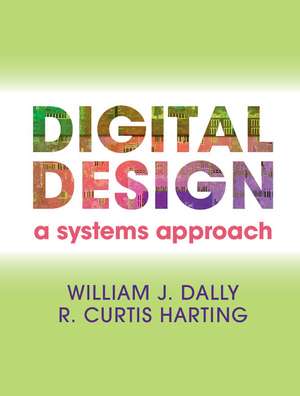
Digital Design
Autor William James Dally, R. Curtis Hartingen Limba Engleză Hardback – noi 2012
În analiza volumului Digital Design, remarcăm imediat distincția clară față de documentația tehnică standard: autorii William James Dally și R. Curtis Harting nu se limitează la descrierea componentelor izolate, ci prioritizează integrarea acestora în arhitecturi complexe. Descoperim aici o metodologie care reflectă practica modernă din industrie, unde accentul cade pe modul în care modulele interacționează pentru a forma un sistem digital funcțional și eficient. Structura cursului este riguros organizată în șapte părți, facilitând o progresie logică de la fundamentele abstractizării digitale și algebra booleană spre circuite aritmetice avansate și logică secvențială sincronă. Notăm cu interes includerea unor secțiuni critice pentru designul contemporan, precum constrângerile de timp (timing constraints), metastabilitatea și sistemele de memorie, elemente adesea tratate superficial în manualele introductive. Dacă Introduction to Logic Circuits & Logic Design with Verilog de Brock J. LaMeres v-a oferit cadrul teoretic și fundamentele designului pe hârtie, Digital Design oferă instrumentele practice și viziunea sistemică necesară pentru a proiecta hardware capabil să ruleze în medii de producție. Un aspect distinctiv este integrarea limbajului Verilog HDL nu doar ca sintaxă, ci ca instrument de productivitate. Autorii pun accent pe scrierea unui cod mentenabil, optimizat pentru sinteza automată prin instrumente CAD. Cu peste 600 de exerciții și aproape 500 de ilustrații tehnice, volumul publicat de Cambridge University Press se transformă dintr-un simplu manual într-un ghid de inginerie aplicată, esențial pentru înțelegerea fluxului complet de design digital, de la poarta logică la arhitectura de sistem.
Preț: 562.19 lei
Preț vechi: 694.07 lei
-19%
Carte tipărită la comandă
Livrare economică 05-19 decembrie
Specificații
ISBN-10: 0521199506
Pagini: 636
Ilustrații: 469 b/w illus. 68 tables 639 exercises
Dimensiuni: 196 x 241 x 38 mm
Greutate: 1.48 kg
Ediția:New.
Editura: Cambridge University Press
Locul publicării:Cambridge, United Kingdom
V-ar putea interesa
-
 Fundamentals of Digital Logic with Verilog DesignStephen Brown-18%Preț: 1491.35 lei1818.72 lei
 -
 -40%Preț: 488.78 lei820.18 lei
 -
 Foundations of Computer EngineeringMarilyn Wolf-41%Preț: 471.78 lei796.01 lei
 -
 -23%Preț: 906.97 lei1177.89 lei
 -
 Fundamentals of Digital Logic with VHDL Design ISEStephen Brown-21%Preț: 346.64 lei438.67 lei
 -
 Digital Electronics: A Practical Approach with VHDLWilliam Kleitz-13%Preț: 581.68 lei668.61 lei
 -
 -11%Preț: 721.06 lei810.18 lei
 -
 Logic and Computer Design Fundamentals, Global EditionM. Morris Mano-11%Preț: 679.86 lei763.89 lei
 -
 Moss, G: Digital Systems, Global EditionGreg Moss-13%Preț: 604.49 lei694.83 lei
 -
 Foundations of Analog and Digital Electronic CircuitsAnant Agarwal-28%Preț: 546.19 lei754.30 lei
 -
 -20%Preț: 608.92 lei761.16 lei
 -
 -19%Preț: 297.86 lei369.37 lei
 -
 Complex Digital CircuitsJean-Pierre DeschampsPreț: 398.30 lei
 -
 Quick Start Guide to VHDLBrock J. LameresPreț: 518.91 lei
 -
 Introduction to Logic Circuits & Logic Design with VHDLBrock J. Lameres-15%Preț: 580.21 lei682.59 lei
 -
 Introduction to Logic Circuits & Logic Design with VerilogBrock J. Lameres-19%Preț: 571.32 lei705.33 lei
 -
 Digital ElectronicsGareth MonkmanPreț: 411.88 lei
 -
 Digital Design from the VLSI PerspectiveVaibbhav TaraatePreț: 413.63 lei
De ce să citești această carte
Această carte este esențială pentru studenții și inginerii care doresc să treacă de la simpla înțelegere a circuitelor la proiectarea sistemelor digitale integrate. Cititorul câștigă o metodologie de lucru bazată pe Verilog HDL, adaptată cerințelor actuale din industria semiconductorilor. Este o investiție în competențe practice, oferind soluții concrete pentru probleme dificile precum sincronizarea și gestionarea întârzierilor în circuitele complexe.
Despre autor
William James Dally este o figură proeminentă în ingineria electrică, deținând titlul de profesor la Universitatea Stanford și funcția de Chief Scientist în cadrul corporației NVIDIA. Expertiza sa în arhitectura sistemelor paralele, rețele și tehnologii de sincronizare este fundamentată pe decenii de activitate la instituții de elită precum Bell Labs, MIT și Caltech. Contribuțiile sale tehnice se regăsesc în majoritatea supercomputerelor moderne, fiind membru al National Academy of Engineering și Fellow IEEE. Această experiență industrială vastă infuzează textul cu o perspectivă pragmatică, rară în literatura academică.
Descriere scurtă
Cuprins
Recenzii
'Bill and Curt have combined decades of academic and industry experience to produce a textbook that teaches digital system design from a very practical perspective without sacrificing the theoretical understanding needed to train tomorrow's engineers. Their approach pushes students to understand not just what they are designing but also what they are building. By presenting key advanced topics, such as synthesis, delay and logical effort, and synchronization, at the introductory level, this book is in the rare position of providing both practical advice and deep understanding. In doing so, this book will prepare students well even as technology, tools, and techniques change in the future.' David Black-Schaffer, Uppsala University
'Everything you would expect from a book on digital design from [Professor] Dally. Decades of practical experience are distilled to provide the tools necessary to design and compose complete digital systems. A clear and well written text that covers the basics and system-level issues equally well. An ideal starting point for the microprocessor and SoC designers of the future!' Robert Mullins, University of Cambridge and the Raspberry Pi Foundation
'This textbook sets a new standard for how digital system design is taught to undergraduates. The practical approach and concrete examples [provide] a solid foundation for anyone who wants to understand or design modern complex digital systems.' Steve Keckler, University of Texas, Austin
'This book not only teaches how to do digital design, but more importantly shows how to do good design. It stresses the importance of modularization with clean interfaces, and the importance of producing digital artifacts that not only meet their specifications, but which can also be easily understood by others. It uses an aptly chosen set of examples and the Verilog code used to implement them … It includes a section on the design of asynchronous logic, a topic that is likely to become increasingly important as energy consumption becomes a primary concern in digital systems … The final appendix on Verilog coding style is particularly useful. This book will be valuable not only to students, but to practitioners in the area. I recommend it highly.' Chuck Thacker, Microsoft
'A terrific book with a terrific point of view of systems. Everything interesting - and awful - that happens in digital design happens because engineers must integrate ideas from bits to blocks, from signals to CPUs. The book does a great job of focusing on the important stuff, moving from foundations to systems, with the right amount of HDL (Verilog) focus to make everything practical and relevant.' Rob A. Rutenbar, University of Illinois, Urbana-Champaign