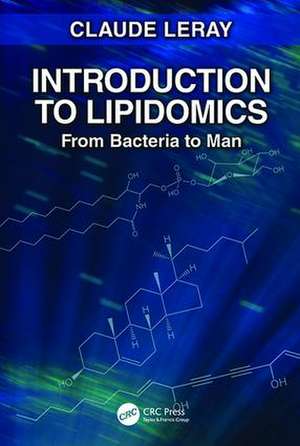
Introduction to Lipidomics: From Bacteria to Man
Autor Claude Lerayen Limba Engleză Hardback – 27 iul 2017
Preț: 1479.17 lei
Preț vechi: 1803.87 lei
-18%
Puncte Express: 2219
Carte tipărită la comandă
Livrare economică 07-21 decembrie
Livrare prin curier în România Termenul estimat este afișat lângă disponibilitate.
Transport gratuit pentru acest produs Plată online sau ramburs, în funcție de opțiunile comenzii.
Retur gratuit în 14 zile Comandă securizată și suport în română.
Specificații
ISBN-13: 9781138406926
ISBN-10: 1138406929
Pagini: 340
Dimensiuni: 156 x 234 mm
Greutate: 0.79 kg
Ediția:1
Editura: CRC Press
Colecția CRC Press
ISBN-10: 1138406929
Pagini: 340
Dimensiuni: 156 x 234 mm
Greutate: 0.79 kg
Ediția:1
Editura: CRC Press
Colecția CRC Press
V-ar putea interesa
-
 -32%Preț: 177.88 lei260.12 lei
 -
 Hydroxyapatite and Related MaterialsPaul W. Brown-18%Preț: 1951.77 lei2380.21 lei
 -
 Element Analysis of Biological Samples: Principles and Practices, Volume IIG. Venkatesh Iyengar-18%Preț: 2047.65 lei2497.13 lei
 -
 The Structure of Biological MembranesPhilip L. Yeagle-18%Preț: 1700.88 lei2074.23 lei
 -
 Amino Acid Chelation in Human and Animal NutritionH. DeWayne Ashmead-18%Preț: 1415.98 lei1726.80 lei
 -
 -5%Preț: 710.60 lei748.00 lei
 -
 Oxygen Transport to Tissue XXXIIJoseph C. Lamanna-18%Preț: 1758.20 lei2144.14 lei
 -
 -5%Preț: 1501.67 lei1580.71 lei
 -
 The Cardiac Lymphatic SystemGanga Karunamuni-18%Preț: 979.56 lei1194.59 lei
 -
 Oxygen Transport to Tissue XXXVSabine van Huffel-18%Preț: 1619.05 lei1974.45 lei
 -
 -5%Preț: 373.70 lei393.37 lei
 -
 Vascular DynamicsN. Westerhof-15%Preț: 672.38 lei791.04 lei
 -
 -5%Preț: 760.83 lei800.88 lei
 -
 Human Body DynamicsAydin Tözeren-15%Preț: 593.01 lei697.66 lei
 -
 Energy Balance in MotionKlaas R. WesterterpPreț: 380.55 lei
 -
 New Perspectives in RegenerationEllen Heber-Katz-18%Preț: 984.66 lei1200.80 lei
 -
 Biomechanics of the Human Urinary BladderRoustem N. Miftahof-5%Preț: 1135.12 lei1194.86 lei
 -
 Lehrbuch der Animalischen PhysiologieMichael SteinhausenPreț: 491.84 lei
 -
 Cardiac Adaptation and FailureMasatsugu Hori-5%Preț: 363.70 lei382.85 lei
Public țintă
Professional Practice & DevelopmentCuprins
Simple Lipids: Simple Lipids with Only One Component. Simple Lipids with Two Different Components. Complex Lipids: Phospholipids. Complex Amino Lipids. Complex Glycolipids. Appendices: Main Biological and Pharmacological Properties of Lipids. Main Lipids Involved in Human Pathologies. Selected History of Lipid Science and Technology. References.
Descriere
With increasing awareness of the urgent need to respond to global warming by reducing carbon emissions and recognition of the social benefits of car-free and car-lite living, more and more city planners, advocates, and everyday urban dwellers are demanding new ways of building cities. In Low Car(bon) Communities, authors Nicole Foletta and Jason Henderson examine seven case studies in Europe and the United States that aim explicitly to reduce dependency on cars. Innovative and inspirational, these communities provide a rich array of data and metrics for comparison and analysis. This book considers these low car(bon) communities potential for transferability to cities around the world, including North America.Aimed at practicing city planners, sustainable transportation advocates, and students in planning, geography, and environmental studies, this book will be an invaluable benchmark for gauging the success of sustainable urban futures.