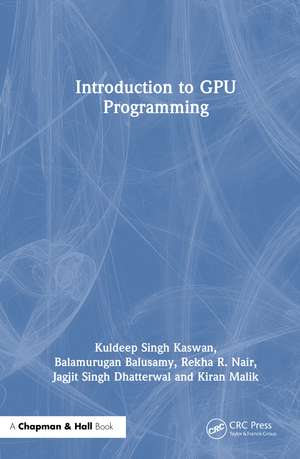
Introduction to GPU Programming
Autor Kuldeep Singh Kaswan, Balamurugan Balusamy, Rekha R. Nair, Jagjit Singh Dhatterwal, Kiran Maliken Limba Engleză Hardback – 2 mar 2027
- Explains GPU execution models (SIMD, SIMT), memory hierarchies (global, shared, constant), and thread-level parallelism with practical illustrations.
- Guides through writing kernels, managing grids and threads, synchronization techniques, and error handling in CUDA and OpenCL.
- Covers GPU memory allocation, coalesced memory access, latency hiding, and bandwidth maximization for performance efficiency.
- Provides coding examples for reduction, scan, sorting, and matrix operations, analyzing synchronization, scalability, and performance bottlenecks.
- Demonstrates GPU acceleration in AI and data science workflows using cuBLAS, TensorRT, RAPIDS, PyCUDA, and Numba.
- Explores multi-GPU programming, unified memory, dynamic parallelism, and GPU virtualization, addressing challenges in energy efficiency and portability.
Preț: 683.80 lei
Preț vechi: 969.53 lei
-29% Precomandă
Puncte Express: 1026
Carte nepublicată încă
Livrare prin curier în România Precomanda se expediază când titlul devine disponibil.
Transport gratuit pentru acest produs Plată online sau ramburs, în funcție de opțiunile comenzii.
Retur gratuit în 14 zile Comandă securizată și suport în română.
Doresc să fiu notificat când acest titlu va fi disponibil:
Se trimite...
Specificații
ISBN-13: 9781041322146
ISBN-10: 1041322143
Pagini: 360
Ilustrații: 54
Dimensiuni: 156 x 234 mm
Ediția:1
Editura: CRC Press
Colecția Chapman and Hall/CRC
ISBN-10: 1041322143
Pagini: 360
Ilustrații: 54
Dimensiuni: 156 x 234 mm
Ediția:1
Editura: CRC Press
Colecția Chapman and Hall/CRC
Public țintă
Undergraduate CoreCuprins
Chapter 1. Evolution of Parallel Computing. 1.1 The Need for High-Performance Computing. 1.2 From CPUs to GPUs: Architectural Shifts. 1.3 Applications Driving GPU Programming. Chapter 2. Fundamentals of GPU Architecture. 2.1 GPU vs CPU: Key Differences. 2.2 SIMD, SIMT, and Thread-Level Parallelism. 2.3 Memory Hierarchy in GPUs. 2.4 Execution Model and Warp Scheduling. Chapter 3. Getting Started with GPU Programming. 3.1 Introduction to CUDA and OpenCL. 3.2 GPU Programming Workflow. 3.3 Environment and Installing. 3.4 Hello GPU: First GPU Program. Chapter 4. CUDA Programming Essentials. 4.1 Kernel Functions and Thread Hierarchy. 4.2 Grids, Blocks, and Threads. 4.3 Synchronization and Barriers. 4.4 Error Handling in CUDA. Chapter 5. Memory Management in GPUs. 5.1 Types of GPU Memory: Global, Shared, Local, Constant. 5.2 Memory Allocation and Transfer. 5.3 Coalesced Memory Access. 5.4 Optimization Strategies. 5.5 GPU Cache Architecture. Chapter 6. Performance Optimization Techniques in GPU. 6.1 Occupancy and Thread Divergence. 6.2 Shared Memory Utilization. 6.3 Latency Hiding and Instruction Pipelining. 6.4 Profiling GPU Programs. 6.5 Example 1: Using Shared Memory for Faster Access. Chapter 7. Parallel Algorithms on GPUs. 7.1 Introduction Parallel Reduction. 7.2 Scan (Prefix Sum) Algorithms. 7.3 Sorting on GPUs. 7.4 Matrix Operations and Linear Algebra Kernels. 7.5 Example 1: Parallel Reduction (Sum). Chapter 8. OpenCL Programming Model. 8.1 Introduction OpenCL Architecture and Execution Model. 8.2 Kernels and Work-Items. 8.3 Memory Objects and Buffers. 8.4 Comparing CUDA and OpenCL. 8.5 Example 1: Simple OpenCL Kernel. Chapter 9. GPU Libraries and Frameworks. 9.1 cuBLAS and cuFFT. 9.2 Thrust Library for Parallel Algorithms. 9.3 TensorRT and GPU-Accelerated AI Libraries. 9.4 Cross-Vendor Libraries and Portable Frameworks. 9.5 Integration with Python (PyCUDA, Numba). Chapter 10. GPU Programming for Data Science. 10.1 GPU Acceleration in Data Analytics. 10.2 RAPIDS Framework. 10.3 GPU-Accelerated Machine Learning. 10.4 Deep Learning with GPUs. 10.5 Bias Detection and Fairness in AI Lending Decisions derived from NLP Sentiment. Chapter 11. Advancements in GPU Programming. 11.1 Multi-GPU Programming. 11.2 Unified Memory and Heterogeneous Computing. 11.3 Dynamic Parallelism. 11.4 GPU Virtualization and Cloud GPUs. Chapter 12. OpenMP Offloading Architecture and Execution Model. 12.1 How the OpenMP Target Model Maps Work to GPU Devices. 12.2 Overview of Teams, Threads, and SIMD Constructs. 12.3 Interaction with Vendor Backends (NVIDIA, AMD, Intel, ARM). 12.4 Compilation Pipeline: Clang/LLVM, GCC, Intel oneAPI Tooling. 12.5 Example 1: OpenMP Target Offload to GPU. Chapter 13. Case Studies and Applications. 13.1 Scientific Simulations on GPUs. 13.2 Image and Video Processing. 13.3 Cryptography and Blockchain Acceleration. 13.4 Real-Time Systems and Gaming Engines. 13.5 Example 1: GPU Image Smoothing (3×3 Filter). Chapter 14. Debugging and Profiling Tools. 14.1 NVIDIA Nsight and Visual Profiler. 14.2 Performance Counters and Tracing. 14.3 Debugging CUDA Applications. 14.4 Benchmarking Best Practices. 14.5 Example 1: Adding NVTX Annotations for Profiling. Chapter 15. Challenges and Future of GPU Programming. 15.1 Power Consumption and Energy Efficiency. 15.2 Portability Across GPU Architectures. 15.3 GPUs vs TPUs and Other Accelerators. 15.4 Future Trends in GPU Computing. 15.5 Example 1: Measuring GPU Power Using NVML. Chapter 16. Multi-GPU, Multi-Node, and Cloud-Native GPU Execution. 16.1 NCCL, RCCL, and Distributed Communication Topologies. 16.2 Pipeline Parallelism, ZeRO, and Sharded Training Strategies. 16.3 Kubernetes GPU Orchestration, MIG, MPS, and Virtualized GPUs. 16.4 Cloud GPU Computing Workflows on AWS/GCP/Azure. 16.5 Performance Engineering in Large-Scale Distributed Environments. 16.6 NCCL All-Reduce. Chapter 17. GPU Acceleration in Emerging Computational Domains. 17.1 GPU Acceleration in Computer Vision and Imaging Pipelines. 17.2 AI/ML Pipelines Accelerated by GPUs. 17.3 Blockchain and Cryptography on GPUs. 17.4 Quantum Computing Simulation on GPUs.
Notă biografică
Kuldeep Singh Kaswan is a distinguished academic figure, currently affiliated with the School of Computing Science & Engineering at Galgotias University in Uttar Pradesh, India. His extensive contributions are centered around the fields of Brain-Computer Interface (BCI), Cyborg Technology, and Data Science. With a remarkable academic journey spanning seventeen years and experience garnered from esteemed global institutions such as Amity University, Noida; Gautam Buddha University in Greater Noida; and PDM University, Bahadurgarh, he has solidified his position as a leading expert in his domain. Dr. Kaswan holds a Doctorate in Computer Science from Banasthali Vidyapith, Rajasthan, a testament to his dedication to advancing knowledge in his field. He has also been awarded the prestigious Doctor of Engineering (D. Engg.) degree from the Dana Brain Health Institute in Iran, further enhancing his international recognition and expertise. A true mentor and guide, Dr. Kaswan has played a pivotal role in supervising numerous undergraduate and postgraduate projects for engineering students. He has published more than 120 Research papers, 25+ authored books and contributed more than 150 book chapters, both at the national and international levels.
Balamurugan Balusamy is Professor and Chairperson of the School of Engineering and IT at Manipal University, Dubai. He previously served as Professor and Associate Dean (Academics) at the Shiv Nadar Institution of Eminence, Delhi-NCR, and held positions as Professor, Director (International Relations), and earlier Associate Professor during his 15-year tenure at VIT University, Vellore. He has also been Professor in the School of Computing Sciences & Engineering at Galgotias University, Greater Noida, and is currently an Adjunct Professor in the Department of Computer Science & Information Engineering at Taylor University, Malaysia.
He was listed among the Top 2% Scientists Worldwide 2023 by Stanford University in the field of Data Science/AI/ML. His work spans engineering education, blockchain, and data science.
Prof. Balusamy has published 200+ high-impact journal papers and has edited or authored over 200 books, collaborating with leading scholars from top QS-ranked universities. He has delivered over 210 talks at international events and has travelled to more than 15 countries for academic and research engagements. He has also organized and hosted over 10 IEEE and ACM international conferences. His teaching philosophy emphasizes design thinking and learner-centred approaches.
Rekha R. Nair is an Associate Professor in the Department of Computer Science and Engineering at Alliance University, Bengaluru, India. She received her Ph.D. in Computer Science from Amrita Vishwa Vidyapeetham, where her research focused on multimodal medical image fusion. She is currently pursuing a Postdoctoral Fellowship at Multimedia University, Malaysia, with research centered on Explainable Artificial Intelligence (XAI), Internet of Things (IoT), and sustainable smart agriculture. Her research interests include Artificial Intelligence, Machine Learning, Deep Learning, Data Science, Medical Image Processing, Computer Vision, Explainable AI, and Intelligent Decision Support Systems. Dr. Nair has authored more than 160 Scopus-indexed publications, with over 1,200 citations and an h-index of 18. She actively supervises postgraduate and doctoral researchers, serves as an editor and reviewer for international journals, and has contributed extensively to interdisciplinary AI applications spanning healthcare.
Jagjit Singh Dhatterwal is an Associate Professor in the School of Computer Science & Artificial Intelligence at SR University, Warangal, Telangana, India. He has supervised numerous undergraduate and postgraduate engineering projects and is actively involved in academic research and mentorship. Dr. Dhatterwal is a member of several prestigious professional organizations, including the Computer Science Teachers Association (CSTA), New York, USA; the International Association of Engineers (IAENG), Hong Kong; the International Association of Computer Science and Information Technology (IACSIT), USA; the Association of Computing Machinery (ACM), USA; IEEE; and is a life member of the Computer Society of India (CSI). He has an extensive publication record, which includes more than 20 books, 140+ book chapters, and over 40 research papers published in reputed national and international journals and conferences. His areas of expertise include Artificial Intelligence, Brain–Computer Interfaces (BCI), Cyborg Technologies, and Multi-Agent Systems. Dr. Dhatterwal continues to contribute significantly to the academic community through his research, writing, and active participation in global professional societies.
Kiran Malik is presently working as an Associate Professor in the Department of Computer Science and Engineering (AIML) at the GL Bajaj Institute of Technology & Management, Greater Noida, India. She has fifteen years of experience working with MAIET, Jaipur, Rajasthan, MRIEM Rohtak, India, and SBMN Engineering College, Rohtak, India. She has received M. Tech. (Software Engineering) and Doctorate in Computer Science and Engineering from Banasthali Vidyapith, Rajasthan. She has supervised many UG projects by engineering students. She is also a member of the Computer Science Teacher Association (CSTA), New York, USA, and the International Association of Engineers (IAENG), Hong Kong.
Balamurugan Balusamy is Professor and Chairperson of the School of Engineering and IT at Manipal University, Dubai. He previously served as Professor and Associate Dean (Academics) at the Shiv Nadar Institution of Eminence, Delhi-NCR, and held positions as Professor, Director (International Relations), and earlier Associate Professor during his 15-year tenure at VIT University, Vellore. He has also been Professor in the School of Computing Sciences & Engineering at Galgotias University, Greater Noida, and is currently an Adjunct Professor in the Department of Computer Science & Information Engineering at Taylor University, Malaysia.
He was listed among the Top 2% Scientists Worldwide 2023 by Stanford University in the field of Data Science/AI/ML. His work spans engineering education, blockchain, and data science.
Prof. Balusamy has published 200+ high-impact journal papers and has edited or authored over 200 books, collaborating with leading scholars from top QS-ranked universities. He has delivered over 210 talks at international events and has travelled to more than 15 countries for academic and research engagements. He has also organized and hosted over 10 IEEE and ACM international conferences. His teaching philosophy emphasizes design thinking and learner-centred approaches.
Rekha R. Nair is an Associate Professor in the Department of Computer Science and Engineering at Alliance University, Bengaluru, India. She received her Ph.D. in Computer Science from Amrita Vishwa Vidyapeetham, where her research focused on multimodal medical image fusion. She is currently pursuing a Postdoctoral Fellowship at Multimedia University, Malaysia, with research centered on Explainable Artificial Intelligence (XAI), Internet of Things (IoT), and sustainable smart agriculture. Her research interests include Artificial Intelligence, Machine Learning, Deep Learning, Data Science, Medical Image Processing, Computer Vision, Explainable AI, and Intelligent Decision Support Systems. Dr. Nair has authored more than 160 Scopus-indexed publications, with over 1,200 citations and an h-index of 18. She actively supervises postgraduate and doctoral researchers, serves as an editor and reviewer for international journals, and has contributed extensively to interdisciplinary AI applications spanning healthcare.
Jagjit Singh Dhatterwal is an Associate Professor in the School of Computer Science & Artificial Intelligence at SR University, Warangal, Telangana, India. He has supervised numerous undergraduate and postgraduate engineering projects and is actively involved in academic research and mentorship. Dr. Dhatterwal is a member of several prestigious professional organizations, including the Computer Science Teachers Association (CSTA), New York, USA; the International Association of Engineers (IAENG), Hong Kong; the International Association of Computer Science and Information Technology (IACSIT), USA; the Association of Computing Machinery (ACM), USA; IEEE; and is a life member of the Computer Society of India (CSI). He has an extensive publication record, which includes more than 20 books, 140+ book chapters, and over 40 research papers published in reputed national and international journals and conferences. His areas of expertise include Artificial Intelligence, Brain–Computer Interfaces (BCI), Cyborg Technologies, and Multi-Agent Systems. Dr. Dhatterwal continues to contribute significantly to the academic community through his research, writing, and active participation in global professional societies.
Kiran Malik is presently working as an Associate Professor in the Department of Computer Science and Engineering (AIML) at the GL Bajaj Institute of Technology & Management, Greater Noida, India. She has fifteen years of experience working with MAIET, Jaipur, Rajasthan, MRIEM Rohtak, India, and SBMN Engineering College, Rohtak, India. She has received M. Tech. (Software Engineering) and Doctorate in Computer Science and Engineering from Banasthali Vidyapith, Rajasthan. She has supervised many UG projects by engineering students. She is also a member of the Computer Science Teacher Association (CSTA), New York, USA, and the International Association of Engineers (IAENG), Hong Kong.
Descriere
This book provides a detailed guide to programming Graphics Processing Units (GPUs) for high-performance computing, covering both foundational concepts and advanced techniques. It introduces GPU architectures, programming frameworks like CUDA and OpenCL, and optimization strategies for memory and thread management.