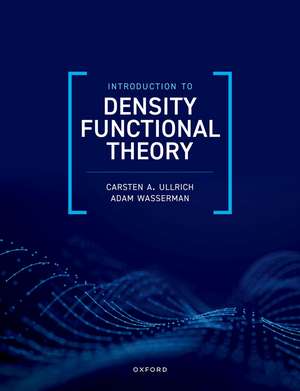
Introduction to Density Functional Theory
Autor Carsten A. Ullrich, Adam Wassermanen Limba Engleză Paperback – 20 aug 2026
Preț: 268.72 lei
Preț vechi: 306.26 lei
-12% Nou
Puncte Express: 403
Carte disponibilă
Livrare economică 06-11 noiembrie
Livrare prin curier în România Termenul estimat este afișat lângă disponibilitate.
Transport gratuit de la 400.00 lei Plată online sau ramburs, în funcție de opțiunile comenzii.
Retur gratuit în 14 zile Comandă securizată și suport în română.
Specificații
ISBN-13: 9780198910671
ISBN-10: 0198910673
Pagini: 240
Ilustrații: Over 100 b/w and colour illustrations
Dimensiuni: 191 x 247 x 12 mm
Greutate: 0.52 kg
Editura: OUP OXFORD
Colecția OUP Oxford
Locul publicării:Oxford, United Kingdom
ISBN-10: 0198910673
Pagini: 240
Ilustrații: Over 100 b/w and colour illustrations
Dimensiuni: 191 x 247 x 12 mm
Greutate: 0.52 kg
Editura: OUP OXFORD
Colecția OUP Oxford
Locul publicării:Oxford, United Kingdom
Notă biografică
Carsten A. Ullrich received his PhD in 1995 at the University of Würzburg and, after several postdoctoral positions, joined the faculty at the University of Missouri in 2001. He received tenure in 2007 and became a full professor in 2013. In 2023 he was appointed Curator's Distinguished Professor of Physics. His research focuses on the study of the foundations and the development of new methodologies in time-dependent density functional theory (TDDFT) and spin-DFT. He has over 125 publications, including a book on TDDFT, and he is a Fellow of the American Physical Society.Adam Wasserman is Professor of Chemistry at Purdue University, where he has taught since 2008. His research focuses on understanding why some chemical bonds are weak while others are strong. To do this, he and his research group develop methods based on Density Functional Theory to calculate the electronic properties of molecules directly from those of their constituent atoms. A Purdue University Faculty Scholar, Dr Wasserman holds a courtesy appointment in the Department of Physics and Astronomy, and has been a recipient of numerous awards, including an Alfred P. Sloan research Fellowship and a Camille and Henry Dreyfus Teacher-Scholar award.
Cuprins
- 1: Introductory remarks
- 2: Review of quantum mechanics
- 3: From densities to Hamiltonians: the main idea of DFT
- 4: Quantum mechanics of N electrons
- 5: More about N-electron wave functions
- 6: What is a functional?
- 7: The variational principle
- 8: The Hohenberg-Kohn theorem
- 9: The Thomas-Fermi model
- 10: Orbitals and Slater determinants
- 11: The Kohn-Sham approach
- 12: A case study: two interacting electrons in 1D
- 13: Defining exchange and correlation
- 14: The homogeneous electron gas
- 15: The local-density approximation
- 16: A brief recap
- 17: Spin in DFT
- 18: Empirical vs. nonempirical approximations
- 19: A taxonomy of functionals
- 20: Orbital functionals and generalized DFT
- 21: Two case studies: H¿¿ , H¿
- 22: Chemical Reactivity
- 23: DFT in practice: molecular calculations
- 24: DFT in practice: solid-state calculations
- 25: Time-dependent DFT
- 26: Epilogue
- Appendix A - The hydrogen atom
- Appendix B - The Pair Density and the xc hole
- Appendix C - Adiabatic Connection
- Appendix D - Hellmann-Feynman and Virial Theorems
- Appendix E - Exchange energy density of the 1D electron gas
- Appendix F - The Chemical Potential
- Appendix G - Uniform Coordinate Scaling
- Appendix H - Linear-response TDDFT and excitation energies
- Appendix I - Test your knowledge
- Appendix J - Answers to selected exercises