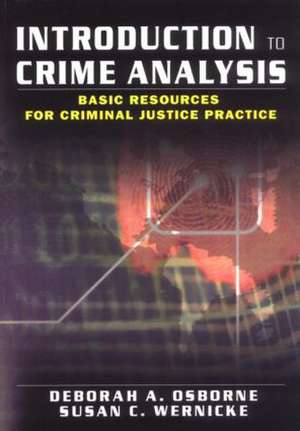
Introduction to Crime Analysis: Basic Resources for Criminal Justice Practice
Autor Deborah Osborne, Susan Wernickeen Limba Engleză Paperback – 2 sep 2003
This book is a practical resource guide for the development of crime analysis in local law enforcement. The tragedy of September 11, 2001, has raised awareness on how crucial it is to analyze information and intelligence. Smaller agencies that cannot financially justify hiring a full-time analyst will find strategies and techniques to teach officers the methods of analysis. Introduction to Crime Analysis: Basic Resources for Criminal Justice Practice provides basic tools and step-by-step directions that will improve the skills and knowledge of new crime analysts.
From the editors: “Military strategists have used analysis for centuries; it makes sense to know as much as possible about the enemy and about the conditions and causes of a situation if we hope to institute any kind of significant change for the better. Career criminals are the enemies of a community's well being. Now that advances in information technology give us the means and methods to fully examine and find meaningful knowledge in the vast amounts of existing information on crimes and criminals, we have an obligation to use our technological strength to protect innocent people. Systematic crime analysis as a law enforcement and public safety asset has become not only possible, but also truly necessary as a weapon in the war against crime.”
Along with defining the various roles of the crime analyst, Introduction to Crime Analysis demonstrates how to:
- improve the personal skills necessary to make you a good crime analyst
- successfully work through the five stages—collection, collation, analysis, dissemination, and feedback and evaluation—of analysis
- select the appropriate crime mapping software for your agency
- evaluate the usefulness of your crime analysis products
- benefit from email discussion groups and professional associations
- create a crime analysis unit-including policies and procedures as well as marketing and funding
Preț: 469.06 lei
Preț vechi: 551.84 lei
-15%
Puncte Express: 704
Carte tipărită la comandă
Livrare economică 24 noiembrie-08 decembrie
Livrare prin curier în România Termenul estimat este afișat lângă disponibilitate.
Transport gratuit pentru acest produs Plată online sau ramburs, în funcție de opțiunile comenzii.
Retur gratuit în 14 zile Comandă securizată și suport în română.
Specificații
ISBN-13: 9780789018687
ISBN-10: 0789018683
Pagini: 172
Dimensiuni: 152 x 229 x 12 mm
Greutate: 0.32 kg
Ediția:New.
Editura: Taylor & Francis
Colecția Routledge
Locul publicării:Oxford, United Kingdom
ISBN-10: 0789018683
Pagini: 172
Dimensiuni: 152 x 229 x 12 mm
Greutate: 0.32 kg
Ediția:New.
Editura: Taylor & Francis
Colecția Routledge
Locul publicării:Oxford, United Kingdom
V-ar putea interesa
-
 Forensic Toxicology: Principles and ConceptsNicholas T. Lappas-26%Preț: 478.22 lei646.93 lei
 -
 Forensic ChemistryMax M. Houck-30%Preț: 465.35 lei665.63 lei
 -
 Forensic Plant ScienceJane H Bock-25%Preț: 479.22 lei636.05 lei
 -
 Child Abuse Investigation Field GuideD'Michelle P. DuPre-16%Preț: 255.33 lei303.19 lei
 -
 Forensic Psychiatry: A Lawyer’s GuideVivian Shnaidman-30%Preț: 480.16 lei681.77 lei
 -
 -20%Preț: 266.42 lei333.03 lei
 -
 -20%Preț: 307.36 lei384.19 lei
 -
 -35%Preț: 287.33 lei442.32 lei
 -
 -29%Preț: 194.89 lei273.26 lei
 -
 -15%Preț: 496.34 lei583.93 lei
 -
 The Mirror: A HistorySabine Melchoir-BonnetPreț: 339.98 lei
 -
 -21%Preț: 279.42 lei354.50 lei
 -
 Studies in Forensic BiohistoryChristopher M Stojanowski-11%Preț: 647.35 lei727.36 lei
 -
 Death in BeijingDaniel AsenPreț: 422.58 lei
 -
 Forensic ScienceChristopher LawlessPreț: 359.44 lei
 -
 -18%Preț: 1252.71 lei1527.70 lei
 -
 Karch's Pathology of Drug AbuseSteven B. Karch MD-18%Preț: 1789.60 lei2182.44 lei
 -
 The Skeleton CrewDeborah HalberPreț: 98.33 lei
 -
 Forensic Toxicology: Mechanisms and PathologyRobert H. Powers-9%Preț: 1627.46 lei1788.42 lei
 -
 Fingerprints and Other Ridge Skin ImpressionsChristophe Champod-9%Preț: 1205.22 lei1324.41 lei
 -
 -18%Preț: 930.06 lei1134.22 lei
 -
 Serial Killers and the Phenomenon of Serial MurderDavid WilsonPreț: 216.18 lei
 -
 Digital Forensics and Cyber CrimePavel Gladyshev-20%Preț: 416.97 lei521.21 lei
 -
 Mobile Phone Security and ForensicsIosif I. Androulidakis-15%Preț: 660.61 lei777.18 lei
Cuprins
- Preface
- Acknowledgments
- Chapter 1. What Is Crime Analysis?
- The Challenge of Defining Crime Analysis
- The Present State of Crime Analysis in Law Enforcement
- Why Analyze Crime?
- Types of Crime Analysis
- Summary
- Suggested Reading
- Chapter 2. The Crime Analyst’s Toolbox
- Overview
- Equipment
- Knowledge of the Law
- Knowledge of Investigative Processes
- Knowledge of Modern Policing Strategies
- Linkage Analysis
- Statistical Analysis
- Profiling
- Spatial Analysis
- Summary
- Suggested Reading
- Chapter 3. Moving Through the Stages of Crime Analysis
- Collection
- Collation
- Analysis
- Dissemination
- Feedback and Evaluation
- The Intelligence Cycle: Another View of the Stages of Analysis
- Summary
- Chapter 4. Geographic Information Systems: Issues and Resources
- Overview
- Points to Remember When Creating Crime Maps
- Mapping Other Data with Crime Data for Analysis
- Privacy Issues
- Resources for Crime Mapping
- Suggested Readings
- Chapter 5. Crime Analysis Products
- Creating Bulletins for Tactical Crime Analysis
- Types of Administrative Crime Analysis Reports
- Other Crime Analysis Products
- Intelligence Analysis Products
- Evaluation of Crime Analysis Products
- Resources for Crime Analysis Products
- Chapter 6. Advice for the New Crime Analyst
- “A Day in the Life of a Crime Analyst”
- Tips for the New Crime Analyst
- “The Ten Commandments of Crime Analysis”
- Chapter 7. Creating a Crime Analysis Unit
- Policy and Procedures for Crime Analysis
- Considerations in Creating a Crime Analysis Unit
- Crime Analysis Units on the Web
- “Marketing” and Funding Crime Analysis
- How Do We Measure Success?
- Crime Analysis Success Stories
- Chapter 8. Education and Training Resources
- Overview
- Training Options for Those Employed in Law Enforcement
- Eduction and Training Offered by Colleges and Universities
- Chapter 9. Other Resources
- Recommended Agency Resources
- Recommended Publications
- Recommended Internet Sites
- Appendix. Examples of Crime Analysis Products
- Bibliography
- Index
- Reference Notes Included
Notă biografică
Deborah Osborne is a crime analyst for the Buffalo Police Department and co-founder/vice president of the Western New York Regional Association of Crime and Intelligence Analysts. She serves on the by-laws committee and the certification committee of the International Association of Crime Analysts (IACA). She is a state certified police instructor and has served as an independent consultant to the Police Service of Northern Ireland (formerly RUC). Ms. Osborne holds a BA in Psychology and an MA in Social Policy., Susan Wernicke has set up a crime analysis unit for the Shawnee Police Department after working ten years for the Overland Park, Kansas, Police Department. During her tenure at the Overland Park Police Department, she held the positions of communications officer, police report clerk, and crime analyst. She has contributed to various publications on crime mapping, including Crime Mapping Successes in the Field, Volumes I and II, and Crime Mapping: Principal and Practice. She has also authored various articles on crime analysis, including an article for The Police Chief magazine titled Integrating Crime Analysis into Local Law Enforcement. Ms. Wernicke is the former Training Coordinator for the Mid-America Regional Crime Analysis Network (MARCAN) and is a crime analysis instructor for the International Association of Chiefs of Police (IACP). She is also the Secretary on the Executive Board for the International Association of Crime Analysts (IACA). She serves as the Committee Chair for the Publications Committee and for the Training Series Oversight and Implementation Committee. In December 2001, Ms. Wernicke was the keynote speaker
Descriere
This book is a practical resource guide for the development of crime analysis in local law enforcement. The tragedy of September 11, 2001, has raised awareness on how crucial it is to analyze information and intelligence. Smaller agencies that cannot financially justify hiring a full-time analyst will find strategies and techniques to teach officers the methods of analysis. Introduction to Crime Analysis: Basic Resources for Criminal Justice Practice provides basic tools and step-by-step directions that will improve the skills and knowledge of new crime analysts.