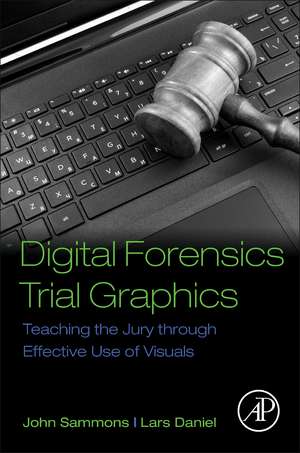
Digital Forensics Trial Graphics: Teaching the Jury through Effective Use of Visuals
Autor John Sammons, Lars Danielen Limba Engleză Paperback – 16 mar 2017
- Helps users learn skills for the effective presentation of digital forensic evidence via graphics in a trial setting to laypeople such as juries and judges
- Presents the principles of visual learning and graphic design as a foundation for developing effective visuals
- Demonstrates the best practices of slide design to develop effective visuals for presentation of evidence
- Professionally developed graphics, designed specifically for digital forensics, that you can use at trial
- Downloadable graphics available at: http://booksite.elsevier.com/9780128034835
Preț: 287.33 lei
Preț vechi: 442.32 lei
-35%
Puncte Express: 431
Carte tipărită la comandă
Livrare economică 24 noiembrie-08 decembrie
Livrare prin curier în România Termenul estimat este afișat lângă disponibilitate.
Transport gratuit de la 400.00 lei Plată online sau ramburs, în funcție de opțiunile comenzii.
Retur gratuit în 14 zile Comandă securizată și suport în română.
Specificații
ISBN-13: 9780128034835
ISBN-10: 0128034831
Pagini: 108
Ilustrații: illustrations
Dimensiuni: 152 x 229 x 13 mm
Greutate: 0.18 kg
Editura: ELSEVIER SCIENCE
ISBN-10: 0128034831
Pagini: 108
Ilustrații: illustrations
Dimensiuni: 152 x 229 x 13 mm
Greutate: 0.18 kg
Editura: ELSEVIER SCIENCE
V-ar putea interesa
-
 -33%Preț: 148.72 lei222.20 lei
 -
 -28%Preț: 159.52 lei220.72 lei
 -
 Digital Forensics: Threatscape and Best PracticesJohn Sammons-32%Preț: 220.08 lei323.71 lei
 -
 On the Foundations of ComputingGiuseppe Primiero-17%Preț: 401.43 lei481.14 lei
 -
 Computational Intelligence in Healthcare ApplicationsRajeev Agrawal-28%Preț: 839.26 lei1161.12 lei
 -
 Blockchain Chicken FarmXiaowei WangPreț: 93.56 lei
 -
 Possible Minds: Twenty-Five Ways of Looking at AIJohn Brockman-36%Preț: 83.27 lei129.23 lei
 -
 The Zynq BookLouise H. CrockettPreț: 297.25 lei
 -
 Algorithms Illuminated (Part 2)Tim Roughgarden-20%Preț: 89.06 lei111.32 lei
 -
 Database SystemsRamez Elmasri-20%Preț: 552.09 lei690.12 lei
 -
 -20%Preț: 986.77 lei1233.45 lei
 -
 Effective Monitoring and AlertingSlawek Ligus-20%Preț: 128.64 lei160.79 lei
 -
 -20%Preț: 309.78 lei387.22 lei
 -
 -37%Preț: 279.56 lei446.20 lei
 -
 Collaborative Computer Security and Trust ManagementJean-Marc Seigneur-20%Preț: 1074.87 lei1343.59 lei
 -
 Tmux 2Brian Hogan-20%Preț: 129.36 lei161.69 lei
 -
 The Revolutionary PhenotypeJean-François GariépyPreț: 122.50 lei
 -
 AdventureJamie LendinoPreț: 117.78 lei
 -
 Preț: 438.57 lei
 -
 Information Theoretic SecurityAdam Smith-20%Preț: 412.02 lei515.03 lei
 -
 Research in Attacks, Intrusions and DefensesDavide Balzarotti-20%Preț: 341.23 lei426.53 lei
 -
 Information SecurityDieter Gollmann-20%Preț: 328.10 lei410.13 lei
 -
 Advances in Information and Computer SecurityGoichiro Hanaoka-20%Preț: 430.84 lei538.55 lei
 -
 -20%Preț: 347.39 lei434.23 lei
 -
 Secure IT SystemsAudun Jøsang-20%Preț: 413.46 lei516.83 lei
 -
 Peeling Design PatternsNarasimha KarumanchiPreț: 314.94 lei
Cuprins
1. Introduction2. But I Am Not an Artist3. Principles of Graphic Design: The Basics4. Slide Design: Best Practices5. Presenting for Comprehension6. Putting It All Together7. Preparing Graphics for Production
Notă biografică
John Sammons is a distinguished scholar and educator in digital forensics, currently serving as a Professor at Marshall University and Associate Director of the Institute for Cyber Security. With a background as a Huntington Police officer, he has been recognized for his investigative work by the U.S. Department of Justice.
He is the author and co-author of several notable books, including the acclaimed "The Basics of Digital Forensics," which was nominated for Digital Forensics Book of the Year in 2013. John also contributed to the digital forensics chapter of Douglas Ubelaker's "Forensic Science: Current Issues, Future Directions."
In addition to his academic roles, he is the Fusion Center Liaison Officer for the West Virginia Intelligence Fusion Center and founded the Appalachian Institute of Digital Evidence, a non-profit focused on research and training in digital evidence. John holds multiple certifications and is a member of several professional organizations, including the American Academy of Forensic Sciences and the FBI Infragard. Before joining Marshall, he co-founded Second Creek Technologies, a digital forensics firm. He also teaches advanced digital forensics and firearms to graduate students and provides training for legal and law enforcement professionals.