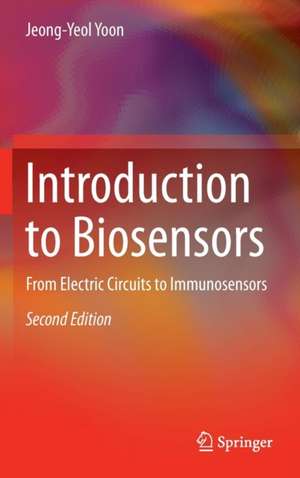
Introduction to Biosensors
Autor Jeong-Yeol Yoonen Limba Engleză Hardback – 10 feb 2016
This book equips students with a thorough understanding of various types of sensors and biosensors that can be used for chemical, biological, and biomedical applications, including but not limited to temperature sensors, strain sensor, light sensors, spectrophotometric sensors, pulse oximeter, optical fiber probes, fluorescence sensors, pH sensor, ion-selective electrodes, piezoelectric sensors, glucose sensors, DNA and immunosensors, lab-on-a-chip biosensors, paper-based lab-on-a-chip biosensors, and microcontroller-based sensors. The author treats the study of biosensors with an applications-based approach, including over 15 extensive, hands-on labs given at the end of each chapter. The material is presented using a building-block approach, beginning with the fundamentals of sensor design and temperature sensors, and ending with more complicated biosensors.
New to this second edition are sections on op-amp filters, pulse oximetry, meat quality monitoring, advanced fluorescent dyes, autofluorescence, various fluorescence detection methods, fluoride ion-selective electrode, advanced glucose sensing methods including continuous glucose monitoring, paper-based lab-on-a-chip, etc. A new chapter on nano-biosensors and an appendix on microcontrollers make this textbook ideal for undergraduate engineering students studying biosensors. It can also serve as a hands-on guide for scientists and engineers working in the sensor or biosensor industries.
Preț: 731.01 lei
Preț vechi: 860.02 lei
-15%
Puncte Express: 1097
Carte tipărită la comandă
Livrare economică 11-25 decembrie
Livrare prin curier în România Termenul estimat este afișat lângă disponibilitate.
Transport gratuit pentru acest produs Plată online sau ramburs, în funcție de opțiunile comenzii.
Retur gratuit în 14 zile Comandă securizată și suport în română.
Specificații
ISBN-13: 9783319274119
ISBN-10: 3319274112
Pagini: 348
Ilustrații: XV, 331 p. 336 illus., 110 illus. in color.
Dimensiuni: 160 x 241 x 25 mm
Greutate: 0.64 kg
Ediția:2nd edition 2016
Editura: Springer
Locul publicării:Cham, Switzerland
ISBN-10: 3319274112
Pagini: 348
Ilustrații: XV, 331 p. 336 illus., 110 illus. in color.
Dimensiuni: 160 x 241 x 25 mm
Greutate: 0.64 kg
Ediția:2nd edition 2016
Editura: Springer
Locul publicării:Cham, Switzerland
V-ar putea interesa
-
 Prostate Cancer: A Case ReportGilles Plourde-26%Preț: 577.78 lei783.90 lei
-
 New Concepts in the Management of Septic Perianal ConditionsRiyadh Mohammad Hasan-25%Preț: 354.89 lei471.24 lei
-
 Smartphone Based Medical DiagnosticsJeong-Yeol Yoon-9%Preț: 665.49 lei731.31 lei
-
 -5%Preț: 1190.36 lei1253.01 lei
-
 Ecological MicrocosmsRobert J. BeyersPreț: 408.37 lei
-
 Modern Tools of BiophysicsThomas Jue-18%Preț: 804.07 lei980.57 lei
-
 INTRODUCTION TO BIOCERAMICS, AN (2ND ED)Hench Larry L-15%Preț: 562.85 lei662.17 lei
-
 Tissue EngineeringJeong-Yeol Yoon-15%Preț: 553.80 lei651.54 lei
-
 -5%Preț: 3577.69 lei3765.99 lei
-
 Preț: 401.07 lei
-
 Cardiac RegenerationMasaki Ieda-24%Preț: 896.82 lei1180.03 lei
-
 -5%Preț: 1107.06 lei1165.32 lei
-
 Processing Medical Thermal ImagesRobert Koprowski-18%Preț: 639.77 lei780.21 lei
-
 -5%Preț: 1100.44 lei1158.36 lei
-
 -15%Preț: 635.20 lei747.29 lei
-
 Seamless Healthcare MonitoringToshiyo Tamura-24%Preț: 1027.35 lei1351.78 lei
-
 Cardiac Cell Culture TechnologiesZbigniew Brzozka-20%Preț: 625.42 lei781.77 lei
-
 Design in NatureClaus Mattheck-18%Preț: 929.37 lei1133.38 lei
Public țintă
Upper undergraduateCuprins
Introduction.- Resistors.- Diodes and Transistors.- Temperature Sensors.- Wheatstone Bridge.- Op-amp.- Light Sensors.- Spectrophotometry.- Fluorescence.- Electrochemical Sensors.- Piezoelectric Sensors.- Glucose Sensors.- Immunosensors.- Lab-on-a-chip Biosensors.- Nano-Biosensors.
Notă biografică
Jeong-Yeol Yoon received his B.S., M.S., and Ph.D. degrees in Chemical Engineering from Yonsei University, Seoul (South Korea) in 1992, 1994, and 1999. His dissertation advisor was Dr. Woo-Sik Kim, and his co-advisor was Dr. Jung-Hyun Kim, while he worked primarily on polymer colloids. Dr. Yoon received his second Ph.D. degree in Biomedical Engineering from the University of California, Los Angeles, in 2004, working on lab-on-a-chip and biomaterials under the guidance of Dr. Robin L. Garrell. He joined the faculty at the University of Arizona in August 2004 and currently holds split home appointments in the Department of Biomedical Engineering (primary) and Department of Biosystems Engineering (secondary). Dr. Yoon also has joint appointments in Chemistry & Biochemistry and BIO5 Institute. He is also Associate Head for Graduate Affairs in the Department of Biomedical Engineering, starting from July 2018. He is currently directing the Biosensors Lab. Dr. Yoon is a member of IBE, ASABE, SPIE, BMES, and ACS and was Councillor-at-Large for IBE for the 2010 and 2011 calendar years. He was the President of the Institute of Biological Engineering (IBE) in 2015. Dr. Yoon currently serves as Editor-in-Chief for the Journal of Biological Engineering (the official journal of IBE), Associate Editor for Biosensors and Bioelectronics (Elsevier), and Editorial Board Member for Scientific Reports (Springer Nature) and Micromachines (MDPI). Dr. Yoon is the author of the book Introduction to Biosensors: From Electric Circuits to Immunosensors, Second Edition (Springer, 2016)
Textul de pe ultima copertă
This book equips students with a thorough understanding of various types of sensors and biosensors that can be used for chemical, biological, and biomedical applications, including but not limited to temperature sensors, strain sensor, light sensors, spectrophotometric sensors, pulse oximeter, optical fiber probes, fluorescence sensors, pH sensor, ion-selective electrodes, piezoelectric sensors, glucose sensors, DNA and immunosensors, lab-on-a-chip biosensors, paper-based lab-on-a-chip biosensors, and microcontroller-based sensors. The author treats the study of biosensors with an applications-based approach, including over 15 extensive, hands-on labs given at the end of each chapter. The material is presented using a building-block approach, beginning with the fundamentals of sensor design and temperature sensors, and ending with more complicated biosensors.
New to this second edition are sections on op-amp filters, pulse oximetry, meat quality monitoring, advanced fluorescent dyes, autofluorescence, various fluorescence detection methods, fluoride ion-selective electrode, advanced glucose sensing methods including continuous glucose monitoring, paper-based lab-on-a-chip, etc. A new chapter on nano-biosensors and an appendix on microcontrollers make this textbook ideal for undergraduate engineering students studying biosensors. It can also serve as a hands-on guide for scientists and engineers working in the sensor or biosensor industries.
Caracteristici
Provides over 14 extensive, hands-on labs at the end of each chapter, many of which are new to the second edition, delivering hands-on guidance and visual demonstration of biosensor applications Takes a step-by-step approach toward the end result of building an antibody-based immunosensor from scratch Includes new material on glucose sensors and microcontrollers for biosensors as well as new lab exercises such as building an op-amp circuit for commercial glucose strips, quantifying lateral flow assays (pregnancy tests) with a smartphone, and building a pulse oximeter (LED+PD circuit) Includes supplementary material: sn.pub/extras