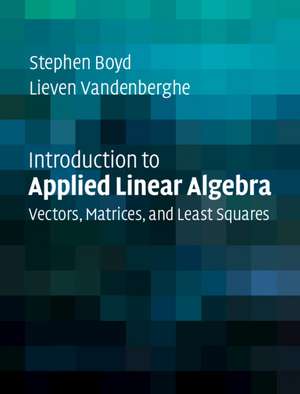
Introduction to Applied Linear Algebra
Autor Stephen Boyd, Lieven Vandenbergheen Limba Engleză Hardback – 7 iun 2018
Găsim în Introduction to Applied Linear Algebra un punct de pornire ideal pentru studenți și profesioniști, deoarece textul este conceput pentru un nivel de începător, nepresupunând nicio expunere anterioară la subiect. Ne-a atras atenția modul în care Stephen Boyd și Lieven Vandenberghe reușesc să transforme un domeniu adesea abstract într-un set de instrumente pragmatice pentru inginerie și știința datelor. Suntem de părere că forța acestui manual rezidă în echilibrul dintre rigoarea matematică și aplicabilitatea imediată: conceptele de vectori și matrice nu sunt prezentate izolat, ci prin prisma utilității lor în sisteme de control, tomografie sau inteligență artificială. Dacă Applied Linear Algebra de Peter J. Olver v-a oferit cadrul teoretic și derivarea principiilor fundamentale, această carte oferă instrumentele practice și algoritmii necesari pentru implementări computaționale moderne. În contextul operei autorului, lucrarea de față servește ca o introducere esențială și mult mai accesibilă față de volumul său de referință, Convex Optimization, pregătind terenul pentru modelarea numerică avansată. Stilul narativ este direct, eliminând formalismul excesiv în favoarea unor exerciții care utilizează seturi de date reale și suport pentru Julia sau MATLAB, facilitând tranziția de la teorie la cod sursă.
Preț: 405.68 lei
Carte tipărită la comandă
Livrare economică 30 noiembrie-14 decembrie
Specificații
ISBN-10: 1316518965
Pagini: 474
Dimensiuni: 208 x 260 x 30 mm
Greutate: 1.22 kg
Editura: Cambridge University Press
Locul publicării:Cambridge, United Kingdom
V-ar putea interesa
-
 The Oxford Linear Algebra for ScientistsAndre Lukas-10%Preț: 267.73 lei298.33 lei
 -
 Linear Algebra: Step by StepKuldeep Singh-9%Preț: 299.12 lei328.62 lei
 -
 Engineering Mathematics Through ApplicationsKuldeep Singh-20%Preț: 442.62 lei552.23 lei
 -
 -28%Preț: 530.42 lei738.22 lei
 -
 Linear Algebra For DummiesMary Jane SterlingPreț: 136.70 lei
 -
 Coding the MatrixPhilip N. KleinPreț: 271.20 lei
 -
 Linear Algebra and Learning from DataGilbert Strang-8%Preț: 528.40 lei574.35 lei
 -
 Differential Equations and Linear AlgebraGilbert Strang-8%Preț: 489.48 lei532.05 lei
 -
 -9%Preț: 608.52 lei668.71 lei
 -
 Engineering MathematicsK.A. Stroud-18%Preț: 442.61 lei539.73 lei
 -
 Matrix ComputationsGene H. Golub-15%Preț: 494.62 lei581.91 lei
 -
 The Manga Guide to Linear AlgebraShin Takahashi-18%Preț: 140.98 lei172.96 lei
 -
 Math for ProgrammingRonald T. Kneusel-35%Preț: 244.36 lei373.43 lei
 -
 Introduction to Linear AlgebraGilbert Strang-5%Preț: 627.35 lei660.37 lei
 -
 Applied Linear Algebra and Matrix MethodsTimothy G. FeemanPreț: 517.52 lei
 -
 Linear AlgebraJörg LiesenPreț: 366.50 lei
 -
 Linear Algebra and Optimization for Machine LearningCharu C. Aggarwal-20%Preț: 397.91 lei497.39 lei
 -
 -27%Preț: 553.98 lei755.16 lei
De ce să citești această carte
Recomandăm această carte oricărui viitor inginer sau specialist în date care dorește să înțeleagă matematica din spatele algoritmilor moderni. Este o resursă valoroasă deoarece nu se pierde în demonstrații abstracte, ci se concentrează pe rezolvarea problemelor din lumea reală. Cititorul câștigă o bază solidă în utilizarea matricelor și a metodei celor mai mici pătrate, esențiale în machine learning și procesarea semnalelor.
Despre autor
Stephen Boyd este profesor în cadrul Departamentului de Inginerie Electrică la Universitatea Stanford, unde conduce Laboratorul de Sisteme Informaționale. Cu un doctorat obținut la UC Berkeley, Boyd este recunoscut la nivel mondial pentru contribuțiile sale în controlul sistemelor și optimizarea convexă, fiind Fellow IEEE și beneficiar al numeroase premii de cercetare și pedagogie. Experiența sa academică este dublată de o înțelegere practică a industriei, fiind cofondator al unor companii de design tehnologic. Lucrările sale anterioare, axate pe optimizare și inegalități matriciale, au definit standardele moderne în ingineria sistemelor.
Descriere scurtă
Cuprins
Recenzii
'This book explains the least squares method and the linear algebra it depends on - and the authors do it right!' Gilbert Strang, Massachusetts Institute of Technology
'The kings of convex optimization have crossed the quad and produced a wonderful fresh look at linear models for data science. While for statisticians the notation is a bit quirky at times, the treatise is fresh with great examples from many fields, new ideas such as random featurization, and variations on classical approaches in statistics. With tons of exercises, this book is bound to be popular in the classroom.' Trevor Hastie, Stanford University, California
'Boyd and Vandenberghe present complex ideas with a beautiful simplicity, but beware! These are very powerful techniques! And so easy to use that your students and colleagues may abandon older methods. Caveat lector!' Robert Proctor, Stanford University, California
'… this book … could be used either as the textbook for a first course in applied linear algebra for data science or (using the first half of the book to review linear algebra basics) the textbook for a course in linear algebra for data science that builds on a prior to introduction to linear algebra … This is a very well written textbook that features significant mathematics, algorithms, and applications. I recommend it highly.' Brian Borchers, MAA Reviews