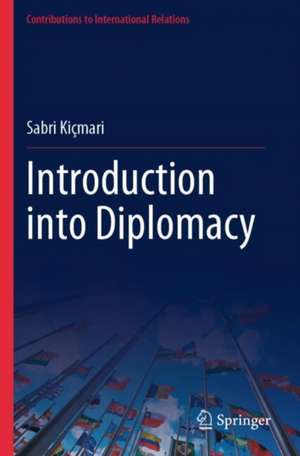
Introduction into Diplomacy: Contributions to International Relations
Autor Sabri Kiçmarien Limba Engleză Paperback – 21 iul 2025
Diplomatic protocol is analysed as an instrument, guiding the position of political and diplomatic representatives according to the ranking system. Practical examples abound, with illustrations of protocol rules from the United States, the United Kingdom, Japan, Australia, France, Germany, China, and Kosovo. The pivotal role of language in diplomacy is discovered as a communication tool, alongside an examination of its specific significance. It also delves into public diplomacy, exploring its evolution over the three two decades, heavily influenced by media developments. The book also focuses on the establishment of sociology of diplomacy as a new independent discipline. It sheds light on the necessary scientific research procedures, both theoretical and empirical, grounded in descriptive methodologies, understanding, and sociological explanations of the diplomatic phenomena. A crucial part of the book examines the connection between diplomacy and ethics and asserts that while states naturally pursue their interests, adherence to ethical principles must remain steadfast. Finally, gain insights into the traits and characteristics of a modern diplomat as the book draws to a close.
Din seria Contributions to International Relations
- 24%
 Preț: 871.08 lei
 - 18%
 Preț: 896.75 lei
 - 18%
 Preț: 697.76 lei
 - 18%
 Preț: 892.43 lei
 - 15%
 Preț: 673.55 lei
 - 18%
 Preț: 698.36 lei
 - 18%
 Preț: 784.40 lei
 - 18%
 Preț: 807.38 lei
 - 18%
 Preț: 779.06 lei
 -
 Preț: 418.65 lei
 - 18%
 Preț: 1137.37 lei
 - 18%
 Preț: 778.44 lei
 - 18%
 Preț: 899.54 lei
 - 15%
 Preț: 670.68 lei
 - 18%
 Preț: 958.44 lei
 - 18%
 Preț: 914.22 lei
 - 18%
 Preț: 747.88 lei
 - 18%
 Preț: 792.45 lei
 - 15%
 Preț: 670.90 lei
 - 18%
 Preț: 756.61 lei
 - 18%
 Preț: 780.29 lei
 - 18%
 Preț: 816.47 lei
 - 18%
 Preț: 697.55 lei
 - 15%
 Preț: 666.20 lei
 -
 Preț: 340.88 lei
 - 18%
 Preț: 811.82 lei
 - 15%
 Preț: 670.48 lei
 - 24%
 Preț: 827.03 lei
 -
 Preț: 454.46 lei
 - 18%
 Preț: 980.62 lei
 - 18%
 Preț: 694.43 lei
 - 18%
 Preț: 952.09 lei
 - 18%
 Preț: 703.28 lei
 - 18%
 Preț: 793.47 lei
 - 18%
 Preț: 753.73 lei
 - 18%
 Preț: 904.19 lei
Preț: 479.80 lei
Preț vechi: 592.34 lei
-19%
Puncte Express: 720
Carte disponibilă
Livrare economică 02-09 noiembrie
Livrare express 22-28 octombrie pentru 53.11 lei
Livrare prin curier în România Termenul estimat este afișat lângă disponibilitate.
Transport gratuit pentru acest produs Plată online sau ramburs, în funcție de opțiunile comenzii.
Retur gratuit în 14 zile Comandă securizată și suport în română.
Specificații
ISBN-13: 9789819738991
ISBN-10: 9819738997
Pagini: 208
Dimensiuni: 155 x 235 x 12 mm
Greutate: 0.32 kg
Editura: Springer
Colecția Contributions to International Relations
Seria Contributions to International Relations
ISBN-10: 9819738997
Pagini: 208
Dimensiuni: 155 x 235 x 12 mm
Greutate: 0.32 kg
Editura: Springer
Colecția Contributions to International Relations
Seria Contributions to International Relations
Cuprins
Definition of diplomacy.- History of diplomacy.- Classics of diplomacy.- Theories on International Relations.- Functions of diplomacy.
Notă biografică
Dr. Sabri Kiçmari, is the Ambassador of the Republic of Kosovo in Japan and has been a prominent public intellectual in his country for many years. Before this role, he had the distinction of being the first Ambassador of Kosovo to both Austria (2008-2013) and Australia (2013-2018). Notably, he is an accomplished author with six published books, including his latest work, History Continues – Three Models of the Continuation of History, which was released by Palgrave Macmillan in 2022. Dr. Sabri Kiçmari, holds a PhD in political science and sociology from the Institute of Political Science and Sociology, graduated from the Rheinische-Friedrich-Wilhelms-Universität in Bonn, Germany.
Textul de pe ultima copertă
The textbook is a rarity as it explores the functions of diplomacy from a practical perspective on diplomatic activity. This in-depth study redefines diplomacy, distinguishing it from conventional definitions. While the historical context of diplomacy is briefly discussed, the spotlight then turns to six diplomatic classics: Niccolo Machiavelli, Hugo Grotius, Ernest Satow, Harold Nicolson, Henry Kissinger, and Geoff R. Berridge. Thus, their brief biographies and core diplomatic tenets are revealed. Many aspects of the theories of international relations are covered, including liberalism, realism, neoliberal institutionalism, and constructivism.
Diplomatic protocol is analysed as an instrument, guiding the position of political and diplomatic representatives according to the ranking system. Practical examples abound, with illustrations of protocol rules from the United States, the United Kingdom, Japan, Australia, France, Germany, China, and Kosovo. The pivotal role of language in diplomacy is discovered as a communication tool, alongside an examination of its specific significance. It also delves into public diplomacy, exploring its evolution over the three two decades, heavily influenced by media developments. The book also focuses on the establishment of sociology of diplomacy as a new independent discipline. It sheds light on the necessary scientific research procedures, both theoretical and empirical, grounded in descriptive methodologies, understanding, and sociological explanations of the diplomatic phenomena. A crucial part of the book examines the connection between diplomacy and ethics and asserts that while states naturally pursue their interests, adherence to ethical principles must remain steadfast. Finally, gain insights into the traits and characteristics of a modern diplomat as the book draws to a close.
Diplomatic protocol is analysed as an instrument, guiding the position of political and diplomatic representatives according to the ranking system. Practical examples abound, with illustrations of protocol rules from the United States, the United Kingdom, Japan, Australia, France, Germany, China, and Kosovo. The pivotal role of language in diplomacy is discovered as a communication tool, alongside an examination of its specific significance. It also delves into public diplomacy, exploring its evolution over the three two decades, heavily influenced by media developments. The book also focuses on the establishment of sociology of diplomacy as a new independent discipline. It sheds light on the necessary scientific research procedures, both theoretical and empirical, grounded in descriptive methodologies, understanding, and sociological explanations of the diplomatic phenomena. A crucial part of the book examines the connection between diplomacy and ethics and asserts that while states naturally pursue their interests, adherence to ethical principles must remain steadfast. Finally, gain insights into the traits and characteristics of a modern diplomat as the book draws to a close.