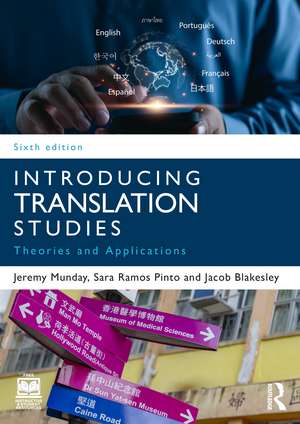
Introducing Translation Studies: Theories and Applications
Autor Jeremy Munday, Sara Ramos Pinto, Jacob Blakesleyen Limba Engleză Paperback – 5 mar 2026
This sixth edition has been substantially revised throughout to include important new material, and it continues to provide a balanced and detailed guide to the theoretical landscape. The theories are applied to a wide range of languages, including Arabic, Bengali, Chinese, English, Punjabi, Portuguese, French and German. A broad spectrum of texts is analysed, including websites, European Union documents, travel brochures, children’s books, Buddhist sutras, literary texts and films. Each chapter comprises an introduction outlining the theories, illustrative texts with translations, case studies, a chapter summary, and discussion points and exercises.
New features in this sixth edition include:
- Updated content reflecting current research and practice: every chapter of this new edition incorporates recent developments, notably in multimodal communication, cognitive approaches to translation, translation and gender, the ideology of translation, and hermeneutics. It also offers a more globally balanced representation of theoretical perspectives and includes a newly structured discussion on translation in the digital age, including the impact of machine translation and AI-powered large language models
- Revised discussion points and refreshed data: figures and tables have been updated throughout to reflect the most recent information
- New in-chapter activities, with integrated links to online resources and articles, encouraging independent research and deeper engagement
- Extensive updated online resources: features include quizzes, flashcards, specially recorded new video introductions, curated journal articles for each chapter, helpful weblinks and downloadable PowerPoint slides to support instructors
Preț: 390.64 lei
Puncte Express: 586
Carte disponibilă
Livrare economică 07-21 noiembrie
Livrare express 24-30 octombrie pentru 45.35 lei
Livrare prin curier în România Termenul estimat este afișat lângă disponibilitate.
Transport gratuit de la 400.00 lei Plată online sau ramburs, în funcție de opțiunile comenzii.
Retur gratuit în 14 zile Comandă securizată și suport în română.
Specificații
ISBN-13: 9781032516561
ISBN-10: 1032516569
Pagini: 342
Ilustrații: 16 schwarz-weiße Abbildungen, 16 schwarz-weiße Zeichnungen, 11 schwarz-weiße Tabellen
Dimensiuni: 174 x 246 mm
Greutate: 0.68 kg
Ediția:6th edition
Editura: Taylor & Francis
Colecția Routledge
Locul publicării:Oxford, United Kingdom
ISBN-10: 1032516569
Pagini: 342
Ilustrații: 16 schwarz-weiße Abbildungen, 16 schwarz-weiße Zeichnungen, 11 schwarz-weiße Tabellen
Dimensiuni: 174 x 246 mm
Greutate: 0.68 kg
Ediția:6th edition
Editura: Taylor & Francis
Colecția Routledge
Locul publicării:Oxford, United Kingdom
V-ar putea interesa
-
 Spanish Vocabulary BuilderJeremy Munday-30%Preț: 138.75 lei199.01 lei
 -
 -18%Preț: 1112.48 lei1356.68 lei
 -
 Preț: 512.76 lei
 -
 How Conversation WorksRonald WardhaughPreț: 418.28 lei
 -
 Preț: 427.55 lei
 -
 Teaching Oral CommunicationWilliam LittlewoodPreț: 412.08 lei
 -
 Language Teaching and Skill LearningKeith JohnsonPreț: 418.37 lei
 -
 -23%Preț: 502.25 lei652.28 lei
 -
 BeowulfAdrian MitchellPreț: 501.75 lei
 -
 Dynamic SyntaxKempson-23%Preț: 474.91 lei616.77 lei
 -
 Islamic State in Translation: Four Atrocities, Multiple NarrativesDr Balsam Mustafa-29%Preț: 197.36 lei279.33 lei
 -
 -36%Preț: 614.78 lei958.70 lei
 -
 Preț: 320.67 lei
 -
 Walther von der Vogelweide WörterbuchDörte Meeßen-14%Preț: 741.57 lei862.29 lei
 -
 Ein Meister an der Peripherie des KapitalismusRoberto Schwarz-19%Preț: 564.87 lei697.37 lei
 -
 Nationalgeschichte erzählenNicholas Beckmann-19%Preț: 615.47 lei759.84 lei
 -
 Epistemologien der GesteLuca Viglialoro-15%Preț: 545.65 lei641.95 lei
 -
 -17%Preț: 188.08 lei225.50 lei
Public țintă
Postgraduate and UndergraduateCuprins
A visual tour of Introducing Translation Studies
List of figures
List of tables
Ackowledgements
Abbreviations
Introduction
Chapter 1 Main issues of translation studies
1.0 Introduction
1.1 The concept of translation
1.2 What is translation studies?
1.3 An early history of the discipline
1.4 The Holmes/Toury ‘map’
1.5 Developments since Holmes
1.6 The van Doorslaer ‘map’
1.7 Audiovisual translation
1.8 Discipline, interdiscipline or multidiscipline?
Chapter 2 The basic concepts of early translation theory
2.0 Introduction
2.1 ‘Word-for-word’ or ‘sense-for-sense’?
2.2 Early Chinese and Arabic discourse on translation
2.3 European Humanism and the Protestant Reformation
2.4 Fidelity, spirit and truth
2.5 Early attempts at systematic translation theory: Dryden, Dolet, Tytler and Yán Fù
2.6 Schleiermacher and the valorization of the foreign
2.7 Towards contemporary translation theory
Chapter 3 Equivalence and meaning
3.0 Introduction
3.1 Roman Jakobson: the nature of linguistic meaning and equivalence
3.2 Nida and ‘the science of translating’
3.3 Koller: equivalence relations
3.4 Later developments in equivalence
Chapter 4 Studying translation product and process
4.0 Introduction
4.1 Vinay and Darbelnet’s model
4.2 Catford and translation ‘shifts’
4.3 Further influence and other proposed models
4.4 Option, markedness and stylistic shifts in translation
4.5 Corpus translation studies
4.6 The cognitive process of translation
Chapter 5 Functional theories of translation
5.0 Introduction
5.1 Text type and genre
5.2 Translatorial action
5.3 Skopos theory
5.4 Translation-oriented text analysis
Chapter 6 Discourse and Register analysis approaches
6.0 Introduction
6.1 The Hallidayan model of language and discourse
6.2 House’s model of translation quality assessment
6.3 Baker’s text and pragmatic level analysis
6.4 Hatim and Mason: the levels of context and discourse
6.5 The appraisal framework
6.6 Criticisms of discourse and Register analysis approaches to translation
6.7 Socio-narrative theory
Chapter 7 Systems theories
7.0 Introduction
7.1 Polysystem theory
7.2 Toury and descriptive translation studies
7.3 Chesterman’s translation norms
7.4 Other models of descriptive translation studies: Lambert and van Gorp and the Manipulation School
Chapter 8 Cultural and ideological turns
8.0 Introduction
8.1 Translation as rewriting
8.2 Translation, gender studies and feminist studies
8.3 Queer translation
8.4 Transgender/trans* translation
8.5 Postcolonial translation theory
8.6 The ideologies of the theorists
8.7 Translation, ideology and power in other contexts
Chapter 9 The role of the translator: visibility, ethics and sociology
9.0 Introduction
9.1 The cultural and political agenda of translation
9.2 The position and positionality of the translator
9.3 The sociology and historiography of translation
9.4 The power network of the translation industry
9.5 Paratexts in translation
Chapter 10 Translation, philosophy and other interdisciplinary research
10.0 Introduction
10.1 Steiner’s hermeneutic motion
10.2 The task of the translator vs. the translator’s task: Walter Benjamin
10.3 Deconstruction
10.4 Cannibalist theory of translation
Chapter 11 New directions and challenges
11.0 Introduction
11.1 New debates on the limits of translation
11.2 From target audience to participatory communities
11.3 Translation in the digital age of globalization
11.4 Eco-translation, labour issues and sustainability
Chapter 12 Research and commentary projects
12.0 Introduction
12.1 Towards a reconceptualization of translation in translation studies
12.2 Translation commentaries
12.3 Research projects in translation studies
Bibliography
Index
List of figures
List of tables
Ackowledgements
Abbreviations
Introduction
Chapter 1 Main issues of translation studies
1.0 Introduction
1.1 The concept of translation
1.2 What is translation studies?
1.3 An early history of the discipline
1.4 The Holmes/Toury ‘map’
1.5 Developments since Holmes
1.6 The van Doorslaer ‘map’
1.7 Audiovisual translation
1.8 Discipline, interdiscipline or multidiscipline?
Chapter 2 The basic concepts of early translation theory
2.0 Introduction
2.1 ‘Word-for-word’ or ‘sense-for-sense’?
2.2 Early Chinese and Arabic discourse on translation
2.3 European Humanism and the Protestant Reformation
2.4 Fidelity, spirit and truth
2.5 Early attempts at systematic translation theory: Dryden, Dolet, Tytler and Yán Fù
2.6 Schleiermacher and the valorization of the foreign
2.7 Towards contemporary translation theory
Chapter 3 Equivalence and meaning
3.0 Introduction
3.1 Roman Jakobson: the nature of linguistic meaning and equivalence
3.2 Nida and ‘the science of translating’
3.3 Koller: equivalence relations
3.4 Later developments in equivalence
Chapter 4 Studying translation product and process
4.0 Introduction
4.1 Vinay and Darbelnet’s model
4.2 Catford and translation ‘shifts’
4.3 Further influence and other proposed models
4.4 Option, markedness and stylistic shifts in translation
4.5 Corpus translation studies
4.6 The cognitive process of translation
Chapter 5 Functional theories of translation
5.0 Introduction
5.1 Text type and genre
5.2 Translatorial action
5.3 Skopos theory
5.4 Translation-oriented text analysis
Chapter 6 Discourse and Register analysis approaches
6.0 Introduction
6.1 The Hallidayan model of language and discourse
6.2 House’s model of translation quality assessment
6.3 Baker’s text and pragmatic level analysis
6.4 Hatim and Mason: the levels of context and discourse
6.5 The appraisal framework
6.6 Criticisms of discourse and Register analysis approaches to translation
6.7 Socio-narrative theory
Chapter 7 Systems theories
7.0 Introduction
7.1 Polysystem theory
7.2 Toury and descriptive translation studies
7.3 Chesterman’s translation norms
7.4 Other models of descriptive translation studies: Lambert and van Gorp and the Manipulation School
Chapter 8 Cultural and ideological turns
8.0 Introduction
8.1 Translation as rewriting
8.2 Translation, gender studies and feminist studies
8.3 Queer translation
8.4 Transgender/trans* translation
8.5 Postcolonial translation theory
8.6 The ideologies of the theorists
8.7 Translation, ideology and power in other contexts
Chapter 9 The role of the translator: visibility, ethics and sociology
9.0 Introduction
9.1 The cultural and political agenda of translation
9.2 The position and positionality of the translator
9.3 The sociology and historiography of translation
9.4 The power network of the translation industry
9.5 Paratexts in translation
Chapter 10 Translation, philosophy and other interdisciplinary research
10.0 Introduction
10.1 Steiner’s hermeneutic motion
10.2 The task of the translator vs. the translator’s task: Walter Benjamin
10.3 Deconstruction
10.4 Cannibalist theory of translation
Chapter 11 New directions and challenges
11.0 Introduction
11.1 New debates on the limits of translation
11.2 From target audience to participatory communities
11.3 Translation in the digital age of globalization
11.4 Eco-translation, labour issues and sustainability
Chapter 12 Research and commentary projects
12.0 Introduction
12.1 Towards a reconceptualization of translation in translation studies
12.2 Translation commentaries
12.3 Research projects in translation studies
Bibliography
Index
Recenzii
'Introducing Translation Studies is one of the ultimate textbooks for any translation studies programme worldwide. This new edition marks the twenty-fifth anniversary of the first edition being published and it does not disappoint. It is good to see theories applied to a range of languages beyond European languages, including Arabic, Bengali, Chinese and Punjabi. It is an incredible resource, and as an educator I cannot wait to share it with my students.'
Charlotte Bosseaux, University of Edinburgh
'This new edition of Introducing Translation Studies isn't just a textbook; it's a passport to the vibrant world of translation studies. With its updated content and interactive features, it's the ultimate companion for global trekkers of translation and interpreting.'
Defeng Li, Macau University, China
'In my opinion, this is the standard textbook for translation theory, and it is used all over the world. In fact, we find it so useful that we have decided to translate it into Swedish to make it more accessible to our students.'
Jan Pedersen, Stockholm University, Sweden
Charlotte Bosseaux, University of Edinburgh
'This new edition of Introducing Translation Studies isn't just a textbook; it's a passport to the vibrant world of translation studies. With its updated content and interactive features, it's the ultimate companion for global trekkers of translation and interpreting.'
Defeng Li, Macau University, China
'In my opinion, this is the standard textbook for translation theory, and it is used all over the world. In fact, we find it so useful that we have decided to translate it into Swedish to make it more accessible to our students.'
Jan Pedersen, Stockholm University, Sweden
Notă biografică
Jeremy Munday is Emeritus Professor of Translation Studies at the University of Leeds and is an experienced translator. His Introducing Translation Studies was first published in 2001 and has been translated into some 15 languages. He is also the author of Style and Ideology in Translation (Routledge 2008) and Evaluation in Translation (Routledge 2012).
Sara Ramos Pinto is an Associate Professor in Translation Studies at the University of Leeds, Vice President of EST and Associate Editor of Target. Her work focuses on audiovisual translation and multimodality, and her recent publications include 'To the Verbal and Beyond: A reception study on the limits of subtitling' (2025).
Jacob Blakesley is Associate Professor in Comparative Literature at Sapienza University of Rome. He is the author of A Sociological Approach to Poetry Translation: Modern European Poet-Translators (Routledge 2018). He is co-series editor (with Duncan Large) of the Routledge Studies in Literary Translation series and co-series editor (with Matthew Treherne) of the Leeds Studies on Dante series.
Sara Ramos Pinto is an Associate Professor in Translation Studies at the University of Leeds, Vice President of EST and Associate Editor of Target. Her work focuses on audiovisual translation and multimodality, and her recent publications include 'To the Verbal and Beyond: A reception study on the limits of subtitling' (2025).
Jacob Blakesley is Associate Professor in Comparative Literature at Sapienza University of Rome. He is the author of A Sociological Approach to Poetry Translation: Modern European Poet-Translators (Routledge 2018). He is co-series editor (with Duncan Large) of the Routledge Studies in Literary Translation series and co-series editor (with Matthew Treherne) of the Leeds Studies on Dante series.
Descriere
Introducing Translation Studies: 6th edition offers updated theory across languages. New content includes AI translation, interactive activities, and online resources. Essential for translation students worldwide.