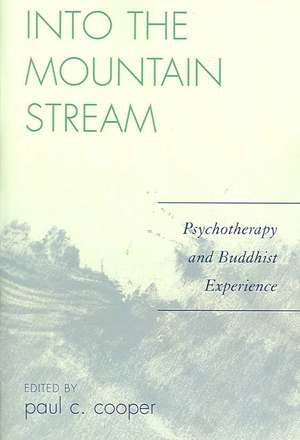
Into the Mountain Stream: Psychotherapy and Buddhist Experience
Editat de Paul C. Cooper Contribuţii de Paul Cooper, Jeffrey L. Eaton, Mark Finn, Susan Flynn, Joan Hoeberichts, Robert Jonas, Barry Magid, Jeffrey Rubin, Susan Rudnick, Marjorie Schuman, Tony Stern, Dorothy Yangen Limba Engleză Paperback – 26 ian 2007
Preț: 456.07 lei
Preț vechi: 607.09 lei
-25%
Puncte Express: 684
Carte tipărită la comandă
Livrare economică 27 noiembrie-11 decembrie
Livrare prin curier în România Termenul estimat este afișat lângă disponibilitate.
Transport gratuit pentru acest produs Plată online sau ramburs, în funcție de opțiunile comenzii.
Retur gratuit în 14 zile Comandă securizată și suport în română.
Specificații
ISBN-13: 9780765704658
ISBN-10: 076570465X
Pagini: 212
Dimensiuni: 150 x 232 x 16 mm
Greutate: 0.36 kg
Editura: Bloomsbury Publishing
Colecția Jason Aronson Inc
Locul publicării:New York, United States
ISBN-10: 076570465X
Pagini: 212
Dimensiuni: 150 x 232 x 16 mm
Greutate: 0.36 kg
Editura: Bloomsbury Publishing
Colecția Jason Aronson Inc
Locul publicării:New York, United States
V-ar putea interesa
-
 -5%Preț: 717.52 lei755.28 lei
 -
 The Complete Systemic SupervisorCheryl L. Storm-5%Preț: 392.48 lei413.14 lei
 -
 Cognitive Behavioral Group TheSöchting-5%Preț: 420.01 lei442.11 lei
 -
 MindfulnessRichard W. SearsPreț: 127.68 lei
 -
 Paradox and Passion in PsychotherapyEmmy Van DeurzenPreț: 322.90 lei
 -
 Mindfulness and Schema TherapyMichiel van Vreeswijk-5%Preț: 342.47 lei360.49 lei
 -
 Schema Therapy with Couples - A Practitioner'sGuide to Healing RelationshipsChiara Simeone-DifrancescoPreț: 398.35 lei
 -
 The First Interview, Fourth Edition: Fourth EditionJames Morrison-5%Preț: 526.22 lei553.91 lei
 -
 Breast Cancer Screening and DiagnosisMahesh K Shetty-5%Preț: 1178.18 lei1240.18 lei
 -
 ACT It OutStefanie Auerbach Stolinsky-5%Preț: 106.44 lei112.04 lei
Cuprins
Chapter 1 Introduction
Chapter 2 Reflections from the Margin
Chapter 3 Coming Home to Wholeness
Chapter 4 From Nowhere to Now Here
Chapter 5 Don't Remove Delusion
Chapter 6 The Light of Faithful Awareness
Chapter 7 Driven to Distraction
Chapter 8 Through the Net
Chapter 9 Cigarette Smoke & Incense
Chapter 10 Oscillations
Chapter 11 Staying Honest
Chapter 12 Bringing Practice Home
Chapter 13 A Transformational Moment
Chapter 2 Reflections from the Margin
Chapter 3 Coming Home to Wholeness
Chapter 4 From Nowhere to Now Here
Chapter 5 Don't Remove Delusion
Chapter 6 The Light of Faithful Awareness
Chapter 7 Driven to Distraction
Chapter 8 Through the Net
Chapter 9 Cigarette Smoke & Incense
Chapter 10 Oscillations
Chapter 11 Staying Honest
Chapter 12 Bringing Practice Home
Chapter 13 A Transformational Moment
Recenzii
The 12 essays in this volume all contribute rich material to the problem of how to suffer life as we encounter it, and it is noteworthy that much of the volume is composed of reports of the journeys that the authors have made in learning about their own suffering. The authors do convey the importance of Buddhist practice and make it clear that any convergence is not the result of simply taking an element here and there and tossing it into a psychological treatment plan. Clearly the reader walks away witha sense of the importance of many years of practice to make integration effective. From this collection the reader will appreciate that the basis of human suffering follows from the construction of an individual's life...
Paul C. Cooper has given us a most interesting and accessible anthology concerning the developing conversation between Buddhism and psychoanalysis. In twelve fairly short, thoughtful, and provocative chapters we read clear examples of how Buddhist-inspired psychoanalytic practitioners use their sensibilities and emotional responsiveness to enhance their clinical work and their own personal lives. In summary, this multitextured volume includes some theory, philosophy, technique, and, most of all, descriptions of the personal experiences of the contributors as patients, as clinicians, and as Buddhist practitioners. It is a book well worth reading if you want to expand and enrich your knowledge and experiential sense of what Buddhistinspired psychoanalystsare doing with their patients. Perhaps most importantly, Cooper and his contributors have given us a sense of how some analysts struggle to achieve a modicum of autonomy, inner peace, and goodness, using a Buddhist-inspired psychoanalytic perspective..
Pushed by an inner imperative to engage both Buddhist and psychoanalytic practices wholeheartedly, the writers of these essays are on fire with their struggle to articulate their lived experience of an as-yet-undelineated frontier of embodied mind where psyche and spirit converge. The result is a splendid feast of stories of people who have sought, with bone-deep courage and unflinching honesty, to honor both their hearts and their intellect in their personal and professional pursuit of truth. They will be called 'pushers of boundaries,' 'troublemakers' and 'keepers of the gateless gates'.
Paul C. Cooper has given us a most interesting and accessible anthology concerning the developing conversation between Buddhism and psychoanalysis. In twelve fairly short, thoughtful, and provocative chapters we read clear examples of how Buddhist-inspired psychoanalytic practitioners use their sensibilities and emotional responsiveness to enhance their clinical work and their own personal lives. In summary, this multitextured volume includes some theory, philosophy, technique, and, most of all, descriptions of the personal experiences of the contributors as patients, as clinicians, and as Buddhist practitioners. It is a book well worth reading if you want to expand and enrich your knowledge and experiential sense of what Buddhistinspired psychoanalystsare doing with their patients. Perhaps most importantly, Cooper and his contributors have given us a sense of how some analysts struggle to achieve a modicum of autonomy, inner peace, and goodness, using a Buddhist-inspired psychoanalytic perspective..
Pushed by an inner imperative to engage both Buddhist and psychoanalytic practices wholeheartedly, the writers of these essays are on fire with their struggle to articulate their lived experience of an as-yet-undelineated frontier of embodied mind where psyche and spirit converge. The result is a splendid feast of stories of people who have sought, with bone-deep courage and unflinching honesty, to honor both their hearts and their intellect in their personal and professional pursuit of truth. They will be called 'pushers of boundaries,' 'troublemakers' and 'keepers of the gateless gates'.