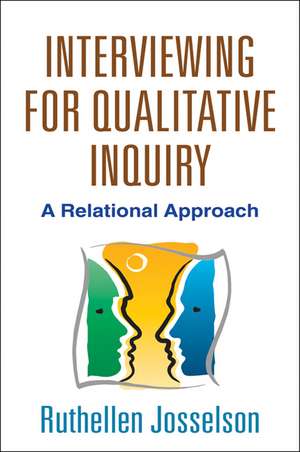
Interviewing for Qualitative Inquiry: A Relational Approach
Autor Ruthellen Josselsonen Limba Engleză Paperback – 10 mai 2013
În literatura academică dedicată metodologiei, adesea se pune accentul pe rigoarea tehnică a colectării datelor, lăsând un gol imens în ceea ce privește gestionarea interacțiunii umane dintre cercetător și subiect. Interviewing for Qualitative Inquiry vine să completeze această lacună, propunând o perspectivă originală: interviul nu ca simplu instrument de extracție a informației, ci ca o relație dinamică și empatică. Găsim în această lucrare o trecere de la procedurile rigide la o „abordare relațională”, unde calitatea datelor depinde fundamental de capacitatea cercetătorului de a cultiva o prezență umană autentică.
Structura volumului este una progresivă și aplicată, pornind de la fundamentele teoretice și planificare, trecând prin arta ascultării și terminând cu gestionarea momentelor dificile. Reținem capitolele dedicate interviurilor „eșuate”, care oferă o lecție rară în manualele de specialitate: analiza erorilor ca metodă de învățare. Cititorii familiarizați cu Interviewing in Depth de John T. Chirban vor aprecia modul în care Ruthellen Josselson rafinează conceptul de profunzime, adăugând o dimensiune pedagogică prin exerciții practice derivate din propriile sale ateliere de lucru.
Această carte reprezintă o sinteză matură în opera autorului. Dacă în Paths to Fulfillment sau Best Friends am văzut rezultatele cercetării sale longitudinale asupra identității feminine, iar în Essentials of Narrative Analysis ne-a oferit cadrul teoretic al analizei poveștilor de viață, volumul de față dezvăluie mecanismul din spatele acestor succese: cum să obții acele narațiuni bogate și semnificative. Este un ghid care transformă interviul dintr-o sarcină administrativă într-o practică reflexivă și etică.
Preț: 265.86 lei
Carte disponibilă
Livrare economică 02-16 noiembrie
Specificații
ISBN-10: 1462510000
Pagini: 206
Dimensiuni: 152 x 229 x 15 mm
Greutate: 0.41 kg
Ediția:1
Editura: Guilford Publications
Colecția Guilford Press
V-ar putea interesa
-
 Structural Equation ModelingNatasha K. Bowen-22%Preț: 422.11 lei539.08 lei
 -
 Ethnographic MethodsKaren O'ReillyPreț: 430.20 lei
 -
 -8%Preț: 453.14 lei492.54 lei
 -
 Preț: 477.73 lei
 -
 Telling Lives: Exploring dimensions of narrativesMarianne HorsdalPreț: 417.56 lei
 -
 Weber and Durkheim: A Methodological ComparisonHenrik JensenPreț: 411.78 lei
 -
 Basic Statistics for Social ResearchRobert A Hanneman-19%Preț: 593.13 lei732.26 lei
 -
 Longitudinal Data Analysis for the Behavioral Sciences Using RJeffrey D. Long-27%Preț: 942.96 lei1291.72 lei
 -
 Conducting Online SurveysValerie M. Sue-15%Preț: 615.32 lei723.91 lei
 -
 Multiple Case Study AnalysisRobert E. Stake-8%Preț: 430.36 lei467.78 lei
 -
 -8%Preț: 445.58 lei484.33 lei
 -
 2010 Census: Operations & OutcomesKatherine M de Luca-27%Preț: 1383.05 lei1887.03 lei
De ce să citești această carte
Această carte este indispensabilă studenților și cercetătorilor din științele sociale care doresc să depășească nivelul întrebărilor standard. Cititorul câștigă nu doar o metodologie, ci și abilități practice de ascultare empatică și gestionare a eticii în teren. Prin exemplele „așa da/așa nu” și anexele cu modele de consimțământ, volumul oferă un set de instrumente complete pentru a conduce interviuri care să genereze date calitative de o profunzime superioară.
Despre autor
Ruthellen Josselson este profesor de psihologie la Towson State University și psihoterapeut cu o vastă experiență clinică, element care își pune amprenta asupra viziunii sale metodologice. Recunoscută la nivel internațional pentru contribuțiile sale în psihologia narativă, a fost distinsă cu Premiul Henry A. Murray de către American Psychological Association în 1994. A predat ca profesor invitat la universități prestigioase precum Harvard și Hebrew University of Jerusalem. Expertiza sa îmbină rigoarea academică a cercetării calitative cu sensibilitatea terapeutică, oferind o perspectivă unică asupra modului în care identitatea umană este construită prin dialog și relație.
Notă biografică
Recenzii
This is a methodological bible for graduate students, undergraduates, and faculty members interested in conducting interviews, gathering life stories, and building a narrative intimacy with participants. Slender but deep, the volume offers respectful support to qualitative researchers so that we may venture into unsteady territory, muster the courage to be psychologically attentive and engaged, and not stumble. With a delicate braid of narrative theory, methodological guideposts, and a terrifically useful list of interview dos and don'ts, Josselson is an intellectually thrilling and methodologically wise escort for novice and experienced interviewers alike. You will want to read this book immediately, teach it, and then pull it out again when you are about to begin another project. It is classic Josselson--compelling, brilliant, and irresistible.--Michelle Fine, PhD, Doctoral Program in Psychology, The Graduate Center, City University of New York
Josselson's book is a gold mine for those who conduct research interviews in order to understand people's experiences on their own terms. Drawing on decades of experience as a researcher and teacher, Josselson provides practical guidance about how to carry out interviews that balance human connection with scientific inquiry. This book should be required reading for all social scientists engaged in interview research; my students will certainly be reading it!--Harold D. Grotevant, PhD, Rudd Family Foundation Chair in Psychology, University of Massachusetts Amherst
A thoughtful account of how to conduct interviews that invite participants to talk. It does a wonderful job of placing the interviewer/n-/interviewee relationship front and center, something often overlooked or inadequately addressed in other books about interviewing for research. It does a terrific job of explaining the difference between interviewing for qualitative research purposes and interviewing for other reasons. I loved that the text was filled with excerpts from transcripts and that these were from interviews about a variety of topics.--Carey E. Andrzejewski, PhD, Department of Educational Foundations, Leadership, and Technology, Auburn University
This is a very well-presented text on conducting interviews. I particularly like the examples of difficult interviews. These examples, along with the refining questions, are major strengths of the book.--Elizabeth Monk-Turner, PhD, Department of Sociology and Criminal Justice, Old Dominion University
Cuprins
2. Introduction to the Research Relationship
3. Planning the Interview
4. Beginning the Interview
5. The Empathic Attitude of Listening
6. The Research Relationship, Part II: Ethics and Humanity
7. The Good Interview
8. Learning from Bad and Difficult Interviews
9. Dos and Don'ts of Interviewing
10. After the Interview
11. Conclusion
Appendix A. Interview Aids
Appendix B. Sample Additional Questions
Appendix C. Sample Informed Consent Form
Descriere
Pedagogical features include:
*Practice exercises adapted from Josselson's popular workshops.
*Annotated examples of ""good"" and ""bad"" interviews.
*A chapter on interviewing dos and don'ts.
*Appendices with interview aids, sample follow-up questions, and a sample consent form.