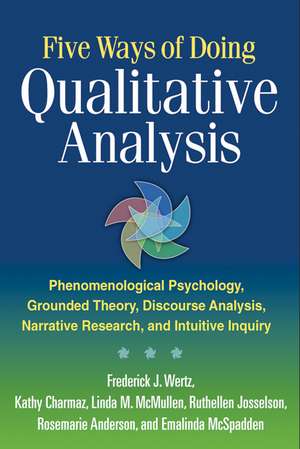
Five Ways of Doing Qualitative Analysis: Phenomenological Psychology, Grounded Theory, Discourse Analysis, Narrative Research, and Intuitive Inquiry
Autor Frederick J. Wertz, Emalinda McSpadden, Kathy Charmaz, Linda M. McMullen, Rosemarie Andersonen Limba Engleză Paperback – 13 mai 2011
Subliniem valoarea pedagogică unică a volumului Five Ways of Doing Qualitative Analysis, care reușește să transforme teoria abstractă în practică aplicată printr-un design experimental riguros. Această ediție se distinge prin modul în care aduce laolaltă cinci perspective metodologice fundamentale — psihologia fenomenologică, teoria fundamentată (grounded theory), analiza discursului, cercetarea narativă și interogația intuitivă — aplicându-le simultan asupra aceluiași material empiric: interviul „Teresa”, o tânără cântăreață de operă a cărei carieră este întreruptă de boală.
Descoperim aici o structură tripartită care facilitează progresia învățării. Prima parte contextualizează evoluția metodologiilor calitative în psihologie, de la practici inovatoare la stabilirea tradițiilor actuale. Partea a doua reprezintă nucleul cărții, unde Frederick J. Wertz, Kathy Charmaz și ceilalți coautori își prezintă analizele specifice, oferind cititorului posibilitatea de a vedea exact cum „lentila” cercetătorului modelează interpretarea datelor. Comparabil cu Analysing Qualitative Data in Psychology de Evanthia Lyons în rigurozitate, acest volum merge mai departe prin includerea reacțiilor subiectului analizat, oferind o perspectivă etică și reflexivă asupra validității cercetării.
Ultima secțiune a cărții este dedicată pluralismului și dialogului între metode. Analiza comparativă a celor cinci abordări evidențiază punctele forte și subiectivitatea inerentă fiecăreia. Un element distinctiv este includerea cazului „Gail”, un al doilea set de date brute care permite cititorului să exerseze tehnicile învățate. Este un instrument esențial pentru cercetătorii care doresc să înțeleagă nu doar „cum”, ci și „de ce” alegem o anumită metodă de analiză în științele sociale.
Preț: 445.58 lei
Preț vechi: 484.33 lei
-8%
Carte disponibilă
Livrare economică 17 noiembrie-01 decembrie
Livrare express 03-07 noiembrie pentru 34.12 lei
Specificații
ISBN-10: 1609181425
Pagini: 434
Dimensiuni: 156 x 234 x 22 mm
Greutate: 0.48 kg
Ediția:1
Editura: Guilford Publications
Colecția Guilford Press
V-ar putea interesa
-
 Preț: 67.84 lei
 -
 Health, Illness, and HealingKathy Charmaz-27%Preț: 1133.31 lei1552.48 lei
 -
 The Examined LifeStephen GroszPreț: 87.48 lei
 -
 The New Dictionary of Kleinian ThoughtElizabeth Bott SpilliusPreț: 444.47 lei
 -
 Psychoanalysis in the Technoculture EraAlessandra LemmaPreț: 430.08 lei
 -
 Conversation As MethodRuthellen Josselson-15%Preț: 610.93 lei718.75 lei
 -
 Transpersonal Research Methods for the Social SciencesRosemarie Anderson-18%Preț: 823.20 lei1003.91 lei
 -
 Playing Pygmalion: How People Create One AnotherRuthellen Josselson-32%Preț: 343.42 lei505.02 lei
 -
 Preț: 151.88 lei
 -
 Preț: 452.20 lei
 -
 Preț: 368.92 lei
 -
 Interviewing for Qualitative Inquiry: A Relational ApproachRuthellen JosselsonPreț: 279.69 lei
 -
 Lacan on LoveBruce Fink-5%Preț: 152.89 lei160.94 lei
 -
 Dynamical Social PsychologyAndrzej NowakPreț: 461.80 lei
 -
 Handbook of Experimental Existential PsychologyJeff Greenberg-27%Preț: 597.58 lei821.28 lei
 -
 The Fundamentals of Psychoanalytic TechniqueR. Horacio Etchegoyen-5%Preț: 590.56 lei621.64 lei
Public țintă
Professional Practice & DevelopmentDe ce să citești această carte
Această carte este indispensabilă pentru studenții și cercetătorii care doresc să stăpânească analiza calitativă dincolo de definițiile de dicționar. Prin aplicarea a cinci metode diferite pe același studiu de caz, cititorul câștigă o înțelegere profundă a modului în care alegerea metodologică influențează rezultatele cercetării. Este un ghid practic ce oferă atât demonstrații de la experți, cât și materiale pentru exercițiu individual.
Despre autor
Coordonată de Frederick J. Wertz, profesor de psihologie la Universitatea Fordham, lucrarea reunește un colectiv de autori de elită în domeniul metodologiei calitative. Printre aceștia se numără Kathy Charmaz, figură centrală în dezvoltarea Constructivist Grounded Theory, și Rosemarie Anderson, pionier al metodei Intuitive Inquiry. Expertiza lor combinată acoperă un spectru larg de tradiții, de la abordări post-pozitiviste la cele interpretative, transformând acest volum într-o referință academică de bază pentru psihologia contemporană și științele sociale.
Descriere scurtă
Notă biografică
Kathy Charmaz is Professor of Sociology and Director of the Faculty Writing Program at Sonoma State University. Much of her scholarship has either used or developed grounded theory methods. She has received mentoring and lifetime achievement awards from the Society for the Study of Symbolic Interaction.
Linda M. McMullen is Professor of Psychology at the University of Saskatchewan, where she served as department head and elected faculty member on the Board of Governors. Her research, which is qualitative and discursive in form, focuses on how people use language to do things and on how language shapes, and is shaped by, social and cultural contexts. She has received the Jillings Award from the Saskatchewan Psychological Association and the University of Saskatchewan Faculty Association Academic Freedom Award.
Ruthellen Josselson is Professor of Psychology at the Fielding Graduate University. Her work uses narrative approaches to investigate a variety of topics. She is a recipient of the American Psychological Association’s Henry A. Murray Award and Theodore R. Sarbin Award, and is a cofounder of the Society for Qualitative Inquiry.
Rosemarie Anderson is Professor of Transpersonal Psychology at the Institute of Transpersonal Psychology and an Episcopal priest. In addition to intuitive inquiry, Dr. Anderson has developed the Body Intelligence Scale, which measures three types of body awareness; embodied writing; and a model of human development that describes development from the perspective of the body. Her website is www.rosemarieanderson.com.
Emalinda McSpadden is a PhD candidate in the Applied Developmental Psychology program at Fordham University. She is a psychology instructor at Hunter College and Bronx Community College, and works as a group therapy moderator for cancer patients. Her current academic work focuses on employing mixed methodologies in developmental and lifespan research.
Recenzii
"Not only do the authors look at a common data set in five different ways, but they also reflect on how all five analyses look to each of them, and these explorations are 'looked back at' by the participant from whom the data set was derived. This book provides an engaging and intimate view of the many selves it takes to bring qualitative analyses into being and the reflexive practices that contribute to the scientific and ethical integrity of research."--Margarete Sandelowski, PhD, RN, FAAN, School of Nursing, University of North Carolina at Chapel Hill
"This unique work is a wholly absorbing adventure in comparative methodology. For the student, it will serve as an effective and informative introduction to a range of central qualitative methodologies. For the seasoned scholar, it provides a wonderfully nuanced view of the complex processes of decision making in qualitative inquiry. The book challenges us to grapple with major issues: the goals of our work, its functions in the social world, and its ethical implications. This is a landmark work in the development of qualitative inquiry."--Kenneth J. Gergen, PhD, Department of Psychology, Swarthmore College
"The logic of the book is transparent: it presents a narrative, multiple interpretations, and a comparison of the varied interpretations. The experience of walking through the various interpretations and then seeing how experts unpack the differences and similarities among them is remarkable. Although many books are written for introductory courses on qualitative methods, very few authors attend to how the structure of a text--not just its content--might be pedagogically significant. I applaud Wertz et al. for thinking explicitly and intentionally about how to conceptualize and organize their text in a way that facilitates learning."--Suzanne M. Wilson, PhD, Department of Teacher Education and Director, Center for the Scholarship of Teaching, Michigan State University
"This text addresses one of the most frequently asked questions in qualitative analysis: what is the difference between phenomenology, grounded theory, discourse analysis, narrative research, and intuitive inquiry? The authors explain the theory that underlies each approach and illustrate its application and the resultant findings, making the book a worthy text for a qualitative methods course. As an added bonus, the authors present the participant's reaction to the results of the five different analyses and discuss the ethical implications in terms of letting the participant speak for herself, issues of confidentiality, and tensions around interpretation of data. I would definitely use this book in my advanced qualitative research course."--Donna M. Mertens, PhD, Department of Educational Foundations and Research, Gallaudet University
"A powerful, richly nuanced, brilliantly innovative pedagogical intervention into the field of qualitative inquiry. This book is clearly written, grounded in case materials, and very accessible to students. The narrative is driven by the voices and insights of preeminent scholars, each an expert in one of five ways of doing qualitative analysis. This book represents the most innovative approach to date for teaching qualitative analysis. It will provide a starting place for the next generation of students who want to learn how to be well-grounded qualitative inquirers."--Norman K. Denzin, PhD, College of Communications Scholar, University of Illinois at Urbana-Champaign