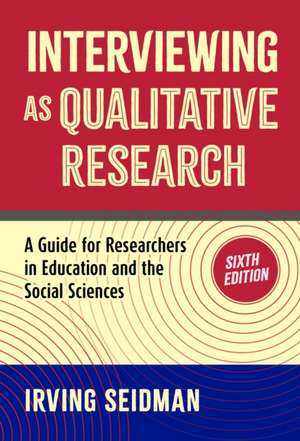
Interviewing as Qualitative Research
Autor Irving Seidmanen Limba Engleză Paperback – 24 iul 2026
For decades, Irving Seidman’s Interviewing as Qualitative Research has served as the leading resource for both new and experienced researchers in education, the social sciences, and the humanities. Now in its sixth edition, this popular text continues to provide comprehensive, step-by-step guidance on phenomenological interviewing, offering a clear and inviting rationale for using in-depth interviewing as a research method.
This significant revision introduces a groundbreaking new chapter by Robert W. Maloy which grapples with the ethical complexities and practical potentials of artificial intelligence. Readers will discover how AI can make vast sets of transcripts accessible and assist in tracking themes and generating profiles—all while maintaining the researcher's vital direct engagement with their participants' stories.
From selecting participants and obtaining informed consent to analyzing and working with final results, this edition addresses the quickly changing challenges of the modern research landscape. With updated references and guidance for interviewing abroad or with children, this book remains an essential resource for doctoral and master’s students and professional researchers across the humanities and social sciences.
Key Features of the Sixth Edition:
- Integrating AI in Research: A dedicated new chapter on the possibilities and problems of using AI to analyze data and manage large-scale transcript sets.
- Ethical Guidance for New Technologies: Critical discussions on the ethical concerns that must guide the use of AI and other digital technologies in contemporary research settings.
- Phenomenological Focus: Refined techniques that stress the art of listening and avoiding leading questions to deepen understanding of participant experiences.
- Step-by-Step Methodology: Practical advice on the entire process, including navigating Institutional Review Boards (IRBs) and obtaining informed consent in diverse contexts.
- Real-World Examples: Features doctoral students’ research to demonstrate how interviewing can effectively address both everyday life and critical life-and-death issues.
- Contemporary Research Tools: Guidance for using technology to interview, including specific considerations for interviewing international participants and children.
Preț: 303.22 lei
Puncte Express: 455
Carte disponibilă
Livrare economică 17 noiembrie-01 decembrie
Livrare prin curier în România Termenul estimat este afișat lângă disponibilitate.
Transport gratuit de la 400.00 lei Plată online sau ramburs, în funcție de opțiunile comenzii.
Retur gratuit în 14 zile Comandă securizată și suport în română.
Specificații
ISBN-13: 9780807784891
ISBN-10: 0807784893
Pagini: 224
Dimensiuni: 157 x 229 x 11 mm
Greutate: 0.29 kg
Ediția:6th edition
Editura: Teachers College Press
ISBN-10: 0807784893
Pagini: 224
Dimensiuni: 157 x 229 x 11 mm
Greutate: 0.29 kg
Ediția:6th edition
Editura: Teachers College Press
Notă biografică
Irving Seidman is a professor emeritus of qualitative research and secondary teacher education at the School of Education, University of Massachusetts, Amherst. He is the author of Oswald Tippo and the Early Promise of the University of Massachusetts (2002), The Essential Career Guide to Becoming a Middle and High School Teacher with Robert Maloy (1999), In the Words of the Faculty (1985), and articles published under the name Earl Seidman.
Cuprins
Contents
Preface ix
Acknowledgments xi
Introduction: How I Came to Interviewing 1
1. Why Interview? 6
The Purpose of Interviewing 8
Interviewing: “The” Method or “A” Method? 8
Why Not Interview? 10
Conclusion 12
Note 12
2. A Structure for In-Depth, Phenomenological Interviewing 14
What Makes Interviewing Phenomenological and Why Does It Matter? 16
Phenomenological Theme One: The Temporal and Transitory Nature of Human Experience 16
Phenomenological Theme Two: Whose Understanding Is It? Subjective Understanding 17
Phenomenological Theme Three: Lived Experience as the Foundation of “Phenomena” 18
Phenomenological Theme Four: The Emphasis on Meaning and Meaning in Context 19
How Do These Phenomenological Themes Matter? 20
The Three-Interview Series 21
Respect the Structure 24
Alternatives to the Structure and Process 25
Length of Interviews 26
Spacing of Interviews 27
Whose Meaning Is It? Validity and Reliability 28
Experience the Process Yourself 32
3. Proposing Research: From Mind to Paper to Action 34
Research Proposals as Rites of Passage 34
Commitment 35
From Thought to Language 36
What Is to Be Done? 37
Questions to Structure the Proposal 37
Rationale 42
Working With the Material 43
Piloting Your Work 44
Conclusion 45
4. Establishing Access to, Making Contact With, and Selecting Participants 46
The Perils of Easy Access 46
Access Through Formal Gatekeepers 49
Informal Gatekeepers 51
Accessing Children 51
Access and Hierarchy 53
Making Contact 53
Make a Contact Visit in Person 54
Building the Participant Pool 56
Some Logistical Considerations 56
Selecting Participants 58
Snares to Avoid in the Selection Process 61
How Many Participants Are Enough? 62
5. The Path to Institutional Review Boards and Informed Consent 64
The Belmont Report 64
The Establishment of Local Institutional Review Boards 65
The Informed Consent Document 67
Seven Key Sections of an Informed Consent Document 68
Special Conditions for Children (Contributed by Julie Simpson) 80
Informed Consent When Using Technology to Interview (Contributed by Julie Simpson) 81
Informed Consent When Interviewing Abroad (Contributed by Julie Simpson) 82
The Complexities of Affirming the IRB Review Process and Informed Consent 84
6. Technique Isn’t Everything, but It Is a Lot 87
Listen More, Talk Less 87
Follow Up on What the Participant Says 90
Listen More, Talk Less, and Ask Real Questions 93
Follow Up, but Don’t Interrupt 94
Two Favorite Approaches 95
Ask Participants to Reconstruct, Not to Remember 97
Keep Participants Focused and Ask for Concrete Details 97
Do Not Take the Ebbs and Flows of Interviewing Too Personally 97
Limit Your Own Interaction 98
Explore Laughter 99
Follow Your Hunches 99
Use an Interview Guide Cautiously 100
Tolerate Silence 101
Conclusion 102
7. Interviewing as a Relationship 103
Interviewing as an “I–Thou” Relationship 103
Rapport 104
Social Group Identities and the Interviewing Relationship 107
Distinguish Among Private, Personal, and Public Experience 116
Avoid a Therapeutic Relationship 117
Reciprocity 118
Equity 119
Interviewing Online or by Telephone and the Relationship Between Participant and Interviewer 120
8. Analyzing, Interpreting, and Sharing Interview Material 124
Managing the Data 124
Keeping Interviewing and Analysis Separate: What to Do Between Interviews 125
Recording Interviews 126
Transcribing Interviews 127
Studying, Reducing, and Analyzing the Text 128
Sharing Interview Data: Profiles and Themes 130
Making and Analyzing Thematic Connections 136
Interpreting the Material 140
Note 141
9. Using AI as an In-Depth Interviewing Researcher 143
Robert W. Maloy
Generative AI’s Revolutionary Uniqueness 144
Using AI as an In-Depth Interviewing Researcher 145
Risks of AI in Research 147
Using AI for In-Depth Interviewing 149
A Pilot In-Depth Interview With and Without AI 152
Comparing Non-AI-Generated and AI-Generated Interview Analysis 156
The Ethics of Using AI in Your Research 157
Conclusion 159
10. The Ethics of Doing Good Work 161
Doing Good Work 161
The Reciprocity Implicit in Treating Participants With Dignity 165
Conclusion 166
Appendix: Two Profiles 167
Nanda: A Cambodian Survivor of the Pol Pot Era 167
Betty: A Long-Time Day Care Provider 174
References 179
Index 201
About the Authors 212
Descriere
Descriere de la o altă ediție sau format:
Provides step-by-step guidance for new and experienced researchers who want to use interviewing as a research method. This expanded edition explains the rationale for interviewing and the complexity of selecting interview participants, important interviewing techniques, and how to work with the results of interviews.
Provides step-by-step guidance for new and experienced researchers who want to use interviewing as a research method. This expanded edition explains the rationale for interviewing and the complexity of selecting interview participants, important interviewing techniques, and how to work with the results of interviews.