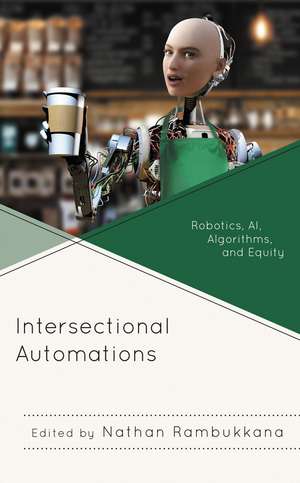
Intersectional Automations: Robotics, AI, Algorithms, and Equity
Editat de Nathan Rambukkana Contribuţii de Chloé L. Nurik, Maude Gauthier, Kim Sawchuk, Scott DeJong, Sebastián Gómez, Jordan Canzonetta, Nikila Lakshmanan, Julia A. Empey, Madelaine Ley, Jamie Foster Campbell, Kristina M. Green, Joep Bouma, Christopher M. Cox, tobias c. van Veenen Limba Engleză Paperback – 29 ian 2025
Preț: 221.74 lei
Preț vechi: 288.60 lei
-23%
Puncte Express: 333
Carte tipărită la comandă
Livrare economică 24 noiembrie-08 decembrie
Livrare prin curier în România Termenul estimat este afișat lângă disponibilitate.
Transport gratuit de la 400.00 lei Plată online sau ramburs, în funcție de opțiunile comenzii.
Retur gratuit în 14 zile Comandă securizată și suport în română.
Specificații
ISBN-13: 9781793620538
ISBN-10: 1793620539
Pagini: 292
Ilustrații: 4 b/w photos; 1 tables;
Dimensiuni: 150 x 226 x 18 mm
Greutate: 0.38 kg
Editura: Bloomsbury Publishing
Colecția Lexington Books
Locul publicării:New York, United States
ISBN-10: 1793620539
Pagini: 292
Ilustrații: 4 b/w photos; 1 tables;
Dimensiuni: 150 x 226 x 18 mm
Greutate: 0.38 kg
Editura: Bloomsbury Publishing
Colecția Lexington Books
Locul publicării:New York, United States
Cuprins
Acknowledgments
Introduction
Part 1: Algorithms, Machine Learning, and Inequity
Chapter 1 Blind Trust, Algorithmic Discrimination, and Self-Regulation in Facebook Advertisements by Chloé L. Nurik
Chapter 2 Faking Age? Ageing and the Algorithmic Assemblage by Kim Sawchuk, Scott DeJong, and Maude Gauthier
Chapter 3 It Was All Fun and Games: Gamewashing Automated Control by Sebastián Gómez
Chapter 4 From Automating to Informating: Toward a Productive Model of Human/Machine Collaboration in Higher Education by Jordan Canzonetta
Part 2: Robots and Social Justice
Chapter 5 The Misogyny of Transhumanism by Nikila Lakshmanan
Chapter 6 Are We All Too Human? Toward an Understanding of Posthumanism and Rights by Julia A. Empey
Chapter 7 Being Sophia: What Makes the World's First Robot Citizen? by Madelaine Ley
Chapter 8 Robosexuality and Its Discontents by Nathan Rambukkana
Chapter 9 Robots as Caretakers: Understanding Long-Term Relationships Between Humans and Carebots by Jamie Foster Campbell and Kristina
Introduction
Part 1: Algorithms, Machine Learning, and Inequity
Chapter 1 Blind Trust, Algorithmic Discrimination, and Self-Regulation in Facebook Advertisements by Chloé L. Nurik
Chapter 2 Faking Age? Ageing and the Algorithmic Assemblage by Kim Sawchuk, Scott DeJong, and Maude Gauthier
Chapter 3 It Was All Fun and Games: Gamewashing Automated Control by Sebastián Gómez
Chapter 4 From Automating to Informating: Toward a Productive Model of Human/Machine Collaboration in Higher Education by Jordan Canzonetta
Part 2: Robots and Social Justice
Chapter 5 The Misogyny of Transhumanism by Nikila Lakshmanan
Chapter 6 Are We All Too Human? Toward an Understanding of Posthumanism and Rights by Julia A. Empey
Chapter 7 Being Sophia: What Makes the World's First Robot Citizen? by Madelaine Ley
Chapter 8 Robosexuality and Its Discontents by Nathan Rambukkana
Chapter 9 Robots as Caretakers: Understanding Long-Term Relationships Between Humans and Carebots by Jamie Foster Campbell and Kristina
Recenzii
As robots, artificial intelligence, and algorithms become an ever-increasing part of daily life people are struggling to make sense of what the "fourth industrial revolution" will ultimately mean for their relationships and their place in this world. Intersectional Automations: Robotics, AI, Algorithms, and Equity interrogates some of the most pressing questions raised by the proliferation of smart technologies. Unlike much of what has been written about algorithmic and robotic culture, Intersectional Automations does not offer sweeping proclamations of utopian or dystopian futures informed by a single perspective. Instead, Nathan Rambukkana expertly threads together diverse academic voices into a smart edited collection that provides a more complex picture of the implications of emerging technologies and the choices individuals, organizations, and governments make surrounding them. Intersectional Automations is an integral read for scholars seeking a holistic perspective of the intricacies of communication and relationships between humans and machines.
This volume stands out first as its defining emphases on social justice expand well beyond central concerns with race, gender and class. The dialogical approach to ethics here is distinctive and vitally important, contra dominant "rulebook" approaches. The understandings of human-machine relations and our inextricable intertwinement with our technologies add critical nuance often missing elsewhere. Individual chapters explore a rich diversity of perspectives, technologies and domains, while conceptually cohering and speaking to one another along the way. I find the critical engagements within and between chapters concerning widely diverse posthumanisms and transhumanisms especially fruitful. The upshot is a most significant contribution to current and future debates across these domains.
Intersectional Automations: Robotics, AI, Algorithms, and Equity is a fine example of critical interactionist thought. This text will be of interest to those in advanced undergraduate courses or even by graduate students seeking to study new computer technologies. Scholars working in this realm will also be appreciative of a text that covers so many areas of study in one compendium.Moreover, its interdisciplinary focus shows us how much critical interpretive sociology has to offer to other fields and disciplines.
This volume stands out first as its defining emphases on social justice expand well beyond central concerns with race, gender and class. The dialogical approach to ethics here is distinctive and vitally important, contra dominant "rulebook" approaches. The understandings of human-machine relations and our inextricable intertwinement with our technologies add critical nuance often missing elsewhere. Individual chapters explore a rich diversity of perspectives, technologies and domains, while conceptually cohering and speaking to one another along the way. I find the critical engagements within and between chapters concerning widely diverse posthumanisms and transhumanisms especially fruitful. The upshot is a most significant contribution to current and future debates across these domains.
Intersectional Automations: Robotics, AI, Algorithms, and Equity is a fine example of critical interactionist thought. This text will be of interest to those in advanced undergraduate courses or even by graduate students seeking to study new computer technologies. Scholars working in this realm will also be appreciative of a text that covers so many areas of study in one compendium.Moreover, its interdisciplinary focus shows us how much critical interpretive sociology has to offer to other fields and disciplines.