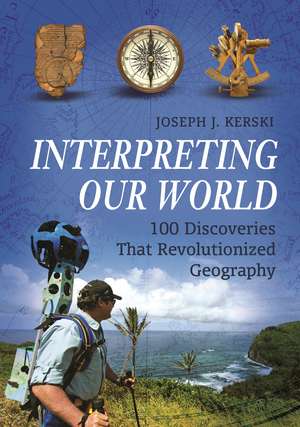
Interpreting Our World: 100 Discoveries That Revolutionized Geography
Autor Joseph J. Kerskien Limba Engleză Paperback – 22 feb 2024
Geography is not simply accounts of the lands of earth and their features; it's about discovering everything there is to know about our planet. This book shows why geography is of critical importance to our world's 21st-century inhabitants through an exploration of the past and present discoveries that have been made about the earth. It pinpoints 100 moments throughout history that had a significant impact on the study of geography and the understanding of our world, including widely accepted maps of the ancient world, writings and discoveries of key thinkers and philosophers, key exploration events and findings during the Age of Discovery, the foundations of important geographic organizations, and inventions in digital mapping.
The book begins with a clear explanation of geography as a discipline, a framework, and a way of viewing the world, followed by coverage of each of the 100 discoveries and innovations that provides sufficient background and content for readers to understand each topic. The book concludes with a concise synopsis of why it all matters and a look forward to 10 possible future discoveries in the next 50 years of geography. Students will gain a clear sense of what is truly revolutionary about geography, perhaps challenging their preconceived notion of what geography actually is, and grasp how important discoveries revolutionized not only the past but the present day as well.
Preț: 155.11 lei
Puncte Express: 233
Carte tipărită la comandă
Livrare economică 02-16 decembrie
Livrare prin curier în România Termenul estimat este afișat lângă disponibilitate.
Transport gratuit de la 400.00 lei Plată online sau ramburs, în funcție de opțiunile comenzii.
Retur gratuit în 14 zile Comandă securizată și suport în română.
Specificații
ISBN-13: 9798765120828
Pagini: 432
Ilustrații: 56 bw illus
Dimensiuni: 173 x 249 x 23 mm
Greutate: 0.8 kg
Editura: Bloomsbury Publishing
Colecția Bloomsbury Academic
Locul publicării:New York, United States
Pagini: 432
Ilustrații: 56 bw illus
Dimensiuni: 173 x 249 x 23 mm
Greutate: 0.8 kg
Editura: Bloomsbury Publishing
Colecția Bloomsbury Academic
Locul publicării:New York, United States
V-ar putea interesa
-
 -31%Preț: 645.55 lei931.73 lei
 -
 -31%Preț: 1050.14 lei1521.95 lei
 -
 -9%Preț: 13216.67 lei14523.82 lei
 -
 Structure in Architecture: History, Design and InnovationRowland J. Mainstone-18%Preț: 1354.95 lei1652.38 lei
 -
 The Anatomy of a ShipwreckClaudia D. GoudschaalPreț: 44.52 lei
 -
 A Summer Search for Sir John FranklinCommander E. a. Inglefield R. N.Preț: 93.32 lei
 -
 Preț: 299.90 lei
 -
 Boonton USA WWII StoriesMR Lloyd CharltonPreț: 124.50 lei
 -
 The Panama CanalJames K. WheatonPreț: 82.27 lei
 -
 The HypocritesMR Andrew M. PattersonPreț: 126.96 lei
 -
 Shared VoyageNational Aeronautcs and AdministrationPreț: 84.62 lei
 -
 The History of the XV-15 Tilt Rotor Research AircraftNational Aeronautics and AdministrationPreț: 130.97 lei
 -
 NapoleonRalph Waldo EmersonPreț: 54.26 lei
 -
 VampiresDana Jan BarteltPreț: 59.68 lei
 -
 A Seafarer's Decoding of the Irish SymbolsDonald J. McMahonPreț: 167.40 lei
 -
 A Modest Enquiry Into the Nature and Necessity of Paper CurrencyBenjamin FranklinPreț: 67.07 lei
 -
 Historia de Los Machado. Cronica de Una IndagacionJose -. Luis MachadoPreț: 195.74 lei
 -
 The Vikings in North AmericaCharles River EditorsPreț: 62.09 lei
 -
 Gold Rush Ghost Towns of North Central CaliforniaJohn G. EdmondsPreț: 33.01 lei
 -
 Fortress BermudaSean Pol O. CreachmhaoilPreț: 239.87 lei
 -
 In Darkest AfricaStanley, Henry MortonPreț: 169.66 lei
Cuprins
Acknowledgments
Introduction: Geography Is Revolutionary
Entry Locator Maps
Selected Chronology
Entries
Aerial Photography
Agriculture
Air Travel
Al-Biruni
Al-Idrisi, Muhammad
Al-Jahiz
Anaximander
Antarctica
Applied Geography
Aryabhata and Brahmagupta
Atmospheric Research
Bridges and Tunnels
Brunel, Isambard Kingdom
Burke and Wills
Burnham, Daniel
Canals
Christaller, Walter
Citizen Science
Columbus, Christopher
Compass
Cook, James
Copernicus
Cross-Staffs, Astrolabes, and Other Devices
Davis, William Morris
Defining Geography
Earth in Space
Ecoregions and Biomes
Environmental Movement
Eratosthenes
Eriksson, Leif
Field Collection Devices
French Geodesic Mission
Geodemographics
Geographic Information Systems (GIS)
Geographical Societies
Geography Departments
Global Positioning Systems (GPS)
Globes
Great Trigonometric Survey of India
Guyot and Agassiz
Harrison, John
Hayden, Powell, and Wheeler Surveys
Henry the Navigator
Herodotus
High-Resolution Mapping
Hipparchus
Homer
Hutton, James
Ibn Battuta
International Geophysical Year
Internet of Things
Land Protection
Latitude and Longitude
Lewis and Clark
Livingstone, David
Mackinder, Halford
Magellan, Ferdinand
Magnetic Field
Malthus, Thomas Robert
Maps
Marco Polo
Marsh, George Perkins
Maury, Matthew
Mercator, Gerardus
Münster, Sebastian
National Mapping Agencies
National Statistical Agencies
Northwest Ordinance
Observatories
Ocean Research
Pei Xiu
Photography
Pliny the Elder
Posidonius
Ptolemy
Quantitative Revolution
Regional Studies
Remote Sensing
Ritter, Carl
Roads, Ports, and Railroads
Sauer, Carl O.
Smith, William
Social Media
Spatial Analysis
Strabo
Supply Chain Management
Surveying
Time
Topophilia
Treaty of Tordesillas
Universalis Cosmographia
Unmanned Aerial Vehicles (UAVs)
Urbanization
Varenius, Bernhardus
Vesuvius
Von Humboldt, Alexander
War
Web Mapping
Wegener, Alfred
Zheng He
Bibliography
Index
Introduction: Geography Is Revolutionary
Entry Locator Maps
Selected Chronology
Entries
Aerial Photography
Agriculture
Air Travel
Al-Biruni
Al-Idrisi, Muhammad
Al-Jahiz
Anaximander
Antarctica
Applied Geography
Aryabhata and Brahmagupta
Atmospheric Research
Bridges and Tunnels
Brunel, Isambard Kingdom
Burke and Wills
Burnham, Daniel
Canals
Christaller, Walter
Citizen Science
Columbus, Christopher
Compass
Cook, James
Copernicus
Cross-Staffs, Astrolabes, and Other Devices
Davis, William Morris
Defining Geography
Earth in Space
Ecoregions and Biomes
Environmental Movement
Eratosthenes
Eriksson, Leif
Field Collection Devices
French Geodesic Mission
Geodemographics
Geographic Information Systems (GIS)
Geographical Societies
Geography Departments
Global Positioning Systems (GPS)
Globes
Great Trigonometric Survey of India
Guyot and Agassiz
Harrison, John
Hayden, Powell, and Wheeler Surveys
Henry the Navigator
Herodotus
High-Resolution Mapping
Hipparchus
Homer
Hutton, James
Ibn Battuta
International Geophysical Year
Internet of Things
Land Protection
Latitude and Longitude
Lewis and Clark
Livingstone, David
Mackinder, Halford
Magellan, Ferdinand
Magnetic Field
Malthus, Thomas Robert
Maps
Marco Polo
Marsh, George Perkins
Maury, Matthew
Mercator, Gerardus
Münster, Sebastian
National Mapping Agencies
National Statistical Agencies
Northwest Ordinance
Observatories
Ocean Research
Pei Xiu
Photography
Pliny the Elder
Posidonius
Ptolemy
Quantitative Revolution
Regional Studies
Remote Sensing
Ritter, Carl
Roads, Ports, and Railroads
Sauer, Carl O.
Smith, William
Social Media
Spatial Analysis
Strabo
Supply Chain Management
Surveying
Time
Topophilia
Treaty of Tordesillas
Universalis Cosmographia
Unmanned Aerial Vehicles (UAVs)
Urbanization
Varenius, Bernhardus
Vesuvius
Von Humboldt, Alexander
War
Web Mapping
Wegener, Alfred
Zheng He
Bibliography
Index
Recenzii
This book potentially fits as a piece of a broader introduction to geography course in the general sense, as it provides interesting descriptions and preludes into more detailed discussions. . . . An upper-level or graduate course might use this
work as well, to begin discussions or deeper implications of these revolutions or revolutionaries. . . . Kerski has accomplished in this work an easy-to-use, accessible reference that captures developments in geography quite handily. In each entry, the passion and drive of geographers to better understand our world shines through.
This is an excellent reference for middle school and high school students, and for general readers interested in geography.
The volume is recommended for collections supporting geography, GIS, and cartographic research. Librarians will need to decide whether to place this in the reference area or the circulating collection due to the readability of the material. Some patrons may want to read the volume as a good, general introduction to many lines of inquiry within geography rather than use the volume in a quick consultancy manner in ready reference.
Summing Up: Highly recommended. High school, community college, and undergraduate students; general readers; professionals/practitioners.
work as well, to begin discussions or deeper implications of these revolutions or revolutionaries. . . . Kerski has accomplished in this work an easy-to-use, accessible reference that captures developments in geography quite handily. In each entry, the passion and drive of geographers to better understand our world shines through.
This is an excellent reference for middle school and high school students, and for general readers interested in geography.
The volume is recommended for collections supporting geography, GIS, and cartographic research. Librarians will need to decide whether to place this in the reference area or the circulating collection due to the readability of the material. Some patrons may want to read the volume as a good, general introduction to many lines of inquiry within geography rather than use the volume in a quick consultancy manner in ready reference.
Summing Up: Highly recommended. High school, community college, and undergraduate students; general readers; professionals/practitioners.