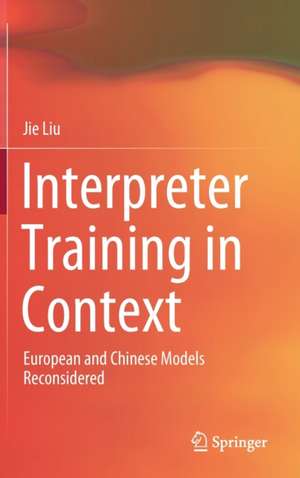
Interpreter Training in Context
Autor Jie Liuen Limba Engleză Hardback – 8 oct 2020
This book addresses an important, yet under-researched domain in interpreting education: how theoretical training models should be responsive to context. To do so, it applies the linguistic concept of ‘context’ to interpreting studies by investigating practices in representative (conference) interpreting training programmes in Europe and China. After presenting an overview of interpreter training programmes, the author describes the need to reassess the applicability of the well-established and widely accepted model of interpreting from the Paris School (ESIT/AIIC model) to the Chinese interpreting training scene.
Building on the theoretical study of context in foreign language classrooms suggested by linguists like Halliday and Hasan (1993); Kramsch (1993) and others, the author subsequently constructs a new curriculum, comprising a four-step approach to consecutive interpreting courses in the Chinese context. The rationale for such an approach is justified in accordance with the overall design of context, taking into account the four dimensions in a teaching–learning environment.
This book is intended for scholars and graduate students who are interested in translation and interpreting, applied linguistics as well as foreign language education. It also serves as a practical guide for developing (university-level) translation and interpreting programmes.
Preț: 721.36 lei
Preț vechi: 848.65 lei
-15%
Puncte Express: 1082
Carte tipărită la comandă
Livrare economică 25 noiembrie-09 decembrie
Livrare prin curier în România Termenul estimat este afișat lângă disponibilitate.
Transport gratuit pentru acest produs Plată online sau ramburs, în funcție de opțiunile comenzii.
Retur gratuit în 14 zile Comandă securizată și suport în română.
Specificații
ISBN-13: 9789811585937
ISBN-10: 9811585938
Pagini: 172
Ilustrații: XIII, 155 p. 15 illus., 6 illus. in color.
Dimensiuni: 160 x 241 x 16 mm
Greutate: 0.38 kg
Ediția:1st ed. 2020
Editura: Springer
Locul publicării:Singapore, Singapore
ISBN-10: 9811585938
Pagini: 172
Ilustrații: XIII, 155 p. 15 illus., 6 illus. in color.
Dimensiuni: 160 x 241 x 16 mm
Greutate: 0.38 kg
Ediția:1st ed. 2020
Editura: Springer
Locul publicării:Singapore, Singapore
Cuprins
Chapter 1 Introducing Basic Concepts of Interpreting and InterpreterTraining.- Chapter 2 Contemporary Interpreter Training Practices in Europe and China.- Chapter 3 Acquiring Interpreting Competence through Training: European and Chinese Training Models Explored.- Chapter 4 Didactic Approaches to Interpreter Training: Contexts, Approaches and Coping Tactics.- Chapter 5 Optimizing Interpreting Education in the Chinese Context: Principles, Curriculum and Pedagogy.- Chapter 6 Towards a Contextual Model for Interpreter Education.
Recenzii
“Interpreter Training in Context: European and Chinese Models Reconsidered is a worthy addition to an important and highly relevant topic. Given its focus, a key part of the work’s audience will naturally be interpreter trainers working in China and/or with Mandarin Chinese … . the volume successfully blends theoretical and practical aspects in an insightful manner, with the clear potential to play an influential role in interpreter training in the Chinese context.” (Antony Hoyte-West, Studies in Comparative Education, Vol. 43 (1), 2022)
Notă biografică
Dazhao Song is an Associate Professor in School of Civil and Resource Engineering, University of Science and Technology Beijing. He received PhD in Safety Technology and Engineering from China University of Mining and Technology. Dr. Song's research focuses on the mechanism of coal/rock dynamic hazards in underground space, the theory and technology of monitoring and early warning. He has made achievements in the electromagnetic radiation effects of coal/rock dynamic hazards in underground works with dozens of research papers published. He serves as the secretary of International Committee on Mine Safety Science and Engineering (ICMSSE), and is selected for the Beijing Nova Programme 2018.
Xueqiu He is a professor in Safety Science and Engineering Department in University of Science and Technology Beijing, and a Visiting Professor in McGill University, Canada. He is the chairman of the International Committee of Mine Safety Science and Engineeringand has chaired the 1st, 2nd and 3rd International Symposium on Mine Safety Science and Engineering. He also serves as an editorial board member for journals such as Journal of China Coal Society. Prof. He's research interest includes: safety science laws, coal mine safety, coal and rock dynamic hazards monitoring and prevention. He has published a dozen of monographs on these topics.
Enyuan Wang is currently dean of the School of Safety Engineering in China University of Mining and Technology, and deputy director of the State Key Laboratory of Coal Resources and Safe Mining. He is a member of the Rockburst Special Committee of China Coal Industry Technical Committee, and China Coal Society's Coal Mine Dynamic Disaster Prevention Committee. His research mainly focuses on coal mine dynamic hazards monitoring and early warning. He has published 5 monographs and 168 journal papers.
Zhenlei Li holds a Ph.D. degree from China University of Mining and Technology. He is now a lecturer in the Department of Safety Science and Engineering in University of Science and Technology Beijing. His research focuses on the mechanism of rock burst hazard. He is a member of the Chinese Society for Rock Mechanics and Engineering, and a member of China Coal Society.
Dr. Jie Liu is an Associate Professor of Safety Science and Engineering Department in Qingdao University of Technology. He majors in gas dynamic hazard prevention in coal mines. His current research is sponsored by National Natural Science Foundation of China. He has published more than 10 journal papers.
Textul de pe ultima copertă
This book addresses an important, yet under-researched domain in interpreting education: how theoretical training models should be responsive to context. To do so, it applies the linguistic concept of ‘context’ to interpreting studies by investigating practices in representative (conference) interpreting training programmes in Europe and China. After presenting an overview of interpreter training programmes, the author describes the need to reassess the applicability of the well-established and widely accepted model of interpreting from the Paris School (ESIT/AIIC model) to the Chinese interpreting training scene. Building on the theoretical study of context in foreign language classrooms suggested by linguists like Halliday and Hasan (1993); Kramsch (1993) and others, the author subsequently constructs a new curriculum, comprising a four-step approach to consecutive interpreting courses in the Chinese context. The rationale for such an approach is justified in accordance with the overall design of context, taking into account the four dimensions in a teaching–learning environment.
This book is intended for scholars and graduate students who are interested in translation and interpreting, applied linguistics as well as foreign language education. It also serves as a practical guide for developing (university-level) translation and interpreting programmes.
This book is intended for scholars and graduate students who are interested in translation and interpreting, applied linguistics as well as foreign language education. It also serves as a practical guide for developing (university-level) translation and interpreting programmes.
Caracteristici
Provides a panoramic overview of major interpreter education models in Europe and China Includes essential information on key elements in interpreter education—curriculum models, didactics, and educational psychology, especially as regards (non-Western) emerging countries like China Presents a four-step curriculum to help university-level interpreting/translation educators in ‘non-Western’ emerging economies Highlights the importance of ‘context’ in implementing interpreter education models