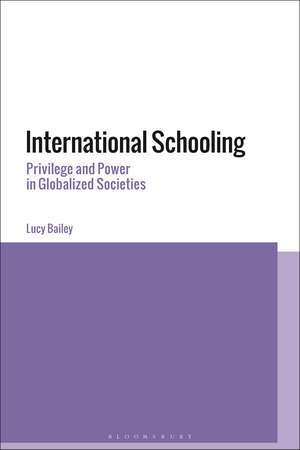
International Schooling: Privilege and Power in Globalized Societies
Autor Lucy Baileyen Limba Engleză Hardback – 21 oct 2021
Presenting research from diverse countries including Russia, Malaysia, the UAE, the UK, and Bahrain, the author explores ways in which international schools adapt to local cultural contexts and examines the views of parents, students, teachers and school leaders towards the education that they provide.
Preț: 660.55 lei
Preț vechi: 974.69 lei
-32%
Puncte Express: 991
Carte tipărită la comandă
Livrare economică 07-21 decembrie
Livrare prin curier în România Termenul estimat este afișat lângă disponibilitate.
Transport gratuit pentru acest produs Plată online sau ramburs, în funcție de opțiunile comenzii.
Retur gratuit în 14 zile Comandă securizată și suport în română.
Specificații
ISBN-13: 9781350169999
ISBN-10: 1350169994
Pagini: 192
Dimensiuni: 156 x 234 mm
Greutate: 0.44 kg
Editura: Bloomsbury Publishing
Colecția Bloomsbury Academic
Locul publicării:London, United Kingdom
ISBN-10: 1350169994
Pagini: 192
Dimensiuni: 156 x 234 mm
Greutate: 0.44 kg
Editura: Bloomsbury Publishing
Colecția Bloomsbury Academic
Locul publicării:London, United Kingdom
Cuprins
Introduction
1. Globalisation, Education and the International Schools Movement
2. Conceptualising the International School
3. The Micro-Politics of International Schools
4. Teaching in International Schools
5. Internationalism or Westernisation?
6. Educating for Global Citizenship
7. Inequalities in the International School
8. International Education and International Schools
Conclusion: What Future for International Education?
References
Index
1. Globalisation, Education and the International Schools Movement
2. Conceptualising the International School
3. The Micro-Politics of International Schools
4. Teaching in International Schools
5. Internationalism or Westernisation?
6. Educating for Global Citizenship
7. Inequalities in the International School
8. International Education and International Schools
Conclusion: What Future for International Education?
References
Index
Recenzii
Lucy Bailey invites stakeholders in international schools to critically examine their likely contribution to global inequality and, equipped with this perspective, suggests pathways to support agendas for progressivism and equity in education. This lucid book should be essential reading for all international school stakeholders whether educators, parents, governors, or investors.
The distinction of international schools and their breath-taking growth appears to have outstripped professional safeguards and lived ethics. While the optics of the industry remain pedantically mired in systemised injustices and inequities, Lucy Bailey takes firm aim at a sector in need of a soul, not a mission statement. Bravo!
Integrating her own research with a comprehensive review of recent literature, Lucy Bailey's International Schooling. is a vital resource for enhancing understandings of international schooling. Juxtaposing analytic angles and empirical vignettes, Bailey offers a set of core registers and significant fault lines for studying this heterogenous and dynamic movement.
This book offers a scholarly exploration, from a mainly sociological perspective, of a range of issues arising in the burgeoning field of international schooling. Engaging with issues of privilege, power, diversity and equality, the book will be of value both to those charged with the promotion of international education in schools and to those researching in the field.
The distinction of international schools and their breath-taking growth appears to have outstripped professional safeguards and lived ethics. While the optics of the industry remain pedantically mired in systemised injustices and inequities, Lucy Bailey takes firm aim at a sector in need of a soul, not a mission statement. Bravo!
Integrating her own research with a comprehensive review of recent literature, Lucy Bailey's International Schooling. is a vital resource for enhancing understandings of international schooling. Juxtaposing analytic angles and empirical vignettes, Bailey offers a set of core registers and significant fault lines for studying this heterogenous and dynamic movement.
This book offers a scholarly exploration, from a mainly sociological perspective, of a range of issues arising in the burgeoning field of international schooling. Engaging with issues of privilege, power, diversity and equality, the book will be of value both to those charged with the promotion of international education in schools and to those researching in the field.