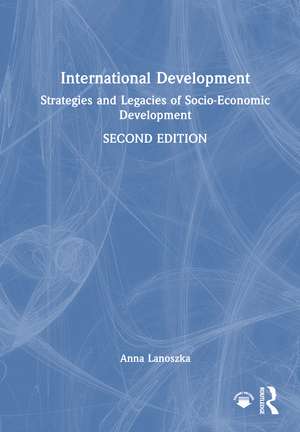
International Development: Strategies and Legacies of Socio-Economic Development
Autor Anna Lanoszkaen Limba Engleză Hardback – 9 iul 2025
Grounded in a thorough historical and theoretical framework, this book explores the evolution of developmental strategies, from post-colonial challenges, the growing influence of international organizations, and the role of state policies to the impacts of global market integration and demands for environmental sustainability. It scrutinizes the effectiveness of international organizations and foreign aid agencies, the resilience of local strategies, and the persistent disparities shaped by historical legacies, extractive and inclusive state institutions, deficit of individual rights, systemic poverty, gender inequality, armed conflicts, environmental hazards, and food insecurity. Through case studies and document-driven insights, it highlights the intersection of institutional frameworks, economic imperatives, and human agency in shaping developmental outcomes. By integrating environmental and sustainability considerations with economic strategies, the book underscores the necessity of inclusive policies that address structural barriers and promote human-centered development. This new edition has been thoroughly updated to include material on decolonization, the various effects of the Covid-19 pandemic, gender and sexual orientation-based discrimination, climate change, migration, and economic insecurity.
With a multi-disciplinary approach taking into account politics, international relations, economics, sociology, cultural studies, and the history of development, this book is an invaluable resource for students and scholars, as well as policy makers and practitioners working and researching in those fields.
Preț: 1157.99 lei
Preț vechi: 1412.18 lei
-18%
Puncte Express: 1737
Carte tipărită la comandă
Livrare economică 03-17 decembrie
Livrare prin curier în România Termenul estimat este afișat lângă disponibilitate.
Transport gratuit pentru acest produs Plată online sau ramburs, în funcție de opțiunile comenzii.
Retur gratuit în 14 zile Comandă securizată și suport în română.
Specificații
ISBN-13: 9781032572550
ISBN-10: 1032572558
Pagini: 270
Ilustrații: 8
Dimensiuni: 174 x 246 x 19 mm
Greutate: 0.66 kg
Ediția:2. Auflage
Editura: Taylor & Francis
Colecția Routledge
Locul publicării:Oxford, United Kingdom
ISBN-10: 1032572558
Pagini: 270
Ilustrații: 8
Dimensiuni: 174 x 246 x 19 mm
Greutate: 0.66 kg
Ediția:2. Auflage
Editura: Taylor & Francis
Colecția Routledge
Locul publicării:Oxford, United Kingdom
Public țintă
Postgraduate, Undergraduate, Undergraduate Advanced, and Undergraduate CoreCuprins
Introduction: development and changing societies I. Conceptualizing development II. Challenges to measuring progress and economic performance III. Classical scholars and critical thinkers IV. Concluding remarks Chapter 1: Theories and strategies of development I. Conceptualizing theories and strategies II. Early theories: from growth models to structural change approaches III. The state as the agent of development: from dependency to state capitalism IV. The state as an obstacle to development: neoliberalism of the past and present V. The state as an enabling environment: institutions and good governance Chapter 2: Colonialism and development I. Conceptualizing historical legacy of colonialism II. Indigenous civilizations and the European powers III. Theoretical explanations of colonialism and imperialism IV. Colonialism and the creation of the Third World V. Decolonialization processes and the post-colony Chapter 3: Developing countries and the global economy I. Conceptualizing the global economy II. Learning to cooperate: the Bretton Woods system III. Attempting to help - debt, aid, and the cartel of good intentions IV. Expanding trade: from GATT to WTO managed globalization V. The fracturing of the global economy in the post-Covid era Chapter 4: State's role and strategies: obstacles and opportunities I. Conceptualizing strategy II. Relying on the state: the politics of foreign aid III. “Fixing” the state: errors of structural reforms IV. Utilizing the state: state-led development V. Institutional framework and good governance Chapter 5: Armed conflicts, violence, and development I. Conceptualizing armed conflict II. Wars in theory and reality: resisting simplification III. Contemplating different explanations of violent conflicts IV. Living and escaping the conflict trap V. Post-conflict reconstruction: scars, fears, and reconciliation Chapter 6: Gender relations and development I. Conceptualizing gender II. Gender and development: feminist interventions III. Gender-based exclusion and discrimination IV. Empowering women: towards equality of all people Chapter 7: Environment, sustainability, and development I. Conceptualizing sustainable development II. The sustainability of economic growth and the scarcity dilemma III. Non-renewable resources and the problem of energy security IV. Deforestation, pollution, and the UN conferences on climate change Chapter 8: Rural development and food security I. Conceptualizing food security II. Global hunger, rural poverty, and tensions in agricultural trade III. IPRs, GMOs, and TRIPS versus Farmers’ Rights IV. Access to food and domestic agricultural policies Chapter 9: Urbanization and challenges of unbalanced growth I. Conceptualizing urbanization II. Growing cities as a problematic force of economic progress III. Displacement in the time of migration and economic insecurity IV. The search for a balanced and inclusive urban development model Afterword
Notă biografică
Anna Lanoszka is Professor of International Economic Relations at the University of Windsor, Canada, specializing in trade and development. She holds a PhD in Political Science from Dalhousie University and a combined undergraduate degree in Political Science and Economics from Carleton University. Previously, she worked in the Accessions Division of the WTO. She has also participated in global consulting projects to support institutional reforms in developing countries.
Descriere
International Development: Strategies and Legacies of Socio-Economic Development examines the multifaceted challenges and strategies underlying socio-economic progress in a globally interconnected world.
Recenzii
‘This excellent book provides an innovative conceptual analysis of international development using a human agency based approach. Professor Lanoszka’s expert analysis moves beyond the free markets or state directed development models to a richer understanding that highlights the crucial role of individual agency. This is a powerful, often passionate study of international development. It convinces us of the need to place people at the centre of international development strategies.’
Donna Lee, Manchester Metropolitan University, UK.
‘Anna Lanoszka has written an impressive introduction to the complex subject of development. It is grounded in key historical and theoretical debates, while retaining a lively and accessible style throughout. It makes excellent use of case studies to bring its subject to life. Lanoszka’s passion for the subject is clearly projected, and will make this book a lively and insightful guide to the persistent and pivotal challenges of global development.’
David Black, Dalhousie University, Halifax, Canada.
‘The study of development is a multi-disciplinary exercise and this lucid and informative book should be of interest to a wide variety of disciplines. Anna Lanoszka has written an accessible introduction to the study of international development that should appeal to both teachers and students. International Development is an historically informed, theoretically engaged text that places the individual at the centre of the process of development without at the same time neglecting the importance of structural and institutional factors.’
Marc Williams, University of New South Wales, Sydney, Australia.
Donna Lee, Manchester Metropolitan University, UK.
‘Anna Lanoszka has written an impressive introduction to the complex subject of development. It is grounded in key historical and theoretical debates, while retaining a lively and accessible style throughout. It makes excellent use of case studies to bring its subject to life. Lanoszka’s passion for the subject is clearly projected, and will make this book a lively and insightful guide to the persistent and pivotal challenges of global development.’
David Black, Dalhousie University, Halifax, Canada.
‘The study of development is a multi-disciplinary exercise and this lucid and informative book should be of interest to a wide variety of disciplines. Anna Lanoszka has written an accessible introduction to the study of international development that should appeal to both teachers and students. International Development is an historically informed, theoretically engaged text that places the individual at the centre of the process of development without at the same time neglecting the importance of structural and institutional factors.’
Marc Williams, University of New South Wales, Sydney, Australia.