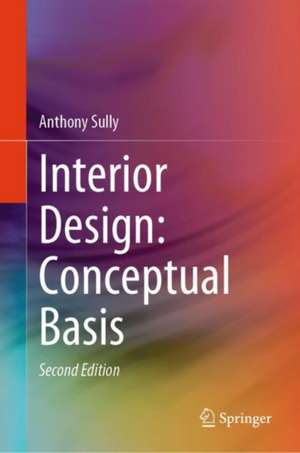
Interior Design: Conceptual Basis
Autor Anthony Sullyen Limba Engleză Hardback – 2 mar 2024
Descoperim în Sully, A: Interior Design o perspectivă care lipsește adesea din volumele comerciale: o fundamentare teoretică riguroasă care transformă designul de interior dintr-o disciplină percepută uneori ca fiind intuitivă, într-una precisă și comunicabilă. Observăm cum autorul Anthony Sully, cu o carieră de peste 45 de ani, reușește să decodeze complexitatea spațiului construit prin lentila geometriei, a proporțiilor și a formei umane. Apreciem în mod deosebit modul în care cele 380 de ilustrații (color și alb-negru) nu servesc doar ca decor, ci ca instrumente analitice pentru a înțelege relația dintre activitatea umană și volumul arhitectural. Pe raftul de artă, alături de The Fundamentals of Interior Design de Simon Dodsworth, acest album se distinge prin rigoarea academică și prin introducerea unui vocabular nou, menit să clarifice procesul de creație. În timp ce alte lucrări se concentrează pe estetica finală, Sully, A: Interior Design pune accent pe „de ce” și „cum”, structurând conținutul progresiv: de la definirea termenilor și analiza corpului uman, până la percepția vizuală și codurile procesului de design. Remarcăm echilibrul fin între experiența practică a autorului și nevoia de a oferi studenților și profesioniștilor un cadru teoretic solid. Lectura devine o experiență de recalibrare a privirii, unde spațiul, lumina și obiectele de depozitare sunt analizate ca elemente vitale ale unui întreg funcțional. Este o resursă care înlocuiește inspirația efemeră cu o metodologie clară, ancorată în principii de design durabile.
Preț: 559.64 lei
Preț vechi: 690.91 lei
-19%
Carte tipărită la comandă
Livrare economică 19-25 noiembrie
Specificații
ISBN-10: 3031514092
Pagini: 296
Ilustrații: XXXIV, 260 p. 298 illus., 251 illus. in color.
Dimensiuni: 160 x 241 x 21 mm
Greutate: 0.67 kg
Ediția:Second Edition 2024
Editura: Springer
Locul publicării:Cham, Switzerland
V-ar putea interesa
-
 Preț: 392.85 lei
 -
 Preț: 388.03 lei
 -
 Interior DetailingDavid Kent Ballast-19%Preț: 554.17 lei684.16 lei
 -
 The Architecture Concept BookJames Tait-15%Preț: 202.32 lei239.22 lei
 -
 Notes on the Synthesis of FormChristopher AlexanderPreț: 235.55 lei
 -
 The Pocket Universal Principles of Interior DesignKelly Harris Smith-19%Preț: 81.02 lei100.20 lei
 -
 PowerHouse: Interior Designs for Self, Style, and SanctuaryPenny Drue BairdPreț: 392.53 lei
 -
 The Fundamentals of Interior DesignSimon DodsworthPreț: 247.84 lei
 -
 Interior Design CourseTomris TangazPreț: 143.13 lei
 -
 -29%Preț: 214.20 lei302.95 lei
 -
 Foundations of Interior DesignSusan J. Slotkis-23%Preț: 667.73 lei872.39 lei
 -
 -36%Preț: 128.88 lei201.60 lei
 -
 -18%Preț: 120.39 lei146.22 lei
 -
 Spatial Strategies for Interior DesignIan Higgins-28%Preț: 197.91 lei273.12 lei
 -
 Interior Design DrawingAlan HughesPreț: 169.56 lei
 -
 Lighting for Interior DesignMalcolm Innes-26%Preț: 169.22 lei229.07 lei
 -
 Preț: 309.12 lei
 -
 Interior Design FundamentalsSteven B. Webber-22%Preț: 544.12 lei695.93 lei
De ce să citești această carte
Recomandăm această carte oricărui student la arhitectură sau designer aflat la început de drum care dorește să treacă dincolo de simpla decorare. Veți câștiga o înțelegere profundă a modului în care geometria și percepția influențează starea utilizatorului. Este un manual de referință care vă învață să comunicați profesional conceptele de design și să evitați erorile clasice de planificare, oferind un fundament teoretic rar întâlnit în literatura de specialitate.
Descriere scurtă
The major themes of this second edition of Interior Design: Conceptual Basis are the seven concepts of planning, circulation, 3D, construction, materials, colour and lighting, which cover the entire spectrum of a designer’s activity. It is assumed that the site, location, building and orientation as well as the client’s brief of activities and needs have been digested and analysed to provide the data upon which the design process can begin. Designed as a highly visual illustrative book, as the interior design medium demands, the hands-on creative process of designing is detailed with original drawn illustrations. Concentrating on the conceptual process of designing interiors, and defining what these concepts are, this book helps the designer to organise his/her process of designing and to sharpen the links between the various skill bases necessary to do the job.
This book is stimulating for students and instructors alike and is aimed at any student who maybe majoring in interior design, interior architecture, architecture, design thinking or furniture design. It is also useful reference for students of design management and design leadership.
Cuprins
Notă biografică
He has written four books previously published in 1970, 2012, 2018 and 2022, and continues to research and engage with current trends and developments. He is also an artist in acrylic and digital media.
Caracteristici
Descriere
Successful interior design requires resolving a multitude of logistical and creative problems to produce a coherent, functional and aesthetically pleasing environment. This book, the first of its kind, tackles the problem from a theoretical approach and not in the conventional how-to or inspiring ideas fashion. Categorising design into nine key elements, including space, light, display, storage, and offering new terminology to describe each area, the author breaks new ground in the field of interior design in an approach that brings vitality and clear communication to a misunderstood and often free-wheeling design discipline.
Drawing on more than 45 years' experience as an interior designer, Anthony Sully provides the ultimate resource in insight and explains best practices from interpreting a client's brief, to analysing the building, to setting up a design team and work schedule plus a host of other practical aspects. Peppered through this toolkit are illustrations and explanations of how to analyse space and form in relation to human activity, the formulation of design concepts, and how to learn from mistakes that have been made in the past.