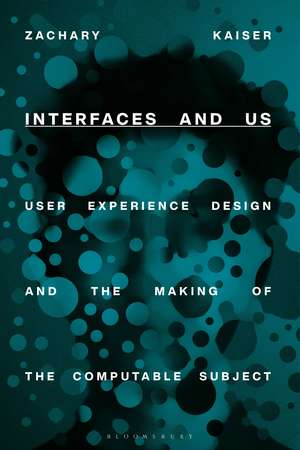
Interfaces and Us: User Experience Design and the Making of the Computable Subject
Autor Zachary Kaiseren Limba Engleză Paperback – 9 feb 2023
- Concepts of freedom vs convenience
- Smart objects and manipulation
- Real world information transformed into data
- Technology's decisions made on our behalf
Preț: 137.13 lei
Preț vechi: 213.30 lei
-36%
Puncte Express: 206
Carte disponibilă
Livrare economică 06-11 noiembrie
Livrare express 22-28 octombrie pentru 60.76 lei
Livrare prin curier în România Termenul estimat este afișat lângă disponibilitate.
Transport gratuit de la 400.00 lei Plată online sau ramburs, în funcție de opțiunile comenzii.
Retur gratuit în 14 zile Comandă securizată și suport în română.
Specificații
ISBN-13: 9781350245242
ISBN-10: 1350245240
Pagini: 224
Ilustrații: 29 color illus
Dimensiuni: 158 x 232 x 12 mm
Greutate: 0.44 kg
Editura: Bloomsbury Publishing
Colecția Bloomsbury Visual Arts
Locul publicării:London, United Kingdom
ISBN-10: 1350245240
Pagini: 224
Ilustrații: 29 color illus
Dimensiuni: 158 x 232 x 12 mm
Greutate: 0.44 kg
Editura: Bloomsbury Publishing
Colecția Bloomsbury Visual Arts
Locul publicării:London, United Kingdom
V-ar putea interesa
-
 The Means of Prediction: How AI Really Works (and Who Benefits)Maximilian Kasy-20%Preț: 123.25 lei154.07 lei
 -
 When Everyone Knows That Everyone Knows...Steven PinkerPreț: 136.05 lei
 -
 Shared WisdomAlex PentlandPreț: 157.02 lei
 -
 Hacking HumanityLara LewingtonPreț: 123.80 lei
 -
 Smartphone NationKaitlyn RegehrPreț: 122.17 lei
 -
 -20%Preț: 419.94 lei524.92 lei
 -
 User FriendlyCliff KuangPreț: 121.07 lei
 -
 -17%Preț: 214.86 lei258.09 lei
 -
 Patterns - Theory of the Digital SocietyArmin NassehiPreț: 165.87 lei
 -
 Digital DegrowthNeil SelwynPreț: 114.31 lei
 -
 Inside Digital Advertising: Platforms, Power, and Material PoliticsDonald MackenziePreț: 156.81 lei
 -
 Ideal Subjects: The Abstract People of AIOlga GoriunovaPreț: 184.30 lei
 -
 A User's Guide to the Age of TechGrant WythoffPreț: 144.30 lei
 -
 Digital ExhaustionPaul LeonardiPreț: 123.33 lei
 -
 A Studious Use: Designing From The UndercommonsGiovanni Marmont-18%Preț: 135.71 lei166.13 lei
 -
 -20%Preț: 95.84 lei120.40 lei
 -
 The Atomic HumanNeil D. LawrencePreț: 94.41 lei
 -
 Cybernetic Circulation ComplexNick Dyer-WithefordPreț: 129.05 lei
 -
 -27%Preț: 147.14 lei202.18 lei
 -
 Empire of AIKaren HaoPreț: 163.45 lei
Cuprins
Acknowledgements
Introduction
1. Historical and Conceptual Roots of the Computable Subjectivity
Introduction: Disrupting the Insurance Industry-"Convenience" and "Freedom"
Producing and Looping, or, Biopolitics and Biopower
The Value of Convenience
Freedom and Countercultural Technocracy
The Selfish System: Cybernetics and Rational Choice Theory
Markets as Information Processors: Cybernetics and Economics
The Neoliberal Governmentality
Conclusion: Foundations and Ramifications
2. Data=World
Introduction: Can You "See" Your Dream Data?
Data and World: An Origin Story
Computational Instrumentation: Templates and Translations
How Computational Instruments Disappear
Conclusion: The Great Inversion, or, Operationalism's Legacy
3. Prediction and the Stabilization of Identity
Introduction: Whisper and the Scrambling of Algorithmic Anticipation
The Digital Production of Fragmentation and Alienation
Ontological Insecurity: One Consequence of Fragmentation and Alienation
The Digital Mirror Self: Soothing Ontological Insecurity with Computation
The Role of UX in Producing, then Soothing, Ontological Insecurity
Consequences: Soft Biopower and the Proscription of Potential
Conclusion: Becoming Cyborgs
4. The Moral Imperative of Normality through Computational Optimization
Introduction: The Optimized Professor and the Pressures of Optimization
Measurement, Normativity, and Morality: Two Origin Stories
The Moral Imperative of Self-Optimizing Technologies: The Case of the Amazon Halo
Consequences: Anxiety, Superfluity, and the Instrumentalization of Interpersonal Interaction
Conclusion: Fighting for Servitude as if it Were Salvation
5. The Questions of Political Economy and the Role of Design Education
Introduction
Question 1: The Issue of Political Economy and Chile's Socialist Cybernetics
Question 2: The Role of Design Education in Resisting the "Reality" of the Computable Subjectivity and the Reformist Approach
Conclusion: Returning to Political Economy and the Limits of the Reformist Approach to Design Education
Conclusion: Towards a Luddite Design Education
The Politics of UX and the Computable Subject as the Ideal Political Subject
The Lingering Problem: The Computable Subjectivity and Political Economy
The Revolutionary Approach: Luddite Design Education
A Provisional Program of Luddite Design Education
A Luddite Design Education, Now
Bibliography
Index
Introduction
1. Historical and Conceptual Roots of the Computable Subjectivity
Introduction: Disrupting the Insurance Industry-"Convenience" and "Freedom"
Producing and Looping, or, Biopolitics and Biopower
The Value of Convenience
Freedom and Countercultural Technocracy
The Selfish System: Cybernetics and Rational Choice Theory
Markets as Information Processors: Cybernetics and Economics
The Neoliberal Governmentality
Conclusion: Foundations and Ramifications
2. Data=World
Introduction: Can You "See" Your Dream Data?
Data and World: An Origin Story
Computational Instrumentation: Templates and Translations
How Computational Instruments Disappear
Conclusion: The Great Inversion, or, Operationalism's Legacy
3. Prediction and the Stabilization of Identity
Introduction: Whisper and the Scrambling of Algorithmic Anticipation
The Digital Production of Fragmentation and Alienation
Ontological Insecurity: One Consequence of Fragmentation and Alienation
The Digital Mirror Self: Soothing Ontological Insecurity with Computation
The Role of UX in Producing, then Soothing, Ontological Insecurity
Consequences: Soft Biopower and the Proscription of Potential
Conclusion: Becoming Cyborgs
4. The Moral Imperative of Normality through Computational Optimization
Introduction: The Optimized Professor and the Pressures of Optimization
Measurement, Normativity, and Morality: Two Origin Stories
The Moral Imperative of Self-Optimizing Technologies: The Case of the Amazon Halo
Consequences: Anxiety, Superfluity, and the Instrumentalization of Interpersonal Interaction
Conclusion: Fighting for Servitude as if it Were Salvation
5. The Questions of Political Economy and the Role of Design Education
Introduction
Question 1: The Issue of Political Economy and Chile's Socialist Cybernetics
Question 2: The Role of Design Education in Resisting the "Reality" of the Computable Subjectivity and the Reformist Approach
Conclusion: Returning to Political Economy and the Limits of the Reformist Approach to Design Education
Conclusion: Towards a Luddite Design Education
The Politics of UX and the Computable Subject as the Ideal Political Subject
The Lingering Problem: The Computable Subjectivity and Political Economy
The Revolutionary Approach: Luddite Design Education
A Provisional Program of Luddite Design Education
A Luddite Design Education, Now
Bibliography
Index
Recenzii
Zach Kaiser's Interfaces and Us dares to peel back the plastic film protecting interface design to reveal how it is both shapes and is shaped by everything from convenience and consumerism to market forces and economic inequality. While finally putting to rest the idea that design is inherently neutral, it's an indispensable guide to the politics of how we interface not just with the digital systems around us, but with late capitalism itself.
Interfaces and Us blends theory, art, activism and pedagogy into a cogent story about the making of selves and societies. This incisive text will be an inflection point for design education.
Shedding light on User Experience as an academic discipline, while exploring the intricate connection between data, culture, and design, Interfaces and Us is a timely read for designers grappling with the role they play in a world being transformed by data.
Interfaces and Us blends theory, art, activism and pedagogy into a cogent story about the making of selves and societies. This incisive text will be an inflection point for design education.
Shedding light on User Experience as an academic discipline, while exploring the intricate connection between data, culture, and design, Interfaces and Us is a timely read for designers grappling with the role they play in a world being transformed by data.