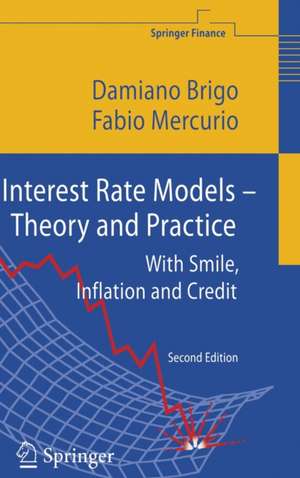
Interest Rate Models - Theory and Practice: Springer Finance
Autor Damiano Brigo, Fabio Mercurioen Limba Engleză Hardback – 4 aug 2006
Considerăm lucrarea Interest Rate Models - Theory and Practice drept un pilon fundamental în literatura financiară cantitativă, autoritatea celor doi autori, Damiano Brigo și Fabio Mercurio, fiind validată de dubla lor expertiză: rigoarea academică dublată de o practică bancară de elită. Această ediție a doua, publicată sub egida Springer în seria Springer Finance, nu este doar o actualizare, ci o extindere masivă a modelelor de piață LIBOR, adaptată complexității piețelor moderne. Descoperim aici o arhitectură logică ce pornește de la fundamentele non-arbitrajului și modelele de rată scurtă (one-factor și two-factor), avansând rapid către cadrul Heath-Jarrow-Morton (HJM) și modelele de piață (LFM și LSM). Notăm cu interes modul în care autorii integrează problematica volatilității — de la dinamica volatilității locale la modelele stocastice — oferind soluții pentru calibrarea pe date reale de piață. Față de lucrările anterioare ale autorilor, precum Credit Models and the Crisis sau Counterparty Risk and Funding, care se concentrează pe mecanismele de risc după colapsul financiar, acest volum pune bazele teoretice și practice necesare pentru înțelegerea derivatelor de rată a dobânzii și a celor de credit, inclusiv CDS și opțiuni pe CDS. Cititorul care a aplicat ideile din Interest Rate Modeling de Lixin Wu va găsi aici o completare esențială prin focusul pe produsele hibride și derivatele pe inflație, elemente care diferențiază volumul de față prin aplicabilitatea în zona de trading și management de portofoliu. Structura cuprinsului indică o progresie naturală, culminând cu analize riguroase asupra riscului de contrapartidă, o necesitate impusă de cadrul Basel II.
Din seria Springer Finance
-
 Preț: 366.66 lei
 -
 Preț: 397.87 lei
 - 18%
 Preț: 816.31 lei
 -
 Preț: 410.70 lei
 - 18%
 Preț: 1212.11 lei
 - 15%
 Preț: 683.25 lei
 -
 Preț: 462.03 lei
 - 15%
 Preț: 664.01 lei
 - 18%
 Preț: 1034.69 lei
 - 18%
 Preț: 1112.87 lei
 - 18%
 Preț: 952.45 lei
 - 18%
 Preț: 1117.48 lei
 -
 Preț: 409.69 lei
 - 18%
 Preț: 926.92 lei
 - 15%
 Preț: 616.89 lei
 - 15%
 Preț: 612.10 lei
 -
 Preț: 439.86 lei
 - 18%
 Preț: 987.53 lei
 - 15%
 Preț: 666.85 lei
 - 15%
 Preț: 551.04 lei
 - 15%
 Preț: 635.29 lei
 -
 Preț: 390.72 lei
 - 17%
 Preț: 432.44 lei
 -
 Preț: 404.05 lei
 - 18%
 Preț: 839.74 lei
 - 18%
 Preț: 833.11 lei
 - 18%
 Preț: 943.27 lei
 - 19%
 Preț: 547.43 lei
 - 18%
 Preț: 779.29 lei
 -
 Preț: 373.03 lei
 - 18%
 Preț: 741.55 lei
 - 15%
 Preț: 671.02 lei
 - 18%
 Preț: 978.38 lei
 - 17%
 Preț: 409.92 lei
 - 15%
 Preț: 677.79 lei
Preț: 967.72 lei
Preț vechi: 1180.15 lei
-18%
Carte tipărită la comandă
Livrare economică 27 noiembrie-11 decembrie
Specificații
ISBN-10: 3540221492
Pagini: 1040
Ilustrații: LVI, 982 p.
Dimensiuni: 160 x 241 x 61 mm
Greutate: 1.65 kg
Ediția:2nd edition 2006
Editura: Springer
Colecția Springer Finance
Seria Springer Finance
Locul publicării:Berlin, Heidelberg, Germany
V-ar putea interesa
-
 The Complete Guide to Option Pricing FormulasEspen Gaarder Haug-14%Preț: 337.03 lei392.07 lei
 -
 -17%Preț: 597.83 lei720.47 lei
 -
 Options, Futures, and Other DerivativesJohn Hull-23%Preț: 1817.20 lei2360.00 lei
 -
 Mastering Derivatives MarketsFrancesca Taylor-19%Preț: 443.13 lei547.07 lei
 -
 Mastering Financial CalculationsBob Steiner-15%Preț: 433.04 lei509.47 lei
 -
 Intermediate Financial TheoryJean-Pierre Danthine-33%Preț: 444.06 lei666.40 lei
 -
 Financial Mathematics: A Comprehensive Treatment in Discrete TimeGiuseppe Campolieti-8%Preț: 513.76 lei558.44 lei
 -
 Introduction to Stochastic Finance with Market ExamplesNicolas Privault-9%Preț: 984.40 lei1081.76 lei
 -
 Preț: 451.70 lei
 -
 Introduction to Stochastic Calculus Applied to FinanceDamien LambertonPreț: 455.29 lei
 -
 -18%Preț: 800.09 lei975.71 lei
 -
 -19%Preț: 564.36 lei696.74 lei
 -
 -19%Preț: 554.35 lei684.37 lei
 -
 Interest Rate Derivatives Explained: Volume 2Jörg KienitzPreț: 366.26 lei
 -
 SABR and SABR LIBOR Market Models in PracticeChristian Crispoldi-15%Preț: 609.58 lei717.15 lei
 -
 Brazilian Derivatives and SecuritiesMarcos C. S. Carreira-11%Preț: 723.41 lei812.82 lei
 -
 -9%Preț: 584.56 lei642.37 lei
 -
 An Introduction to Mathematical Finance with ApplicationsArlie O. Petters-15%Preț: 490.51 lei577.07 lei
 -
 Mathematical Finance: Theory Review and ExercisesEmanuela Rosazza GianinPreț: 357.66 lei
Public țintă
ResearchDe ce să citești această carte
Această carte este indispensabilă analiștilor cantitativi și cercetătorilor care au nevoie de o metodologie riguroasă pentru calibrarea modelelor LIBOR și evaluarea derivatelor complexe. Veți câștiga o înțelegere profundă a modului în care volatilitatea stocastică și riscul de credit influențează prețurile în piața reală, beneficiind de expertiza unor autori care au definit standardele moderne în modelarea ratelor dobânzii.
Descriere scurtă
The old sections devoted to the smile issue in the LIBOR market model have been enlarged into several new chapters. New sections on local-volatility dynamics, and on stochastic volatility models have been added, with a thorough treatment of the recently developed uncertain-volatility approach. Examples of calibrations to real market data are now considered.
The fast-growing interest for hybrid products has led to new chapters. A special focus here is devoted to the pricing of inflation-linked derivatives.
The three final new chapters of this second edition are devoted to credit. Since Credit Derivatives are increasingly fundamental, and since in the reduced-form modeling framework much of the technique involved is analogous to interest-rate modeling, Credit Derivatives -- mostly Credit Default Swaps (CDS), CDS Options and Constant Maturity CDS - are discussed, building on the basic short rate-models and market models introduced earlier for the default-free market. Counterparty risk in interest rate payoff valuation is also considered, motivated by the recent Basel II framework developments.
Cuprins
Recenzii
SHORT BOOK REVIEWS
"The text is no doubt my favorite on the subject of interest rate modeling. It perfectly combines mathematical depth, historical perspective and practical relevance. The fact that the authors combine a strong mathematical (finance) background with expert practice knowledge (they both work in a bank) contributes hugely to its format. I also admire the style of writing: at the same time concise and pedagogically fresh. The authors’ applied background allows for numerous comments on why certain models have (or have not) made it in practice. The theory is interwoven with detailed numerical examples…For those who have a sufficiently strong mathematical background, this book is a must."
From the reviews of the second edition:
"The book ‘Interest Rate Models – Theory and Practice’ provides a wide overview of interest rate modeling in mathematical depth. … The authors found a good approach to present a mathematically demanding area in a very clear, understandable way. The book will most likely become … one of the standard references in the area. … if one were to buy only one book about interest rate models, this would be it." (David Skovmand and Michael Verhofen, Financial Markets and Portfolio Management, Vol. 21 (1), 2007)
"This is the book on interest rate models and should proudly stand on the bookshelf of every quantitative finance practitioner and student involved with interest rate models. If you are looking for one reference on interest rate models then look no further as this text will provide you with excellent knowledge in theory and practice. … is simply a must for all. Especially, I would recommend this to students … . Overall, this is by far the best interest rate models book in the market." (Ita Cirovic Donev, MathDL, May, 2007)
"This is a very detailed course on interest rate models. Its main goal is to construct some kind of bridge between theoryand practice in this field. From one side, the authors would like to help quantitative analysts and advanced traders handle interest-rate derivatives with a sound theoretical apparatus. … Advanced undergraduate students, graduate students and researchers should benefit from reading this book and seeing how some sophisticated mathematics can be used in concrete financial problems." (Yuliya S. Mishura, Zentralblatt MATH, Vol. 1109 (11), 2007)