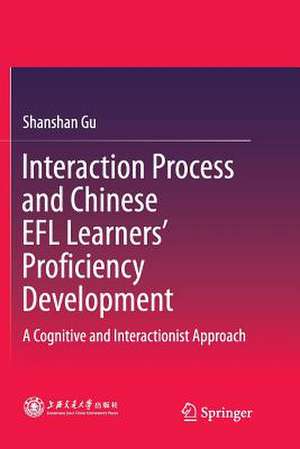
Interaction Process and Chinese EFL Learners' Proficiency Development
Autor Shanshan Guen Limba Engleză Paperback – 12 ian 2019
Preț: 368.86 lei
Puncte Express: 553
Carte tipărită la comandă
Livrare economică 10-24 octombrie
Livrare prin curier în România Termenul estimat este afișat lângă disponibilitate.
Transport gratuit de la 400.00 lei Plată online sau ramburs, în funcție de opțiunile comenzii.
Retur gratuit în 14 zile Comandă securizată și suport în română.
Specificații
ISBN-13: 9789811349560
ISBN-10: 9811349568
Pagini: 172
Ilustrații: XIV, 156 p. 16 illus., 4 illus. in color.
Dimensiuni: 155 x 235 x 10 mm
Greutate: 0.27 kg
Ediția:Softcover reprint of the original 1st edition 2018
Editura: Springer
Locul publicării:Singapore, Singapore
ISBN-10: 9811349568
Pagini: 172
Ilustrații: XIV, 156 p. 16 illus., 4 illus. in color.
Dimensiuni: 155 x 235 x 10 mm
Greutate: 0.27 kg
Ediția:Softcover reprint of the original 1st edition 2018
Editura: Springer
Locul publicării:Singapore, Singapore
Cuprins
Introduction.- A Cognitive and Interactionist Approach to Second Language Acquisition.- Perspectives on Interaction Process in Second Language Acquisition.- Issues in Research Methodology.- Effects of Interaction Process on Development of English as A Foreign Language.- Conclusions and Implications.
Textul de pe ultima copertă
This book provides readers a better understanding of the interaction-learning relationship in the English as a Foreign Language (EFL) context. It introduces theories on input, output, and learners’ internal mechanisms, and presents the pedagogical implications of how to adapt focus-on-form instruction in Chinese EFL classrooms. As such, it will be of particular interest to those readers who want to explore the relationship between interaction and language acquisition.
Caracteristici
Adopts a cognitive and interactionist approach to SLA Includes a multi-dimensional study of the interaction process Offers an in-depth discussion of the interaction-learning relationship in the Chinese EFL context Sheds new light on how to adapt focus-on-form instruction through communicative interaction Includes supplementary material: sn.pub/extras