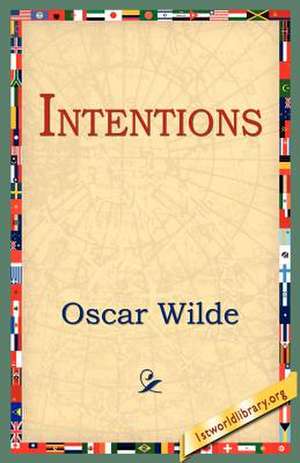
Intentions
Autor Oscar Wilde Editat de 1st World Library, 1stworld Libraryen Limba Engleză Paperback
Preț: 88.61 lei
Puncte Express: 133
Carte disponibilă
Livrare economică 17 noiembrie-01 decembrie
Livrare prin curier în România Termenul estimat este afișat lângă disponibilitate.
Transport gratuit de la 400.00 lei Plată online sau ramburs, în funcție de opțiunile comenzii.
Retur gratuit în 14 zile Comandă securizată și suport în română.
Specificații
ISBN-13: 9781595403346
ISBN-10: 1595403345
Pagini: 200
Dimensiuni: 147 x 207 x 13 mm
Greutate: 0.28 kg
Editura: 1st World Library
ISBN-10: 1595403345
Pagini: 200
Dimensiuni: 147 x 207 x 13 mm
Greutate: 0.28 kg
Editura: 1st World Library
V-ar putea interesa
-
 The Happy Prince and Other StoriesOscar WildePreț: 28.01 lei
 -
 The Selfish GiantOscar Wilde-17%Preț: 47.96 lei57.95 lei
 -
 The Voyage OutVirginia Woolf-25%Preț: 60.38 lei79.99 lei
 -
 -33%Preț: 47.79 lei71.69 lei
 -
 The Picture of Dorian Gray: Clothbound ClassicsOscar Wilde-26%Preț: 102.16 lei137.16 lei
 -
 The Canterbury TalesGeoffrey ChaucerPreț: 50.02 lei
 -
 Ojos de Godo RojoManuel GayolPreț: 93.51 lei
 -
 Fra Le Nebbie del PassatoArturo IsselPreț: 51.06 lei
 -
 Wrestling GodArthur Allen Crummer PhdPreț: 90.42 lei
 -
 The Wisdom of IsraelEdwin CollinsPreț: 39.83 lei
 -
 The HolidayMR Les PeetzPreț: 60.66 lei
 -
 The Tragedy of Hamlet, Prince of DenmarkWilliam ShakspearePreț: 42.19 lei
 -
 SoliloquySheridan SpencePreț: 48.10 lei
 -
 Hawaii TriptychCristina SalatPreț: 108.32 lei
 -
 Pride and PrejudiceJane AustenPreț: 31.55 lei
 -
 Portrait of the Artist as a Young ManJames JoycePreț: 36.92 lei
 -
 Robinson CrusoeDaniel DefoePreț: 36.10 lei
 -
 Return of Sherlock HolmesArthur Conan DoylePreț: 37.26 lei
 -
 Preț: 37.75 lei
 -
 The Portrait of a LadyHenry JamesPreț: 38.73 lei
 -
 Preț: 73.35 lei
 -
 Das Bildnis des Dorian GrayOscar WildePreț: 60.63 lei
Notă biografică
Vera or, The Nihilists By Oscar WildeVera or, The Nihilists is a play by Oscar Wilde. It is a melodramatic tragedy set in Russia and is loosely based on the life of Vera Zasulich. It was Wilde's first play, and the first to be performed. In 1880, with only a few copies privately printed, arrangements were made with noted actresses for a production in the United Kingdom, but this never materialized. The first public performance was in New York City in 1883 at the Union Square Theatre, based on revisions made by Wilde while lecturing in America in 1882. The play was not a success and folded after only one week.It is rarely revived.At the time of writing, the reform-minded Tsar Alexander II was involved in a struggle with revolutionaries who sought to assassinate him (and eventually succeeded). Though none of Wilde's characters correspond to actual Russian people of the time, the above situation was well-known both to Wilde and to the audience for which he was writing. It has been suggested that the plot was inspired by true events. In 1878, three years before the play's completion, Vera Zasulich shot the Governor of St Petersburg, Trepov. Wilde described himself as a Socialist, although Ellmann describes his Socialism as more "a general hatred of tyranny" than a specific political belief.Marie Prescott and her husband, Mr Perzel purchased the rights to perform the play, and she was the leading actress in its first performance at the Union Square Theatre. Wilde travelled to America for the second time in his life specifically to oversee the production.The play was withdrawn after one week. Mr Perzel stated to newspapers "the play is withdrawn simply because it did not pay," citing that he had lost $2,500 on the piece the previous week. He also implied that he had hoped Wilde himself would lecture between the acts, allowing him to capitalise on Wilde's popularity as a public speaker.Peter Sabouroff (an Innkeeper).Vera Sabouroff (his Daughter).Michael (a Peasant).Dmitri Sabouroff.Colonel Kotemkin.Ivan the Czar.Prince Paul Maraloffski (Prime Minister of Russia).Prince Petrovitch.Count Rouvaloff.Marquis de Poivrard.Baron Raff.General Kotemkin.A Page.A Colonel of the Guard.Peter Tchernavitch, President of the Nihilists.