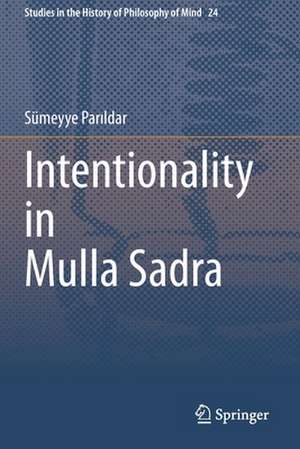
Intentionality in Mulla Sadra: Studies in the History of Philosophy of Mind, cartea 24
Autor Sümeyye Par¿ldaren Limba Engleză Paperback – 12 mar 2021
Din seria Studies in the History of Philosophy of Mind
- 18%
 Preț: 758.09 lei
 - 25%
 Preț: 591.84 lei
 - 18%
 Preț: 759.56 lei
 - 15%
 Preț: 498.36 lei
 - 15%
 Preț: 670.93 lei
 - 15%
 Preț: 602.50 lei
 - 18%
 Preț: 813.53 lei
 - 15%
 Preț: 674.85 lei
 - 18%
 Preț: 696.78 lei
 - 15%
 Preț: 614.61 lei
 - 18%
 Preț: 728.70 lei
 - 15%
 Preț: 672.49 lei
 -
 Preț: 371.97 lei
 - 18%
 Preț: 703.46 lei
 - 18%
 Preț: 696.01 lei
 - 15%
 Preț: 672.70 lei
 - nou
 Preț: 761.56 lei
Preț: 434.09 lei
Puncte Express: 651
Carte tipărită la comandă
Livrare economică 30 noiembrie-14 decembrie
Livrare prin curier în România Termenul estimat este afișat lângă disponibilitate.
Transport gratuit pentru acest produs Plată online sau ramburs, în funcție de opțiunile comenzii.
Retur gratuit în 14 zile Comandă securizată și suport în română.
Specificații
ISBN-13: 9783030398866
ISBN-10: 3030398862
Pagini: 192
Ilustrații: XIII, 175 p. 1 illus.
Dimensiuni: 155 x 235 x 11 mm
Greutate: 0.3 kg
Ediția:1st ed. 2020
Editura: Springer
Colecția Studies in the History of Philosophy of Mind
Seria Studies in the History of Philosophy of Mind
Locul publicării:Cham, Switzerland
ISBN-10: 3030398862
Pagini: 192
Ilustrații: XIII, 175 p. 1 illus.
Dimensiuni: 155 x 235 x 11 mm
Greutate: 0.3 kg
Ediția:1st ed. 2020
Editura: Springer
Colecția Studies in the History of Philosophy of Mind
Seria Studies in the History of Philosophy of Mind
Locul publicării:Cham, Switzerland
Cuprins
Chapter 1. INTRODUCTION
Include:1.1 What is the Philosophical Problem of Intentionality? 1.2 Constructing the Intentionality Problem: Brentano and His Historiography 1.3 What was Brentano's Project?
Chapter 2.INTENTIONALITY AS IMMATERIALITY
Include:2.1 Brentano and his description of Intentionality as mark of the mental: The Soul and Its Immateriality 2.2 De Anima and Definition of the Soul 2.3 Soul and Its Immateriality in Mulla Sadra
Chapter 3.INTENTIONAL OBJECTS
Include: 3.1 What is an Intentional Object? a. Meaning and Introduction of a Theory of Objects b. Reductionist Answers to the Problem of Intentional Objects: Russell and Quine 3.2 Quest for a Different Frame to the Problem of Intentionality: Mental Existence a. Existence as a Concept b. Existence as Predicate c. Non-existence d. Universals as Mental Existence e. Quiddity as Mental Existence
Chapter 4. SENSE PERCEPTION AS INTENTIONAL
Include: 4.1 Sense Theory in Aristotle and Avicenna 4.2 Sense Theory in Mulla Sadra 4.3 External Senses 4.4 Internal Senses
Chapter 5. Conclusion: ontology of intentionality and primacy of existence Include: 5.1 Is Intentionality Action or Content? 5.2 Primacy of Existence
Include:1.1 What is the Philosophical Problem of Intentionality? 1.2 Constructing the Intentionality Problem: Brentano and His Historiography 1.3 What was Brentano's Project?
Chapter 2.INTENTIONALITY AS IMMATERIALITY
Include:2.1 Brentano and his description of Intentionality as mark of the mental: The Soul and Its Immateriality 2.2 De Anima and Definition of the Soul 2.3 Soul and Its Immateriality in Mulla Sadra
Chapter 3.INTENTIONAL OBJECTS
Include: 3.1 What is an Intentional Object? a. Meaning and Introduction of a Theory of Objects b. Reductionist Answers to the Problem of Intentional Objects: Russell and Quine 3.2 Quest for a Different Frame to the Problem of Intentionality: Mental Existence a. Existence as a Concept b. Existence as Predicate c. Non-existence d. Universals as Mental Existence e. Quiddity as Mental Existence
Chapter 4. SENSE PERCEPTION AS INTENTIONAL
Include: 4.1 Sense Theory in Aristotle and Avicenna 4.2 Sense Theory in Mulla Sadra 4.3 External Senses 4.4 Internal Senses
Chapter 5. Conclusion: ontology of intentionality and primacy of existence Include: 5.1 Is Intentionality Action or Content? 5.2 Primacy of Existence
Notă biografică
Sümeyye Parildar was born in Ankara in 1980. After her BA in Marmara University Theology Faculty, she completed her first MA in Islamic Philosophy in the same university. Her second MA is in Philosophy in Birmingham University. She received her PhD in Exeter University with the dissertation titled 'Intentionality in Mulla Sadra' in 2014. She is a lecturer in Istanbul University since 2015.
Textul de pe ultima copertă
This volume translates Brentano’s intentionality into medieval psychological and ontological discussions through Sadrian theories of sense perception and mental existence. Applying a new methodology, it reframes various parts of Sadrian theory around the problem of intentionality, which results in a refreshed reading of the philosopher Mulla Sadra. The book starts out by defining intentionality problem and discussing the historiography of Brentano’s conceptualization. It examines immateriality, content and aboutness, and sense perception. In its conclusion, the book claims that intentionality in Mulla Sadra combines ontological and psychological realities and that as a result of Sadrian monism, the intentionality, intentional object, the agent, and the reality are different versions of same reality.
Caracteristici
Applies a contemporary topic to Islamic philosophy Uses a methodology that is neither comparative nor strictly classical or contemporary Bridges contemporary and medieval discussions Claims a new reading focusing on gradational ontology and monism