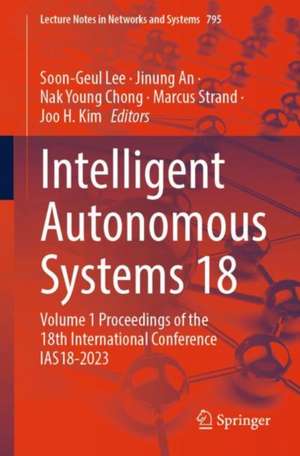
Intelligent Autonomous Systems 18: Volume 1 Proceedings of the 18th International Conference IAS18-2023: Lecture Notes in Networks and Systems, cartea 795
Editat de Soon-Geul Lee, Jinung An, Nak Young Chong, Marcus Strand, Joo H. Kimen Limba Engleză Paperback – 25 apr 2024
Remarcăm faptul că Intelligent Autonomous Systems 18 se distanțează de documentația oficială sau de manualele teoretice prin natura sa empirică; volumul nu doar descrie protocoale, ci documentează rezultate concrete din teste de teren și simulări complexe. Față de Artificial Intelligence for Autonomous Vehicles and Driver Assistance Systems, care oferă o perspectivă generală asupra algoritmilor de învățare automată, lucrarea editată de Soon-Geul Lee și echipa sa este mult mai aplicabilă, concentrându-se pe implementări specifice de fuziune a datelor și arhitecturi hardware hibride. Abordarea diferă și de Autonomous Robots and Agents prin gradul ridicat de specializare tehnică — aici nu discutăm doar despre omniprezența roboților, ci despre soluții matematice pentru problema eliminării constrângerilor minime în robotică mobilă sau despre generarea de hărți globale în medii off-road variabile.
Structura este riguros organizată în cinci capitole care reflectă progresia de la vehicule autonome și roboți (Capitolele 1 și 2) către percepție, senzori și fuziune de date (Capitolele 3 și 4), culminând cu sistemele autonome aplicate. O atenție deosebită este acordată interacțiunii om-mașină și mediilor de tip digital twin, reflectând tema conferinței IAS18: impactul inteligenței artificiale asupra sistemelor autonome. Observăm o tranziție clară de la teoria pură la realizarea sarcinilor în lumea reală, exemplificată prin studii despre eroarea de poziționare la andocare sau utilizarea filtrelor Kalman extinse (EKF) în odometria vizual-monoculară. Volumul reușește să capteze stadiul actual al tehnologiei, oferind o bază solidă pentru inginerii care caută soluții la provocări de fiabilitate în medii dinamice.
Din seria Lecture Notes in Networks and Systems
- 20%
 Preț: 1107.82 lei
 - 18%
 Preț: 2039.79 lei
 - 20%
 Preț: 1026.15 lei
 - 20%
 Preț: 1224.62 lei
 - 18%
 Preț: 1337.49 lei
 - 20%
 Preț: 1513.82 lei
 - 20%
 Preț: 296.41 lei
 - 18%
 Preț: 1110.13 lei
 - 20%
 Preț: 1251.65 lei
 - 20%
 Preț: 1648.37 lei
 - 20%
 Preț: 1160.96 lei
 - 20%
 Preț: 1390.94 lei
 - 20%
 Preț: 1395.91 lei
 - 18%
 Preț: 1172.24 lei
 - 20%
 Preț: 1390.03 lei
 - 20%
 Preț: 1399.33 lei
 - 18%
 Preț: 1325.53 lei
 - 18%
 Preț: 1340.29 lei
 - 18%
 Preț: 1327.69 lei
 - 20%
 Preț: 1293.34 lei
 - 18%
 Preț: 1400.84 lei
 - 18%
 Preț: 928.77 lei
 - 18%
 Preț: 1017.19 lei
 - 20%
 Preț: 1700.56 lei
 - 20%
 Preț: 1287.92 lei
 - 20%
 Preț: 1461.49 lei
 - 18%
 Preț: 1564.35 lei
 - 24%
 Preț: 898.76 lei
 - 18%
 Preț: 1228.09 lei
 - 18%
 Preț: 1236.51 lei
 - 18%
 Preț: 1241.01 lei
 - 18%
 Preț: 1243.71 lei
 - 20%
 Preț: 1286.21 lei
 - 18%
 Preț: 1263.44 lei
 - 20%
 Preț: 1403.63 lei
 - 18%
 Preț: 1397.87 lei
 - 20%
 Preț: 1453.89 lei
 - 20%
 Preț: 1305.75 lei
 - 20%
 Preț: 1845.06 lei
 - 20%
 Preț: 1470.33 lei
 - 20%
 Preț: 1902.56 lei
 - 20%
 Preț: 1872.46 lei
 - 20%
 Preț: 2352.65 lei
 - 20%
 Preț: 1334.56 lei
 - 20%
 Preț: 1408.87 lei
Preț: 1410.08 lei
Preț vechi: 1762.60 lei
-20%
Carte disponibilă
Livrare economică 09-23 noiembrie
Specificații
ISBN-10: 3031448502
Pagini: 654
Ilustrații: XVII, 654 p. 341 illus., 319 illus. in color.
Dimensiuni: 155 x 235 mm
Greutate: 1.1 kg
Ediția:2024
Editura: Springer Nature Switzerland
Colecția Springer
Seria Lecture Notes in Networks and Systems
Locul publicării:Cham, Switzerland
V-ar putea interesa
-
 Introduction to Autonomous Mobile Robots, second editionDavide Scaramuzza-14%Preț: 587.96 lei683.67 lei
 -
 Driving Intelligence: The Green Book: Routes to AutonomyJ. Mark Bishop-20%Preț: 297.95 lei372.44 lei
 -
 -15%Preț: 419.58 lei493.62 lei
 -
 -26%Preț: 1940.92 lei2640.50 lei
 -
 Advances in Automation and Robotics ResearchHéctor A. Moreno-18%Preț: 1112.18 lei1356.31 lei
 -
 Intelligent Autonomous Systems 17Ivan Petrovic-20%Preț: 1945.99 lei2432.49 lei
 -
 -23%Preț: 806.29 lei1047.13 lei
 -
 Advances in Service and Industrial RoboticsDoina Pisla-24%Preț: 1713.83 lei2255.03 lei
 -
 Cooperatively Interacting VehiclesChristoph StillerPreț: 469.23 lei
 -
 Robot Intelligence Technology and Applications 8Anwar P. P. Abdul Majeed-18%Preț: 1172.24 lei1429.56 lei
 -
 -20%Preț: 531.38 lei664.22 lei
 -
 Robotics Goes MOOCBruno SicilianoPreț: 404.01 lei
 -
 -18%Preț: 4172.41 lei5088.31 lei
 -
 Intelligent Mobile Edge Computing and SensingWanming Hao-20%Preț: 1284.86 lei1606.07 lei
 -
 Recent Advancements in Artificial IntelligenceRichi Nayak-20%Preț: 1984.01 lei2480.02 lei
 -
 -18%Preț: 1274.67 lei1554.48 lei
 -
 -20%Preț: 1648.37 lei2060.47 lei
 -
 Emerging Electronics and AutomationDaniel-Ioan Stroe-18%Preț: 1272.76 lei1552.15 lei
 -
 -24%Preț: 5080.31 lei6684.62 lei
 -
 Intelligent Control, Robotics, and Industrial AutomationSanjay Sharma-18%Preț: 1768.37 lei2156.55 lei
De ce să citești această carte
Recomandăm acest volum cercetătorilor și inginerilor din robotică și AI care au nevoie de studii de caz validate și arhitecturi de sistem testate. Cititorul câștigă acces la soluții tehnice de ultimă oră pentru fuziunea senzorilor și navigarea autonomă în condiții dificile. Este o resursă esențială pentru a înțelege cum pot fi implementate conceptele de digital twin și metaverse în operarea sistemelor fizice autonome.
Descriere scurtă
This book is a compilation that aims to serve researchers and practitioners in related fields by providing a timely dissemination of recent progress in the areas of autonomous mobility and robotics. The contents of this book are based on a collection of papers presented at the 18th International Conference on Intelligent Autonomous Systems (IAS18 2023), held at the Suwon Convention Center in Suwon, Korea. The conference took place fully in person from July 4 to 7, 2023, with the theme “Impact and Effect of AI on Intelligent Autonomous Systems.” It encompassed discussions on theories, applications, and creative innovations in intelligent autonomous systems, covering topics such as autonomous vehicles, intelligent agents, smart sensors and actuators, smart haptics, human–machine interaction, digital twin, digital health, and metaverse, VR, AR, or MR. For ease of reading, the 91 papers have been grouped into five chapters: Chapter 1: Intelligent Autonomous Vehicles; Chapter 2: Autonomous Robots; Chapter 3: Intelligent Perception and Sensors; Chapter 4: Data Fusion and Machine Learning for Intelligent Robots; and Chapter 5: Applied Autonomous Systems. The articles included in this book underwent a rigorous peer-review process and were presented at the IAS18-2023 conference. For researchers working in the field of intelligent autonomous systems technology, we believe this book provides valuable insights into recent advances in autonomous technologies and applications, thereby enriching their studies. We extend our heartfelt thanks to all the authors and editors who contributed to this edition.